Pages

Showing posts with label COVID-19. Show all posts

Monday, December 12, 2022

Capsule Reviews in the Time of Coronavirus (16)

In addition to watching the usual streaming channels like Netflix, Amazon Prime, Disney+, etc., I watch a wide variety of YouTube channels. This has led me to discovering several YouTube channels (and a podcast) that particularly produce some great content. Here are a few of my favorites:

Gilbert Gottfried’s Amazing Colossal Podcast
When comedian Gilbert Gottfried passed away in April, I wrote an appreciation of his podcast on Facebook. Here’s a more “formal” review…

I discovered the terrific Gilbert Gottfried’s Amazing Colossal Podcast in 2021, an interview show with co-host Frank Santopadre. Launched in 2014, they’ve hosted hundreds of guests from a wide range of fields, ranging from comics, comedy, animation, and films. Tying them all together is a deep love for classic pop culture and Old Hollywood. Both Gottfried and Santopadre are incredibly knowledgeable about the golden age of Hollywood, including classic films, television, as well as the dark and seamy side of the industry, both true and apocryphal (and the seamier the better lol).

To name just a few, guests have included Richard Benjamin and Paula Prentiss, Kevin Pollack, Dick Van Dyke, Paul Reiser, Alan and Adam Arkin, and literally hundreds more. As this suggests, many guests are the last connection to the golden age of Hollywood, with conversations running the gamut from admiration, to the profane and the hilarious. Being comedians, there’s plenty of needling, but to his credit, no one laughs the hardest than Gottfried when he is the butt of the joke. For anyone with an interest in classic Hollywood, it’s a wonderful way to hear first person reminiscences from the people who were there.

Even with Gottfried's passing, the site has remained active under Santopadre and shows remain available online.

Cartoonist Kayfabe

Hosted by “master comics makers” Ed Piskor and Jim Rugg, Cartoonist Kayfabe covers the comics field broadly, ranging from a look at specific comics, magazines and books, interviews, and appreciation of other cartoonists—essentially, just a couple of comics geeks shooting the breeze as fans and talking shop as pros.

What particularly impresses me about the two hosts is their deep knowledge and broad appreciation of all comics, past and present, and diverse genres from classic comic strips, comics from the golden age to the present, undergrounds, alternative and more. Given how broad and fragmented comics have become over the past several decades, it would be easy to suffer from tunnel vision, but Piskor and Rugg are knowledgeable and well informed, and even as successful pros, clearly retain a youthful and infectious appreciation of the form. They have great chemistry and an affable presence. Even when they discuss controversial issues, they generally always do so with humor, fairness and without negativity or disparagement. They both also have remained prolific as cartoonists and leveraged their popularity to promote their own work. They’re great inspirations as fans and cartoonists. After all, anybody who can wrangle an interview with Fantagraphics publisher Gary Groth has my respect!

Comic Tropes
ComicTropes is somewhat similar to Cartoonist Kayfabe (though I believe came first), hosted and produced by comics fan and historian Chris Piers. As the show’s name suggests, it focuses on the tropes and the “recurring elements that creators or characters use” which provides “an excuse to drill down on various techniques and comic book history.” That said, this definition allows leeway for a wide range of topics. The show is primarily focused on comic books and comic book history—Piers is also affable and good humored, encouraging interaction with his viewers through small contests, funny little stunts and fan art. (One hilarious bit featured him taking swigs at offbeat sodas in between segments.)

BeKindRewind
BeKindRewind host Isabelle C. looks at Hollywood history primarily through a feminist and progressive lens, focusing particularly on actresses and issues related to diversity and representation. The show's angle makes the channel particularly fascinating and informative.

Though her work covers the broad history of the entertainment industry, she has a particular interest in classic Hollywood and actors from the ‘30s through the ‘70s, but also to the present day, having covered actresses like Bette Davis, Deborah Kerr, Jane Fonda, Myrna Loy and more. (A piece about Lee Grant’s history as a blacklisted actor even got a complimentary shout out from the actress herself!) She does a great job as well in recounting the behind the scenes stories and maneuverings behind Oscar races, performances and casting, often citing the sources of her research. Though never shy about expressing her opinion and views, she never comes across as unreasonable or inflexible. She's well informed and knowledgeable and offers a fresh perspective on Old Hollywood. 

Nerd of the Rings/The Broken Sword
Though there are, perhaps unsurprisingly, a plethora of YouTube channels devoted to the lore of J.R.R. Tolkien's Lord of the Rings, I found the Nerd of the Rings and Broken Sword channels to be the most informative and entertaining. Though definitely for the serious fan, I have found them to be great companions to the books and films (including the recent first season of the Rings of Power), exploring the histories, characters and world of Middle Earth, both well known and obscure, for people like me who love the series but have perhaps found the original source material like the Silmarillion and the appendices of the Lord of the Rings too dense or inaccessible. I don't know if anyone beyond hardcore fans will appreciate the channels, but their success and the number of such panels suggest that there's a large, receptive audience.

Cultured Bubble
I’ve always been puzzled by the appeal of “reaction videos,” where you watch someone else watch a movie trailer or even full-length film, usually for the first time, while they provide commentary and real-time reactions.

That is until I came across the YouTube channel Cultured Bubble, hosted by “Tanya from Germany,” who says she is trying to break out of her culture bubble (and heal from C-PSTD). The first video of hers I came across was Jojo Rabbit—given her background as a German, I was curious about her reaction to the film. Other films she covered have included Monty Python and the Holy Grail and the Star Wars films, which amazingly she had never seen! I found Tanya’s videos because she is such a genuine and sweet presence—very open hearted, sensitive and receptive. (What made her videos on the Star Wars films particularly amusing and insightful was that she decided to watch them in the order they were intended, i.e., episodes I-III first, rather than when they were made chronologically—as a result, when she sees Darth Vader appear in Episode IV, she gets a bit upset because she was became so invested in having watched Anakin grow up as a child in the initial films lol.)

Tanya recently announced she was taking a break, feeling that the channel and watching the films was preventing her from attending to personal wellness issues (she occasionally has mentioned an abusive childhood). I hope she finds the peace she seeks, as she is seems a very sweet, perceptive and delightful individual.

Friday, October 21, 2022

Capsule Reviews in the Time of Coronavirus (15)

Another review "dump”...

From Executive Suite, to Margin Call and the Big Short, I’ve always enjoyed boardroom and financial dramas and shenanigans, both fictional and real. There has been an abundance of such shows and series recently, some of which I review below…

Dropout 
(Hulu)
First up is the Dropout, which follows the rise and fall of Elizabeth Holmes, the disgraced former CEO of Theranos, who earlier this year was convicted of fraud.

While Holmes, of course, did not initially set out to deceive, her fatal flaw was placing her ambition to be a billionaire and disruptor—like her idols Steve Jobs and Bill Gates—above her ability to deliver an actual working product, which she claimed would be a game-changing medical screening device based on a single drop of blood that she had been advised early on could never work. Instead, enabled by the belief in her own press and an inner circle and board of directors and venture capitalists who were charmed by this (apparently) charismatic telegenic blond, her priority to maintain her superstar aura and keep the company solvent took precedence over the technology.

Over the course of the series, the audience receives a fascinating peek into the world of Silicon Valley startups as we watch her continue to dig herself deeper in a hole as she moves forward prematurely without a functional product, forcing her to engage in a deception regarding the claims of her product, turning the work environment at Theranos paranoid and toxic.

Though it’s likely she would eventually have been found out, her downfall is accelerated by low level young staff who become whistleblowers when they not only realize that the touted technology is not working but that standard rival medical equipment is being used to actually do the work. Complicating matters is that one of the whistle blowers was Tyler Schultz, the grandson of a member of Holmes’ board, former secretary of state George Schultz. Tyler’s claims caused a rift between family members and, if not for the tenaciousness of the whistle blowers and the financial ability of Tyler’s family to fend off the aggressive tactics of Holmes’ lawyers, none of this might have come to light until much later.

Holmes’ awkwardness and psychopathy are well portrayed by Amanda Seyfried, who leads a talented supporting cast including Naveen Andrews as her much older svengali and COO, with whom she secretly had an intimate relationship, as well as Alan Ruck (as the Walgreens executive who championed the company’s partnership with Theranos), Sam Waterston as George Schultz, Stephen Fry, Anne Archer, Laura Metcalf, William H. Macy, Bill Irwin, and others.

WeCrashed 
(AppleTV+)
This series covers the rise and fall of Adam and Rebekah Neumann and their WeWork startup that at one point was inexplicably valued at $47 billion. This is another story that I was familiar with through articles and documentaries. Starring Jared Leto and Anne Hathaway, it says a lot about the Neumanns that I found Leto way less annoying than the real-life Neumann.

Neumann is a driven entrepreneur in search of money and an idea. While his brainchild, WeWork, is essentially a communal co-work space rental company, Neumann, a showman with the ability to dazzle and create a cult of personality through new agey double-talk, he somehow convinced investors who should have known better that his rental company was actually a tech company with potential for unlimited growth. Before reality (and long-term leases) sets in—along with a crash in the commercial rental market—Neumann and Rebekah burn through money like crazy to support their lifestyle (private jet and homes) as well as fulfill their goal to “elevate the world’s consciousness” and keep the company growing to unrealistic heights and proportions.

While everything ultimately crashed around them—and we see the devastating impact of the young employees at the company who not only lost their jobs but a lot of money that they leveraged believing that the were going to become millionaires (or billionaires) when the company went public—the Neumann’s themselves of course frustratingly seem to still come out ahead financially with golden parachutes.

Minx
(HBOMax)
Set in the early 1970s with the women’s lib movement and sexual revolution underway, Minx is an HBO dramedy series that follows the start up of a Playgirl-like magazine by a shrewd porn magazine publisher named Doug Renetti (Jake Johnson) and a serious-minded and an earnest but uptight feminist and aspiring magazine writer named Joyce Prigger (Ophelia Lovibond). The series is the flip side of Boogie Nights: whereas the movie followed a cast of misfits who find some semblance of family in the adult industry but ultimately find themselves (mostly) trapped in the lives they’ve made for themselves, in Minx the characters find the magazine and Joyce’s arrival an opportunity for self-discovery and empowerment. (The show is similarly set in the San Fernando Valley during the same era).

Like Boogie Nights, the series and its production design perfectly capture the era of the 1970s and the San Fernando Valley setting. It’s got a great ensemble cast, which includes the diverse quirky staff at the magazine operation and the canny addition of Joyce’s sister Shelly, who is a married suburban mom but way more grounded, open-minded and easy-going to the more open sexuality of the era than her over-achieving sister Joyce.

I also give credit to the show for putting its money where its mouth is by being an equal-opportunity exploiter lol. There has been way more male full-frontal penises on display on this show than female nudity. Like all good series, the show gets better, richer and broadens its scope each episode. As someone with some experience in publishing, I found the portrayal of the realities of big magazine publishing from the perspective of business, distribution and censorship (as well as the Mob connections to magazine distribution) fascinating.

Just don’t watch it with the kids around!


Succession (HBOMax)
Yes, I’m a late comer to this series, now in its third season. I tried it once a few years back and couldn’t quite get into it. But this time around I got more caught up in this Shakespearean-level family drama surrounding media giant Logan Roy (the bigger than life Brian Cox) and his children and senior level employees, who all try to position themselves and ingratiate themselves to the senior Roy as the successor to his company. Indeed, the black comedy is a very conscious riff on “King Lear” (as well as partly inspired by Rupert Murdock). I have to admit, however, that I can take the show only in small doses since the characters are pretty horrible people lol.

Friday, October 7, 2022

Capsule Reviews in the Time of Coronavirus (14)

This is a “review dump” of sorts—several reviews I wrote of various comics and books I’ve read over the past year but sat on as I found the “right” time to post them. Rather than sit on them longer, I decided to finally post them…

Valerian: The Complete Collection, Volume 1 (Kindle edition)
by Pierre Christin and Jean-Claude Mézières

Back in January, I noted the passing of French bandes-dessinée cartoonist Jean-Claude Mézières who, along with co-creator and writer Pierre Christin, chronicled the adventures of time traveling space cop Valerian and his comely sidekick, Laureline. (The series, also sometimes known as Valerian and Laureline, was brought to the screen in 2017 by director and Valerian fan Luc Busson) The sci-fi fantasy series ran from 1967 to 2010 and was popular and successful in its native France and internationally. Though not as well known in the U.S., it nevertheless has been often cited as an influence on films like Star Wars, Alien and the Fifth Element, particularly in their production design.

I’ve picked up a few of the sporadic graphic album English-language releases of the series over the years, but recently discovered that a complete English-language collection of the series began in 2017, likely initially tied to the film’s release. I picked up the Kindle edition of Volume I, collecting the first four stories. The first, “Bad Dreams,” is an origin of sorts, with Mézières and Christin still finding their way—Valerian travels to 11th century France in search of a rogue time traveler and is rescued along the way by the smart and resourceful Laureline, a French peasant girl. When she discovers his identity as a space traveler, he takes her with him into the future, where she becomes his partner. (She was not created to be a long term character until they wrote the series and realized what they had stumbled upon). In one of the other stories, “Earth in Flames,” they travel to1986 New York City, in the aftermath of a cataclysmic event that has struck earth and created the future Valerian lives in.

The book also includes several nice text pieces in front, including a comprehensive overview and history of the series and an interview with Christin and Mézières by filmmaker Luc Busson.

Valerian is a fun, breezy epic space opera/adventure series with a strong humanist and progressive bent. The Europeans have a great tradition in the genre and are great draftsmen, blending strong illustration technique with a cartoony style, so the series is a sight to behold. Apparently, the collection was completed in seven volumes.

The Tolkien Years of the Brothers Hildebrandt (Kindle edition)
by Greg Hildebrandt and Tim Hildebrandt 

I became a lifelong Lord of the Rings fan when I first read J.R.R. Tolkien’s the Hobbit, followed by the trilogy. I discovered it at the perfect time in my life, when I was around 13 years old as a junior high school student in the first part of the 1970s, just as it first hit the U.S. mainstream zeitgeist.

The Hildebrandt brothers no doubt helped boost the series with their immensely popular calendars of 1976, ‘77 and ‘78. While I don’t recall that I got the calendars myself (I now wonder why I didn’t request them as Christmas presents!), I remember poring over them in bookstores. Together with Ralph Bakshi’s 1978 animated film, the Hildebrandt brothers’ interpretation of Middle Earth greatly informed the way I envisioned Middle Earth in my own mind. (I have sketchbooks full of Middle Earth drawings influenced both by the Hildebrandts and Bakshi.)

So it was a thrill to discover this book, the Tolkien Years of the Brothers Hildebrandt, that compiles all the pieces from the calendars and offers detailed production notes and personal reminiscences by Greg Hildebrandt, Jr., who as a child watched his father and uncle paint these pieces, often serving as a model for the paintings. The book includes a generous number of rough sketches and their original photo references as well. I was too young to purchase all the calendars, so having all the pieces in this collection bring back wonderful memories of my early love of the series.

King of Spies by Mark Millar and Matteo Scalera
I randomly stumbled across this graphic novel in my local comic-book store, having not been aware of it previously. I found the art and storyline compelling and I wasn’t disappointed—the graphic novel collects the 4-issue arc originally published by Image.

Millar is a popular and prolific comic-book writer—his credits include work on major characters like the X-Men and Superman, and creator-owned work like Kingsman, which of course has been turned into a popular film franchise. (One of his projects influenced the Marvel film, Captain America: Civil War.)

King of Spies follows the last days of a top British spy named Roland King. Upon learning he has six months to live before succumbing to cancer, he decides it’s time to clean up the mess he’s helped make in the world, turning against the people he served and protected working as a willing pawn in their not always pure political ends and agendas. He also seeks redemption for the havoc and pain he’s caused to his family, particularly his ex-wife and estranged son who’s followed in his footsteps and is among those in the intelligence community now working to stop King. One could easily see Sean Connery in this role (or Jeff Bridges, who stars in a new streaming series called the Old Man—though I haven’t seen it yet, it seems to have a similar vibe).

There is great momentum, violence, raw energy, cheekiness and narrative force in the story, in large part thanks to the bravura art and storytelling of artist Matteo Scalera. The story left me pumped and breathless!

In 2017, Netflix bought Millar’s comics universe—but it was still a surprise to see Netflix’s imprint on the spine of the book. I understand it’s under development at Netflix.


Saturday, April 2, 2022

Capsule Reviews in the Time of Coronavirus (13): West Side Story and the Jack Benny Show


West Side Story
I initially planned to see West Side Story in the theater, but never got my act together (my son arguably was even more excited to see it since he did so separately with friends and greatly enjoyed it). So this past weekend, when it dropped on DisneyPlus, my wife and I watched it and greatly enjoyed it.

I generally don't automatically dismiss “remakes” as some people do, since the original production will always be around to be enjoyed and appreciated. Additionally, in live theater, many musicals and plays are regularly revived and re-staged—and re-imagined—for modern audiences. (In 2021, my wife and I saw the Lincoln Center touring production of “My Fair Lady” on stage when it came to town; and, in 2017, my family and I saw a touring production of “West Side Story,” which offered another point of comparison for me.)

That said, on the face of it, this was a faithful adaptation of the original stage production that also clearly paid homage and respected the original film. While some changes were made (as was done in the original film), the filmmakers reportedly worked to emulate and imitate many of the lighting and color cues of the first film. The end credits even paid homage to the opening credits of the first film. (The music and orchestration also felt very faithful and it was a thrill to hear updated for modern sound systems.)

That said, they still found ways to deepen the characters and heighten the story’s authenticity and emotional impact, mostly through some slight tweaks in the script but especially through Spielberg’s staging and his virtuosity as a filmmaker.

Though the original film “opened up” the story to take advantage of the streets and the gritty urban environment of New York, Spielberg and company take it further, staging “America” outdoors in the streets, “I Feel Pretty” in a Gimbels department store (a store I recalled going to as a young child with my mom!) and “Cool” on an abandoned pier.

The film also strengthens and tweaks Tony and Maria’s relationship—a sequence of them spending the day together in the city both makes them closer but also foreshadows potential pitfalls. Later in the scene, their joining together in a church to promise themselves to each other—a sort of faux wedding—also was reminiscent of the original source material, Shakespeare’s “Romeo and Juliet,” a connection that my wife felt was more overt in this adaptation. The cast is great, with special kudos to Arian DeBose, whose work I first encountered and made a great impression on me in the AppleTV musical comedy series, Schmigadoon.

Spielberg is at the top of his game (though, let’s face it, he has been for many years now), but he really brings all these skills to bear in the film’s staging, production design and camera work. It’s a shame that this film has underperformed—it’s truly among the best and most heartfelt movies of 2021.

The Jack Benny Show
Years ago—even before the days of CD—shortly after college, I owned an audiocassette of random Jack Benny Radio Show episodes. Back in the day, I listened to it to death (audioshows are particularly great while drawing!). I found them genuinely funny and they were a revelation—sure, I was aware of him when I was growing up, occasionally showing up as a “special guest” on tv, but I was too young to have heard his radio show or watched his tv series first hand (which overlapped for several years). Between those recordings and discovering the transplendent To Be or Not To Be around college, I became a big admirer of Benny.

A few weeks ago, I went on a Benny kick and got to re-affirm my admiration for the comedian. Something triggered my memory of that audiotape (probably hidden away in some box somewhere at home), so I decided to see what I could find online…and, of course, there was plenty on YouTube, even though these were audio radio shows.

One was 11 hours(!) of consecutive radio shows) that I listened to over a couple days, followed by a 5-hour collection on another YouTube channel (strangely, with the musical numbers edited out). I also ended up watching a couple episodes of Benny’s tv show, partly because of the guest stars: one featured Jimmy Stewart and his real-life wife (I read that the Stewarts became Benny’s next-door neighbor comic foils on the series, in the same way actor Ronald Colman was a put-upon Benny neighbor on the radio show.) Another episode guest-starred Humphrey Bogart in what reportedly was his only tv appearance in his career— both appearances were not simple cameo walk-ons, but full episode performances.

If you’ve never listened to the radio show, I highly recommend them—not as nostalgic comedy pieces but because they are genuinely funny. They are also surprisingly meta, obviously pre-dating shows like the Garry Shandling Show that similarly took you behind the scenes of the show within the show.

One of Benny’s great strengths, of course, was surrounding himself with a great cast—I was recently listening to an interview with Barry Sonenfeld on the terrific Gilbert Gottfried’s Amazing Terrific Podcast (which I also recommend, especially if you love old Hollywood), who noted that the greatest comedians recognize that the greatest laughs are found not in the punch line per se, but in the reaction to the funny line—and Benny was the master of that, milking laughs with his reactions and pauses perfectly.

Anyway, the cast included his real-life wife Mary Livingstone, who eventually retired due to incredible stage fright she developed later in life, which is a shame since she’s truly terrific and has a great voice and delivery; his announcer Don Wilson, who in the shows I recently listened to, transparently tried to work in the name of the show’s sponsor, Jello, wherever he could shoehorn it in; his fizzy and hepcat orchestra leader Phil Harris; Dennis Day, the innocent naive tenor singer who replaced singer Kenny Baker, who reportedly left the show because he was unhappy playing someone so guileless; and, of course, Rochester, his valet.

Thursday, February 10, 2022

Capsule Reviews in the Time of Coronavirus (12)

Lone Rider: The First British Woman to Motorcycle Around the World
by Elspeth Beard (Kindle edition)

During my recent visit to the Peterson Art Museum, an exhibit called “Adventure: Overland” featured motorcycles ridden around the world or cross country. Among the bikes on display was a BMW R60/6, which the remarkable Elspeth Beard rode solo around the world in the early 1980s over a two-and-a-half year period. Starting from her native England, she traveled across the continental U.S., then through New Zealand, Australia, Indonesia, Malaysia, Thailand, India, Nepal, Pakistan, Iran, Turkey, Greece, and Europe until her return to England. One of the first women to undertake such a trip, she traveled more than 35,000 miles. Based on a mention of the book at the exhibit, I purchased her 2017 memoir of her adventure, Lone Rider. Partly thanks to this book, Beard's accomplishment has finally received overdue recognition.

Like the best travelogues, the book is as much about her personal journey as her geographic one. Though she had been toying with the idea of the trip for awhile, she partly decided to embark on the adventure after breaking up with a boyfriend. Because of her gender, no one took her plan seriously—these included her own family (classic English eccentrics) as well as several magazines that not only declined her request for sponsorship or coverage, but even mocked her. Of course, this only motivated her more.

Part of her plan was to find work for a brief while in Australia, preferably at an architectural firm, to earn money for the journey as well as academic credit for her college architectural degree. Her experience also exposed the best and worst of the national character of many of the countries she visited—such as the nearly senseless devotion to colonial bureaucracy in India to the ruggedness of the terrain and people of Australia (of all the countries, Oz’s outback seemed to be the most harsh and inhospitable). As a woman traveling alone, she of course on occasion had to fend off unwanted advances. many physical—the men in one country I won’t name here seemed to feel particularly entitled, though they seemed to simply back off when clearly rebuffed. Along the way, she also met up with like-minded riders and traveling companions, including a potential beau who traveled from England to spend some time with her on the road. As one could imagine, she faced a variety of serious obstacles, such as serious illness and motorcycle breakdowns in remote areas.

Beard wrote the book partly due to interest in Hollywood, so it was written with the advantage of hindsight, bringing readers up to date on her life in the years following her accomplishment (she had a child and became a successful architect) and how her experience and some of the people she befriended on the road had a lasting impact on her.

It is a remarkable story of growth and resilience, and a fascinating look at an earlier time that has disappeared as the world has become “smaller” with the advent of tourism, mobile phones and the Internet.

Around the World in Eighty Days and North Korea from the Inside by Michael Palin

Beard’s memoir put me to mind to read a couple of other travelogue books, both by Monty Python troupe member Michael Palin: Around the World in Eighty Days (2010) and North Korea from the Inside (2019). Both are companion books to his BBC travelogue series of the same names. The former is an updated edition of his 1990 book, released after his 1989 circumnavigation of the globe, in which he followed the footsteps of Jules Verne’s Phileas Fogg in the novel of the same name. (The 1989 show was the first of what would become a series of trips by the comedian-actor around the globe.)

Like Beard’s memoir, Palin’s trip was undertaken just before the dawn of mobile phones and the web, giving travelers willing to go off the beaten track a sense of exotic romanticism and adventure. Nevertheless, Palin’s well known patience and good humor always shines through.

People sometimes ask where I get my ideas from for my comic-book series. Though news stories “ripped from the headlines” often are a source of inspiration, so are travelogues like these, which encompass other diverse work, such as Anthony Bourdain’s No Reservations and the original Top Gear British series.

Don’t Look Up (Netflix)

I’m a huge fan of director Adam McCay’s film the Big Short, which used comedy and bravura filmmaking devices to tell the story and explain the reasons for the 2008 global financial meltdown. Though not to the same degree, I also enjoyed Vice, his biopic on former Vice President Dick Cheney.

Given those films, I looked forward to Don’t Look Up, his farce starring Leo DiCaprio, Jennifer Lawrence and a supporting cast of other well known actors, including Meryl Streep, about the dysfunctional role that politics, media and social platforms play today in addressing global crises. McCay wrote and directed Don’t Look Up out of alarm and personal frustration over the way people and institutions have responded to the threat of climate change and the environment. Dropping the movie in the midst of the COVID-19 pandemic crisis also gives it a sense of immediacy and relevancy.

Nevertheless, I felt the movie fell short. It preaches to the choir and, in my view, is too shrill and goes too over the top. Nearly all the characters live up to our lowest expectations, existing as stereotypes of the worst of what people believe about the media and our political leaders. In contrast, in the Big Short, nearly all the characters (most based on real people) had some self-awareness, and a healthy amount of cynicism, for what they were doing, even as they tried to exploit the situation for financial gain. In contrast, nearly all the characters in Don’t Look Up seem to be one-note types with no such inner life or introspection. McCay portrays these figures as buffoons—in the real world, the people who run things often indeed act out of self-interest and some personal or political agenda, but in actuality, are much smarter and canny (and, hence, evil), which makes them more dangerous. I’m not sure what McCay is trying to accomplish or tell us, other than perhaps shame those in positions of power? Don’t Look Up doesn’t really tell us anything we don’t already know or suspect, which I think ultimately makes it toothless and a disappointment.

A Very Punchable Face by Colin Jost

Staten Island, one of the five boroughs that make New York City, has received more than its usual share of attention in recent years, partly due to the fact that two members of the cast of the NBC show, Saturday Night Live—Colin Jost and Pete Davidson—famously hail from there. (This was particularly hammered home recently when news emerged that the two had invested in an effort to purchase a Staten Island ferry with the goal of turning it into a nightspot.)

Staten Island often gets knocked because its vibe differs so much from the rest of New York City. Much more suburban (even bucolic for a time) compared to “The City,” it is physically twice the size of Manhattan, but houses less than 500,000 of the city’s nearly 9 million total residents. Perhaps more notoriously, Staten Island’s political makeup is radically different than the rest of New York as well.

This was the main reason I was curious about Colin Jost’s memoir, A Very Punchable Face. Jost, too, is well aware of Staten Island’s reputation—his chapter on growing up there is even titled, “Wait, You're from Staten Island?” echoing the response he often receives when people found out.

While Jost quickly acknowledges all the negative aspects, he also embraces the positive, both sometimes two sides of the same coin. Staten Island is well known to be home of many of New York’s firefighters and police officer—as well as high profile mobsters. Indeed, Jost comes from a family of firefighters—his mother was a doctor who worked for the city and he tells harrowing stories of his mom arriving at the World Trade Center just as the towers collapsed, probably being saved by fellow firefighters who had the wherewithal to find shelter for her moments before. (Davidson’s father died at the World Trade Center.)

Born in Brooklyn, I lived on Staten Island from the ages of 2 to 16, during the prime “golden age” of childhood. Growing up there, I've often said in retrospect that I had the best of both worlds—a Tom Sawyer childhood, with Manhattan just a ferry ride away. I lived on a dead end street, half of which was still wooded. So summers were spent playing ball in the streets and sandlots, and building forts (often multi-story and up in the trees!), with winters spent playing “guns” in snow-covered woods and playing ice hockey at nearby ponds. (I last visited in 2009 and found that families and friends from my childhood still live there—though my street has long since been paved through and fully developed, I was surprised how many woods still exist on the island itself, including by my old public schools.)

Jost has led a charmed (and, yes, privileged) life, which to his credit he’s well aware of. He attended a well-regarded private Catholic High School which led him to, like many comedy writers, Harvard, where he edited the Harvard Lampoon.

Whether or not Jost has reached a level of achievement or celebrity to warrant a memoir, A Very Punchable Face is genial and self-effacing.

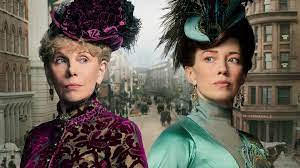
The Gilded Age (HBOMax)

For better or worse, I'm a fan of the Downton Abby franchise, so this new series from the same creator, Julian Fellowes, intrigued me. The series takes place in 1880s New York, as new money (such as the railroad robber barons) clashed with old money. Like Downton Abby, the Gilded Age tackles the immense social change that society (and high society) underwent, with all of the families very conscious of social class. 

Though Downton Abbey was more subtle about it, the Gilded Age is soapy and even trashier, but Fellowes nevertheless does a good job of swiftly engaging the audience and investing you in the characters. In this era of limited series, some shows sometimes take awhile to pick up steam, but Fellowes covers a lot of ground in just the first two episodes that were available when I began watching and drew me in nearly immediately. As times, the characters' dialogue and self-awareness are usually a too on point, but the show skillfully keeps you engaged nonetheless.

No Time to Die

I have to say, I haven’t been as enamored of the Daniel Craig Bond films as others. While I understand it wouldn't be desirable nor likely possible to recapture the Connery Bond era—the gold standard of the series—I feel the lightness, charm and panache of those films have disappeared. I'm glad that Bond remains a viable juggernaut, but nevertheless it is simply another action franchise (that, frankly, I feel has been matched if not surpassed by the Mission: Impossible films, which I feel have gotten better with each successive movie.) 

That said, without giving anything away, No Time to Die serves as a fitting end and capstone to Craig's enormously successful run as Bond. I look forward to seeing the series being refreshed and, perhaps, reinvented once again with a new Bond. 

Taking Paris: The Epic Battle for the City of Lights by Martin Dugard

Taking Paris is an easy and breezy read of the taking, occupation and recapture of Paris during World War II. Like a thriller, the story is filled with good guys and bad, the latter of which are particularly repugnant when one thinks of the death and destruction some left in their wake, especially when betraying people who trusted them. Worse, many of them didn't receive the kind of punishment they deserved. 

The book, though, goes beyond Paris, but also to the soul of France itself, best embodied during the war by the somewhat remote Charles DeGaulle, who became the de facto leader of free France despite the best efforts of President Roosevelt. It's well told.


Wednesday, October 20, 2021

Capsule Reviews in the Time of Coronavirus (10)

My Fair Lady
I’m a theater-goer and while I’ve had the opportunity to see several classic musicals on stage over the years, one play that’s always been high on my list to see is “My Fair Lady.” So when I saw that tickets for the Lincoln Center Theater’s touring production of the show were available for October—its visit to L.A. rescheduled and cancelled earlier due to the pandemic—I grabbed a pair for the Oct. 9 show for my wife and me, COVID-19 be damned!

Adding to the appeal was that the show was being presented in the heart of Hollywood, at the Dolby Theatre, where the Academy Awards are held, next door to the famed Grauman’s Chinese Theatre (though now officially the TCL Chinese Theatre) and directly across the street from where the talk show, Jimmy Kimmel Live broadcasts. And, yes, vaccinations were required and checked at the door; everyone in the audience wore masks.

This touring production is based on a much lauded 2018–19 revival production that originated with Lauren Ambrose as Eliza, Harry Hadden-Paton as Higgins, the late Diana Rigg as Mrs. Higgins, and Allen Cordener as Pickering. (When Ambrose concluded her run, Laura Benanti assumed the role.) This touring production starred Shereen Ahmed and Laird Mackintosh as the leads.
The challenge of any show as iconic as “My Fair Lady” is to escape the shadow of the much beloved and excellent film adaptation. While I’m not quite sure the cast of the production I saw quite succeeded in that tall order and made the characters their own, it was nonetheless a solid production. Featuring actors in the lead roles somewhat closer in age than the film does somewhat change the dynamic of the story in a subtle interesting manner; the nature of the relationship between Eliza and Higgins has always been complex and an endless source of debate (playwright George Bernard Shaw, who wrote the original play, “Pygmalion,” on which “My Fair Lady” is based, was adamant that their relationship was not romantic).The theme of Eliza discovering the spark of he soul independent of Higgins also seemed to come through more. That said, when done right and with thoughtfulness, “My Fair Lady” remains critic-proof and the characters indelible. The story and its timeless songs and melodies remain appealing and crowd-pleasing as ever. (I should add that, following the production, I watched the film!)

Afterwards, my wife and I had lovely dinner at Musso and Frank’s on a last-minute whim!

For All Mankind (Apple TV+)
This science fiction (sf) series posits a fascinating alternate history where the Soviet Union was the first to land on the moon, sparking a fierce space race between the super powers. While I noticed the series when it dropped in 2019 and was intrigued by its premise, I did not get around to watching it until this summer during the pandemic and ended up bingeing the first two seasons over a week or so. (A third season is in the works.) This series makes a nice complement to the HBO series “From the Earth to the Moon” and the film The Right Stuff, which I admire.

I have to assume that the title, “For All Mankind,” is meant to be partly ironic—much of the series focuses on the women who train and become astronauts, partly after the Soviets shock the world when they land a woman on the moon on its second landing. As this suggests, like the best sf, the series examines real-life issues through its alternate history lens: the success of women astronauts helps spur the passage of the Equal Rights Amendment (which ultimately failed in the real world), while race and LGBTQ issues also emerge.

In addition, enough of “real” history is weaved into the series, which adds to its believability. Historical figures like Richard Nixon and Ronald Reaga, and astronauts Neil Armstrong, Buzz Aldrin and Deke Slayton, as well as rocket scientist Wernher von Braun, all play roles, sometimes as major characters. (As an example of how the series plays with history, in the series, Teddy Kennedy is unable to go on a planned vacation to Chappaquiddick when he is recalled to Washington, DC for NASA hearings and eventually succeeds Nixon as president. Similarly, the second season begins with a montage to show some of the “highlights” of the 1970s, including the fact that Beatle John Lennon survived the shooting and becomes a peace activist).

The series features a large ensemble cast, with the characters’ personal lives—while admittedly occasionally soapy—are intertwined with thrilling space missions as well as NASA and Washington politics. The first season generally focuses on introducing us to the characters and the differences of this world from our own, and the acceleration of the space race, concluding with the beginning of construction of the U.S. space station on the moon. The second season further expands that and, for the first time, we see the Russian cosmonauts on screen and, unlike our own world, the militarization of both the moon and space. Without giving anything away, the second season ended on an action-packed culmination of several storylines that come to a head that the series successfully pulls off, a season finale that was genuinely thrilling and left you wanting more—I must admit, the finale left me breathless and looking forward to the next season.


Saturday, September 25, 2021

Disneyland in the Time of Coronavirus

In July, with COVID restrictions easing (at the time), my family and I took the plunge for a two-day trip to Anaheim to spend one day each at Disneyland and the adjacent California Adventure.*

Though COVID-19 restrictions had lessened, Disneyland still limited attendance. As a result, the park was nowhere near as crowded as we’ve experienced in the past—with a couple of exceptions (like Space Mountain and the Matterhorn), most waits for rides were reasonable, ranging from just a few to 40 minutes. (Until about five years ago, it was a family tradition to go to Disneyland during the holidays until the crowd size began giving us diminishing returns of enjoyment.)

It had been two years since our last visit and, since then, Galaxy’s Edge—the new “Star Wars-themed land”—and the Marvel’s Avengers Campus had respectively opened at Disneyland and California Adventure.

Galaxy’s Edge

While Star Tours has been a fixture at Disneyland since the late 1980s, the new Galaxy’s Edge offers a more immersive Star Wars universe experience. Set in a frontier town on a planet called Batuu, visitors interact with local denizens and Star Wars characters (including stormtroopers) and can explore the alleyways, shops and restaurants.

The centerpiece of Galaxy’s Edge is a full-size replica of the iconic Millennium Falcon and two rides: Millennium Falcon: Smuggler’s Run and the Rise of the Resistance. To ride the latter, guests must obtain "boarding passes" through the Disney app on their mobile phones at two specified time windows: 7 a.m. and 12 noon. Tickets are limited, so a little after 7 a.m. the morning of our planned visit to Disneyland, I dutifully logged on and discovered that the ride was already sold out.

While waiting for the park to open, a Disneyland employee told us that the full allotment of tickets were usually taken in only 4 seconds! He said he heard people used their smartphone clocks—tied to international atomic clocks—to countdown to the ticket window. Though I dutifully tried this approach for the 12 noon window, I had no better luck, though it looks like I came close. So that ride will need to wait for another day.

That said, as soon as the park opened to guests, we headed straight for Galaxy’s Edge and happily discovered there was virtually no line for Smuggler’s Run. While Rise of the Resistance is a state-of-the-art ride, Smuggler’s Run, while simpler, is certainly no slouch, similar to Star Tours as a “magic motion,” multi-media ride, but interactive—plus, of course, you get to pilot the Millennium Falcon!

The immersive experience begins on lineas park guests enter a “space port” and are told of their “mission” by an animatronic-controlled smuggler named Hondo Ohnaka, who tells you that he has procured the Falcon to smuggle some spices and you are the crew. (Chewbacca makes an appearance during the presentation.)

Guests are then split into groups of six and assigned roles of two each: pilots, gunners and engineers. You’re then herded into the cockpit of the Millennium Falcon. As a motion ride, it’s similar to Star Tours, but more interactive since you get to pilot the ship, fire guns or act as engineer. Everyone is prompted over the intercom when to engage—while no doubt the ride is controlled, the ride still responds to your actions. Our first time on the ride, my son and I both piloted and got a kick out of being able to “fly” the iconic Millennium Falcon and punch it into hyper space. I thought the ride was a blast and being able to walk through corridors that resembled the Star Wars movie set was a thrill.

California Adventure: Avengers Campus
On our second day, we visited California Adventure. The last few times we’d been to the park, the Avengers Campus—devoted to the successful Marvel universe films—had still been under construction.

Like the Galaxy’s Edge, the Avengers Campus is an immersive experience that allows you to interact with Marvel super-hero characters, including live shows, immersive facilities and rides. Marvel’s Guardians of the Galaxy ride has been a popular attraction at the park for a few years now (replacing the Tower of Terror ride, which uses the same skeleton of the original drop tower ride), and the Avengers Campus builds on the popularity of that ride and, of course, the Marvel films.

One of the centerpiece rides is Web-Slingers: A Spider-Man Adventure. Like Rise of the Resistance, advance online reservations are required but are not as competitive, so I was able to score spaces.

Like Guardians of the Galaxy and Rise of the Resistance (and even the Haunted Mansion ride), guests enter an anteroom where the ride is set up with a story presentation that features actor Tom Holland as Peter Parker/Spider-Man in an effective multi-media production where Holland is convincingly integrated with live action/practical effects in the presentation

From there, you go into the heart of the ride, consisting of guided cars that take you through the  Tony Stark-funded research facility where you are recruited to use spidey-webs to destroy an out-of-control army of Spider-bots that have infested the building. Though at its heart a shoot ‘em up arcade game similar to Disneyland’s Buzz Lightyear Ride, what sets this game apart is that guests put on wristband shooters that allow you to fire digital webbing onto a live screen like Spider-Man to take out the Spider-bots. It’s an amazing bit of technology.

Of course, we also enjoyed many of the classic old school rides like Pirates of the Caribbean, Star Tours and Indiana Jones. Better yet, since Disneyland was not yet at full capacity since it had only re-opened a few months before, wait times for the most part were from only a few to 20-40 minutes at most.

I have to admit, spending two days at the parks was a bit exhausting, partly due to it being pretty hot on the second day when we were at California Adventure. That said, with things slowly re-opening after more than a year in lockdown, it was a nice family getaway.

Below are some additional pics—click here to see our full vacation gallery.

* We originally planned to visit my mother and siblings in Northern California but when it became clear we needed to remain vigilant in protecting my mom’s health, we decided on the trip to Disneyland.