
Monday, September 9, 2024

Friday, October 6, 2023
Flash Gordon to Return

That said, the syndicated comic strip has been going through some great change in recent years, but hopefully the new series will find new generation of readers. I think the new strips looks great and I'm quite looking forward to it...


Tuesday, July 18, 2023
Cameo Appearance in Crankshaft!

Coinciding with Comic-Con this week, my booth, the latest issue of Rob Hanes Adventures, and I all make a cameo in today’s Crankshaft syndicated comic strip, courtesy of Crankshaft’s creator-writer Tom Batiuk and artist Dan Davis, when some characters make a trip down to the convention in the strip!
Tom, of course, is the cartoonist creator of the long-running comic strip Funky Winkerbean, which he retired at the end of 2022 after 50 years of syndication—it was a strip I grew up with when I lived in New York and which I have started to revisit now that the strip is being collected. Crankshaft spun off from Funky Winkerbean in 1987, with many characters appearing in both strips.
Tom is a real comics fan and not only did I discover he liked my work, in 2016, he commissioned me to do a faux comic-book cover featuring characters he created and drew in his childhood—it appeared in the Feb. 14, 2016 episode of Funky Winkerbean, fulfilling a childhood dream (albeit for one day) to do a newspaper strip! (It was a fun piece to do and Tom graciously said I really nailed it, saying he knew I’d be the right person for what he had in mind.) I’ve met Tom in person on his occasional forays to Comic-Con and, as I reported last year, had a lovely dinner with him and his wife when he was a guest at the show!
Obviously, it was quite a surprise and honor when Tom contacted me earlier this year to tell me about his plan to portray me and my booth in this sequence—in fact, because he wanted to feature the cover to my latest issue in the strip, his request provided the impetus for me to produce the cover when I did, since he needed it in time to deliver the strip to the syndicate (usually a few months in advance). Anyway, yes, I’d been keeping this under wraps since early spring and how cool now to see it in print!

Friday, August 26, 2022
Friday, July 8, 2022
Remembering R.C. Harvey

I enjoy comics history and scholarship nearly as much as comics themselves, so Bob's work in this area always interested me. Over the years, I was aware that he was working on a biography on Caniff, so I'd always ask about its status. I was delighted when Fantagraphics released it, called Meanwhile... —though he told me he had to cut it down a bit for length, the book still came in at nearly 1000 pages. I obviously was the target audience, but it says much about Bob's writing skills that I found the book to be a great read and engaging—I tore through it in less than a week. It sits in a prominent place on a bookshelf and I still occasionally go through it.
One other nice connection—Bob received the Inkpot Award from San Diego Comic-Con the same year as me in 2018! It was more than well deserved and I'm glad I had the opportunity to congratulate him in person.
Below: A sample of Bob's clean cartooning style and the cover to his biography of Milton Caniff.


Friday, April 29, 2022
Remembering Neal Adams

Just as importantly, he was a significant activist and champion for social issues as well as artist’s rights: he helped bring “relevance” to comics (also often with O’Neil) and tried to create a union for comics professionals. He also successfully fought for the return of artist’s work (including that of Jack Kirby’s) and, along with cartoonist Jerry Robinson and others, on the eve of the release of the 1978 Superman film, persuaded (or, rather, shamed) DC Comics/Warner Brothers into providing Superman’s impoverished creators—Jerry Siegel and Joe Shuster—a pension and modicum of financial security, as well as creator credit, by using the attention to the movie as leverage.

Adams also provided work and mentorship to many cartoonists, especially through his comics and illustration studio, Continuity Studios.
Though I’d often go by his table at comics conventions, I had the opportunity to meet him back in 2019 at an event organized by local cartoonists that he kindly hosted at his L.A. Continuity office. After his talk, he invited me to sit with him and was delighted to learn that I was Filipino (he asked)—he spoke about how much he admired the great Philippine-based cartoonists who broke into the industry in the 1970s.
I had intended to also bring my copy of Muhammad Ali vs. Superman for his autograph (pictured above), but told him that I had forgotten it. He laughed, slapped my back and said, “Next time!”
Being on the eve of the pandemic, I didn’t find the right time to follow up, but regardless it was a thrill to get these memorable few moments with him and this photo. He always seemed so hale and active, so the news was a bit of a surprise to me. My condolences to his wife and widow; the news of his passing is giving his legacy and influence the attention it deserves.
Friday, January 14, 2022
Saturday, January 30, 2021
Cartoonist Shows You "How to Murder Your Wife"

The primary reason for my curiosity in this film is that it's about a successful cartoonist named Stanley Ford, played by the great Jack Lemmon, whose profession and comic strip in the film (an action-adventure secret agent series called Bash Brannigan) are integral to the story. The film was directed by journeyman director Richard Quine and written by screenwriter George Axelrod.
In addition to being a cartoonist man-about-town, Ford is a confirmed bachelor who keeps a man servant in residence named Charles (the great character actor Terry Thomas) and lives in a pretty cool upscale multi-level bachelor pad studio in Manhattan. The film is racy for it’s time and it’s why I call it a “sex comedy”—Ford is pretty successful with the ladies and Charles, rather creepily, revels in his employer’s romantic escapades. (I’m glad now I never caught this film when I was young or it would have given me very skewed expectations of life as a cartoonist!)
The film opens cleverly with Ford in the middle of an exotic adventure with foreign-looking villains (one of whom is reminiscent of Odd Job from Goldfinger from the year before) that takes you through the streets and docks of Manhattan, as his man servant takes photos—it turns out these are reference photos for the comic strip. (While I’m pretty sure most cartoonists didn’t go to this extent to achieve verisimilitude, Ford notes later in the film that this is what makes his strip so popular—readers knew Bash wouldn't do anything he hasn't done himself. It's a conceit that becomes important later in the film.)

Of course, wackiness ensues. While Ford seems to settle into the highs and lows of married life—the sex is great and she’s a great cook, keeps house, and takes care of him, she also keeps him up all night watching TV (to improve her English), has re-decorated his bachelor pad, and put a crimp in his carefree routine. As a result of his new domesticity, his comic strip turns into a gag strip about married life called The Brannigans.

I’ll leave it at that so as not to spoil the rest of the film, but this is where I offer the caveat that the film, of course, is “of it’s time”—an era that popularized the trope that husbands and the American male are hen-pecked and women only want to marry so that they can spend their spouse's money shopping.

That said, I've always enjoyed these 1960s' breezy PG "sex comedies" when I was a kid, such as Goodbye Charlie and Sex and the Single Girl (which Quine also directed, along with another personal favorite film of mine from the period, Paris When It Sizzles). The actors are great and the film looks terrific—Lemmon, of course, is always Lemmon and he engages in quite a bit of physical comedy that is impressive and considerable even for him.

And while, of course, not intended to be an accurate portrayal of cartoonists and comics, I nevertheless enjoyed the representation of the profession. You get to see him at the drawing board and inking. It should be added that the strips in the movie are terrific, done by professional cartoonist Mel Keefer, an experienced newspaper comic strip artist on titles like Perry Mason and Rick O'Shay.
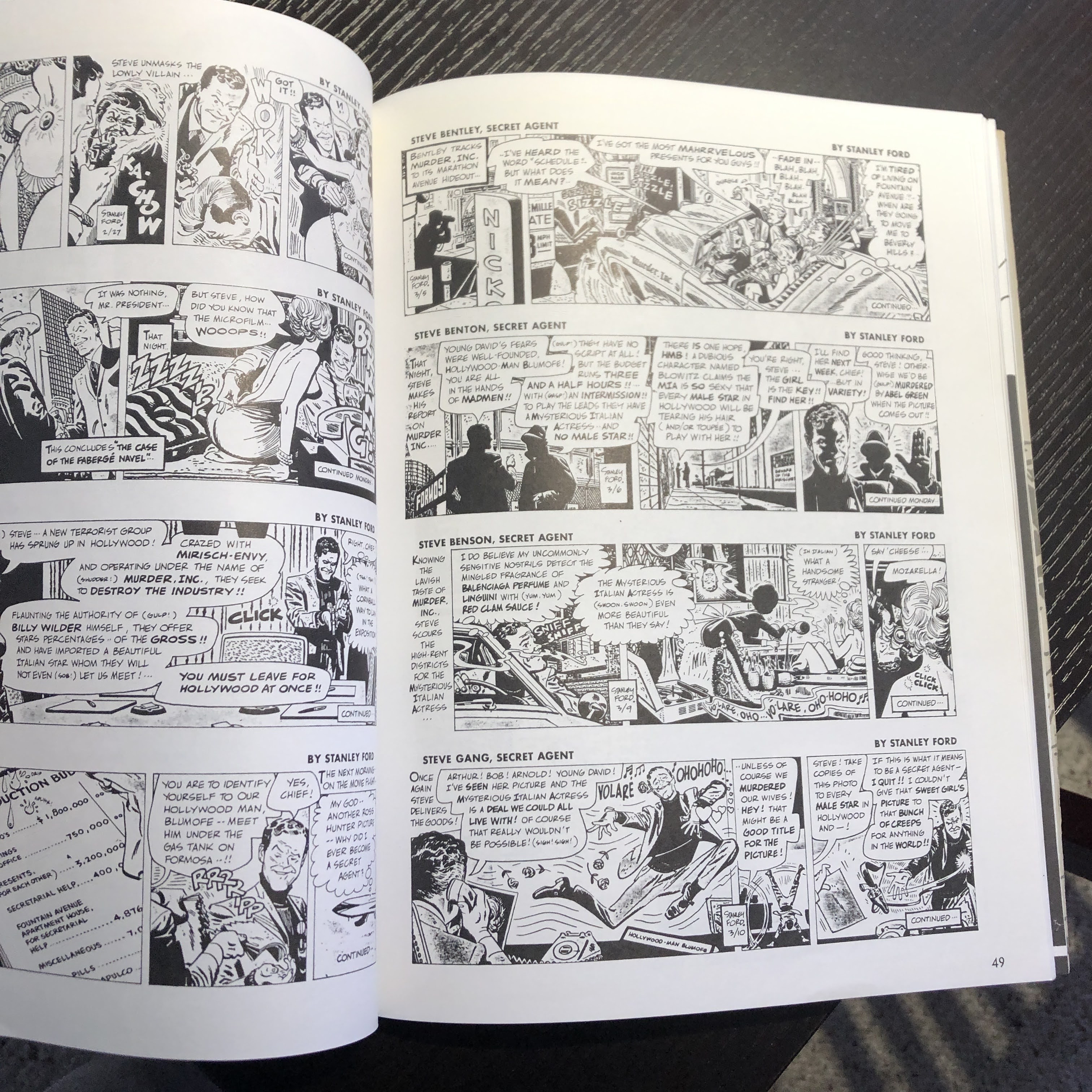
I also discovered years later that one of my favorite cartoonists of all time—the great Alex Toth— did a series of teaser strips to promote the series in the Hollywood Reporter (signed “Stanley Ford,” natch) and include samples of that work below!


Tuesday, April 19, 2016
Extracurricular Activities

A couple of years ago, I had the pleasure to meet Tom Batiuk, the cartoonist-creator of the syndicated comic strip Funky Winkerbean, at the San Diego Comic-Con. Although the strip is not carried in any papers local to me, I was able to tell him that I grew up reading his work in New York. (For a great article on Tom and his work, click here.)
He had seen my work before and our conversation morphed into his asking about my interest to produce a piece of commissioned art for the series. As part of a storyline in which a mother was tracking down missing issues in her son’s comic-book collection of his favorite comic-book series, Batiuk invited established comic-book artists—including Bob Layton, Neil Vokes, Michael Gilbert, Terry Austin, Mike Golden and Norm Breyfogle—to produce faux covers for a character named Starbuck Jones. (In actuality, it is a character Batiuk created and drew in elementary school.) An interview about the project can be found here.
Batiuk was now extending the project and thought I’d be perfect for a kid adventure series he wanted to feature that he also created in his youth called Charlie & Chuck. For reference, Batiuk sent me samples of the original strips he created as a kid, logos, as well as the covers that already appeared. Otherwise, I was pretty free to come up with an appropriate cover. The art was produced in black and white, which Batiuk then colored in his studio.

Monday, September 19, 2011
REVIEWS: Caniff

Over the past decade, there has been an explosion of upscale art books and deluxe reprint collections devoted to comics and cartoonists, with great care given to the quality and presentation of the projects. These have included full compilations of work like Terry and the Pirates (IDW), the Spirit (DC Archives), Peanuts (Fantagraphics), Dick Tracy (Fantagraphics), as well as high end coffee table books like Scorchy Smith and the Art of Noel Sickles and the first volume of a projected three-part project, Genius Isolated: The Life and Art of Alex Toth, both from IDW.
Milton Caniff, the creator-writer-artist of the groundbreaking Terry and the Pirates and, later, Steve Canyon, has been one of the major beneficiaries of this effort to document the legacies of comics and their creators. Two new additions to the growing Caniff canon are the hardcover oversized coffee table art book Caniff from IDW (360 pages) by Dean Mullaney and a hardcover deluxe collection of Steve Canyon: The Complete Series Volume 1 from Hermes Press (208 pages). Given the attention Caniff has received over the years—including a 952-page biography in 2007 and numerous collections of his work by multiple publishers over the years since the 1980s—one would think that much of this work had been exhausted by now. But these two new projects present extensive work not reprinted before.
Though the coffee table book, Caniff, covers well trodden ground, much of it features never before seen material, culled mostly from the Ohio State University Billy Ireland Cartoon Library and Museum where the artist’s papers officially reside. (Caniff was an active and prominent Ohio State alum and essentially started the Library by donating all his art and papers to the institution after his death.) Indeed, author Mullaney concedes that the book grew out of the discovery during the course of routine research that there was a treasure trove of rarely seen material by Caniff that fans deserved to see.

As a result, since Caniff is most identified for working in this signature style during the bulk of his career from 1934 until his death in 1984, it’s a real revelation to see the artist’s versatility featured in this book.
This versatility is rooted in the fact that Caniff considered himself a newspaperman first, starting out in the artists’ bullpen of the Columbus Dispatch and, later, the Associated Press, when cartoonists also doubled as draftsmen, photo retouchers, mapmakers, commercial illustrators, etc. At a time when photographers hadn’t yet begun to replace artist on newspaper staffs, newspaper cartoonists like Caniff were journeyman craftsmen, ready to whip out logos, mastheads, crossword puzzles, story illustrations, and the like on a tight deadline.
Caniff’s work in these areas—which include portraitures of all the presidential candidates from the 1932 presidential election, watercolors, ghost drawing, spot illustrations, and even custom designs for military units and air force bombers—are all beautifully displayed and reproduced. Many promotional pieces for his strips and work produced gratis for the U.S. military and military men are also well represented and provide a fuller picture of the artist’s abilities than have been previously seen before. Another revelation of this volume is Caniff's bold color work, particularly in his Sunday strips, which really made the work pop off the page.
 This handsome hardcover book, Steve Canyon: The Complete Series Volume 1, is the first ever reprinting of some of the licensed comic-book adaptations of the series from the 1950s, originally published by Dell's Four Color Comics series. It needs to be said up front that while Caniff apparently had a hand in the production of the comic-book series, his actual direct involvement was fairly minimal.
That said, as a rule, such comic-book adaptations from the period are more often than not poor quality, but when I first picked up the book to decide whether to buy it, I was pleasantly surprised by the art—while not as sharp as Caniff’s, it was still competently done. This was partly due to Caniff’s personal participation and quality control—though the artist didn’t have the time to draw the comic-book stories himself, he hired William Overgard, who had worked as his assistant and briefly ghosted the strip when Caniff was ill, to draw it. To create some continuity, Caniff apparently inked the face of Canyon himself in the stories. (Overgard went on to work on the comic strip series, Steve Roper and Mike Nomad.)
The stories are relatively straightforward, simplistic action affairs, obviously geared to a juvenile comic-book audience than the adult newspaper readers Caniff specifically targeted in the syndicated Steve Canyon. The dialogue has none of the panache or style that distinguished the regular strip, nor is the character development anywhere near as sophisticated.
Nevertheless, it’s fun to see this alternative take on the character. Along with the recent DVD release of the Steve Canyon television series, this collection is perhaps more of a curiosity than a serious contribution to Caniff’s legacy that underscores the extent of Caniff’s success and influence in media outside of the comics pages in his heyday.
Friday, May 21, 2010
Potpourri of Cancellations
 There've been several cancellations that I thought deserved mention here....
First up is Little Orphan Annie. Down to only about 20 papers in its last years—and being drawn by indy veteran Ted Slampyak—the strip's iconic status and its licensing potential probably gave it a far longer shelf life than most other strips would have. But as the interview with the licensing person at Tribune Media Services shows (the strip's only syndicate in its 86-year history), the realities of the shrinking newspaper business finally took its toll. It's clear the syndicate considers Annie to be a lucrative property, and plans to explore the new media landscape for new ways to keep the property alive.
Though I grew up with the strip since it ran in the Tribune's sister paper in New York, the Daily News, I didn't read it much, though I certainly was aware of its history: in fact, I devoured many of the strip's adventures in book collection, primarily in Great Comics Syndicated by the Daily News-Chicago Tribune and various collections in the 1970s.
 Shifting gears, NBC also recently announced the cancellation of Law and Order, the original show that started the L&O franchise.
While I wouldn't say I watched the show religiously, I did this season begin watching it fairly regularly again. As it has been throughout its entire run, the series was a dependable and addictive hour of television, solidly constructive and engaging. Since the show was no longer new and shiny, and people took it for granted, some observers noted that the current cast was never one to be found on anyone's "most sexiest people" lists, though the relatively young cast (as seen in the picture at left) certainly qualified!
Series creator David Wolf has been a bit coy about the actual demise of the show, implying it may return in some form (perhaps on a cable channel?). The series was NBC's go-to show this past season when the fourth-place network's Jay Leno at 10 p.m. experiment crashed and burned, and the channel had no other dramas to fill its schedule, so I think L&O deserved much better than this—especially since it would have broken Gunsmoke's record as longest-running drama next season.
Finally, a goodbye to ABC's ignored-but-critically-praised sitcom, Better Off Ted. I've already written about the show so I won't go into depth at how this smart, funny and quirky show—which also managed to have a heart—deserved better promotion and more time to find its audience, but I do think the television landscape is poorer for its cancellation.
Friday, August 31, 2007
It’s a Wonderful Life

As much as I admire Caniff, who created Terry and the Pirates and Steve Canyon, and put the Dragon Lady into the American lexicon, I must admit I was curious as to whether the subject—even one as seminal as Caniff—could sustain a reader's interest in a work of this length; especially since Caniff was by all accounts a modest person who led a charmed life without any real personal demons or secrets, and who was an all-around good guy with few enemies. (After all, conflict is the stuff of drama!)
Well, I should have had more faith. Harvey has artfully woven a compelling and entertaining narrative that is part biography and part literary criticism. All of the stories and anecdotes serve to advance the book's central themes related to the man's personality and career. He also deconstructs many of Caniff's strips and storytelling devices to showcase the cartoonist's artistry.
Caniff was the quintessential all-American: a self-made, over-achieving Horatio Alger who achieved success through grit and hard work. In high school and throughout his college career at Ohio State University, he was an Eagle Scout; a high school and college cheerleader; editor of the yearbook, school newspaper, and humor magazine; a member of men's glee; and of numerous honor societies, including the Sigma Chi fraternity which played an important role in his life. He also was an aspiring actor and performer, and did local theater in college. And he accomplished all this while working nearly full time professionally as a staff artist at a regional newspaper through his entire college career.
This work ethic was ingrained in him at an early age and he astonishingly maintained it throughout his life (yet still he always barely stayed on deadline). As a working artist myself, I must say his dedication to the grind was sobering but inspirational.
(One amusing anecdote in the book has a newspaper editor saying goodbye to Caniff at the end of the day where the cartoonist worked the night shift due to his college schedule; the editor later that evening spotted Caniff on stage performing in a local play, then saw him again the next morning at his drawing board when he came in to work. As this story shows, from the very start, Caniff learned to work at all hours of the day (and night) to meet his deadlines.)

In those heady years, the Caniffs attended private play readings at their neighbors' homes that included Meredith, Ingrid Bergman, and Rex Harrison, and they were regulars in the New York society scene. Caniff's studio often served as a salon of sorts for theater and cartoonist friends, with cocktail parties and poker games often going on at all hours. And through it all, Caniff worked.
Throughout his life, Caniff made the most of every opportunity that came his way. Just as importantly, these opportunities were the direct result of Caniff's hard work, ambition, personal charm, and networking abilities.
Harvey does a terrific job portraying the era and environment in which Caniff worked; in many respects, Caniff's life also encompasses the history of American cartooning and U.S. history. The book is a compelling read, and I'll be saddened when I'm done. It's great to read a story about a nice guy who, for once, finished first.

(Pictured above are the Caniffs at the 1982 San Diego Comic-Con. Photo: Alan Light)
Wednesday, February 28, 2007
Saluting the Centenary of Milton Caniff

Why did Caniff make such an impact on me? After all, he was an artist whose favorite period of mine was produced in the 1930s thru the '40s, a good 40 years before I discovered him when I was an adolescent. What in his work resonated in me after so many decades?
First of all, of course, was his art. In collaboration with his studio-mate, Noel Sickles, who worked on Scorchy Smith at the same time Terry began, Caniff launched a whole new "school" of cartooning, which used high contrast black and white to great dramatic effect (see sample below). The innovative new style captured a sense of urgency and immediacy that was revolutionary, not too unlike cinema verite.

But though the art initially grabbed readers, ultimately it was the stories and the writing that kept readers coming back for more, and made his work timeless. Caniff's writing and plotting brought a new level of sophistication to comics. His characters (usually the villains but sometimes also the protagonists) were not simply driven by the usual pulp desires of greed and evil for their own sake, but sometimes by petty lust and jealousy as well. Caniff's plot turns often hinged on a character acting out, not because they were inherently evil, but usually because of recognizable human frailty, often leading to regret and a realization and acknowledgment of error.

As this suggests, Caniff's characters' were complex, human and unpredictable—and, in the case of iconic characters like the Dragon Lady, bigger than life. But they also were instantly recognizable to readers. As one of the first "deans of cartoonists," Caniff was an innovator and visionary, who by all accounts also was modest and a true gentleman who was an effective ambassador for his field.
For a more detailed assessment of his work, click here. Reprints of Caniff's work are widely available, and a biography of Caniff by comics historian R.C. Harvey is due in June.
Friday, December 1, 2006
Calling Dick Tracy
 The Complete Dick Tracy , a projected compilation of the entire run of Chester Gould's iconic syndicated comic strip. This volume, of course, begins with the very first strip from October1931, and takes the reader through the series' first year and a half.
IDW Publishing has just released the first volume of
I've seen samples of the strip from its first week, so the strip's early crude art was not new to me. Nevertheless, it's fascinating to read the strips in the way they were intended to be in continuity and to watch the growth of the series.
Dick Tracy, of course, is well known for being one of the most stylized and idiosyncratic of newspaper strips (as well as perhaps the most graphically violent). In its early days, however, Gould still was a diamond in the rough and finding his way artistically. The art (even for its time) is fairly crude. But one can see that Gould also had a good sense of his vision: like the Warner Brothers noir films of the period, the strips are raw, violent, and hard boiled. And many of the strip's main elements are already in place like his girlfriend, Tess Trueheart, and his partner Pat Patton.
At the beginning of the strip, Tracy is a civilian, but in the first 10 days of the strip, readers witnessed a home invasion, an unarmed man coldbloodly murdered in front of his family, and the kidnapping of Tess Trueheart. To help crack the case, Tracy is deputized on the spot without much ceremony by the police commissioner, solely on the commissioner's hunch that Tracy might be helpful on the case. (Obviously, those were simpler times!) Tracy quickly becomes the department's rising star and most hardnosed gangbuster.
The strip's evolution and growth are gradual but sure. By the end of the first volume, Tracy's legendary hawk nose is closer to what it eventually became (though not quite all the way there yet!), the art gets sharper, and one can see Gould finding his style, particularly becoming more bold and confident in his use of solid black. In addition, more of the strip's classic characters like Dick Tracy, Jr. are introduced, and you start seeing the debut of the kinds of distinctive-looking and unsightly villains that Dick Tracy became known for. By the way, the first villain faced by Tracy in the strip is Big Boy, who Al Pacino played in Warren Beatty's stylized film adaptation of the strip. (Unfortunately, the radio-TV watch and the spaceship were still decades away!)
This is a great time to be a comic strip fan now that the complete runs of classic series like Dick Tracy, Peanuts, Popeye , Gasoline Alley, and Terry and the Pirates have become available or are underway. The first volume of Dick Tracy is a hefty tome, making it well worth the proce of admission.
Friday, October 27, 2006
Leonard Starr on Stage

One of the strips carried in the News was Leonard Starr's Mary Perkins On Stage. However, I never read it. As a kid who drew his own crude comics, I could see it was well drawn. But as far as I was concerned, it was a soap opera "chick" strip, so I always skipped over it to look at the other features.
Well, the first volume of a projected collection of the series has just been released and now that I'm older, wiser, and a bit more mature, I'm glad I've been given this new opportunity to re-discover this strip--and from its very start too.
In short, I was blown away.
Starr hit the ground running with the strip. Though the art continued to show improvement over the years, the artist was already at top form. Starr's art is photorealistic slick, and his advertising art background is apparent (samples of this can be found in the collection's extras). His figure work is beautiful, his use of blacks terrific, and his sense of place and staging would rival any movie production designer. And fitting for a strip set in New York's theater world, the characters are emotive yet naturalistic. (and, of course, the women are beautiful yet feminine.) And though the art was lush, Starr's work was also very expressive, warm and full of life.

After reading just this first volume I realize now that Starr is perhaps one of the finest draftsmen/illustrators to ever work in the medium, certainly technically. He's that good.
The writing matches the art fine. Yes, I guess it is a "chick" strip, but I nevertheless found the stories in this first volume to be a compelling page turner. Yes, Mary is a "goody two shoes"--a classic small town girl in the big city who is the trusting ingénue--but with the help of some good folks who sincerely wish to help out the young naïve actress, her pluck and good nature allows her to overcome the many shady characters she comes across.
Telling a story in the daily strip format is a unique skill and Starr was adept at it. As little I read of the strip, I'm still somewhat familiar with how it turned out in later years, so I can see that the series already was fairly well realized from the start. As someone who partly loved classic strips because they offered a more sophisticated alternative to the heroic operatic fantasy stories that characterized comic books (at least at the time), it's nice to know there room for a quality strip like this in today..s market.
But make no mistake--as the text pieces point out (which includes an introduction by comic-book super-fantasy artist Walt Simonson, who mentions Howard Chaykin is a fan as well), On Stage was an adventure strip--the lead character just happened to be an actress in New York.
While On Stage probably would not be the first choice on many people's list--even comics fans--worthy of reprint, this collection clearly makes the case of why it's deserving to be seen by a new generation of comics readers. In later years, Perkins' character became professionally successful, more mature, and less naïve. I am looking forward to watching the continuing adventures and growth of the strip and the characters, and I hope sales on this first volume are strong enough to continue the series.