Pages

Showing posts with label Marvel Comics. Show all posts

Saturday, May 4, 2024

My Favorite Star Wars Comic

For this Star Wars celebration day, I thought I’d highlight one of my favorite single comic book issues of all time—Star Wars #38, drawn by the great Mike Golden and written by the legendary late Archie Goodwin.

Aside from the terrific art, I felt that Golden really cracked the code in drawing Star Wars. There already was great work in the series, but Golden’s work was less pulpish and more stylish and sleek—I especially dug the way he portrayed blaster fire and other crackle.

I know I’m not alone in admiring this issue—at WonderCon last month, when I went by Golden’s booth, this issue (bagged) was on display. I asked his assistant at the booth what it was going for—she said $100. I really don’t know the street value of the book, but I assume you’d get Golden’s signature on it too. I keep my copy of the issue sitting on a shelf nearby on its own (also bagged) just because I like having it closeby and readily accessible.

I recently re-read the issue for the first time in a long time. The story is a bit thin, though a solid science fiction tale. To be fair, however, it was literally a filler issue—I did not remember until I just re-read it that this issue was supposed to see the start of the adaptation of The Empire Strikes Back—but for some reason, Marvel had to delay it a month and published this one-off issue in place.

So the six-issue adaptation of Empire started next issue, drawn by the late Al Williamson (and adapted by Goodwin), who of course is considered one of the best and most definitive Star Wars artists—he’d go on to also draw the Star Wars syndicated comic strip and the adaptation of The Return of the Jedi as well.

May the 4th Be With You!


Wednesday, November 15, 2023

Capsule Reviews

The Marvels
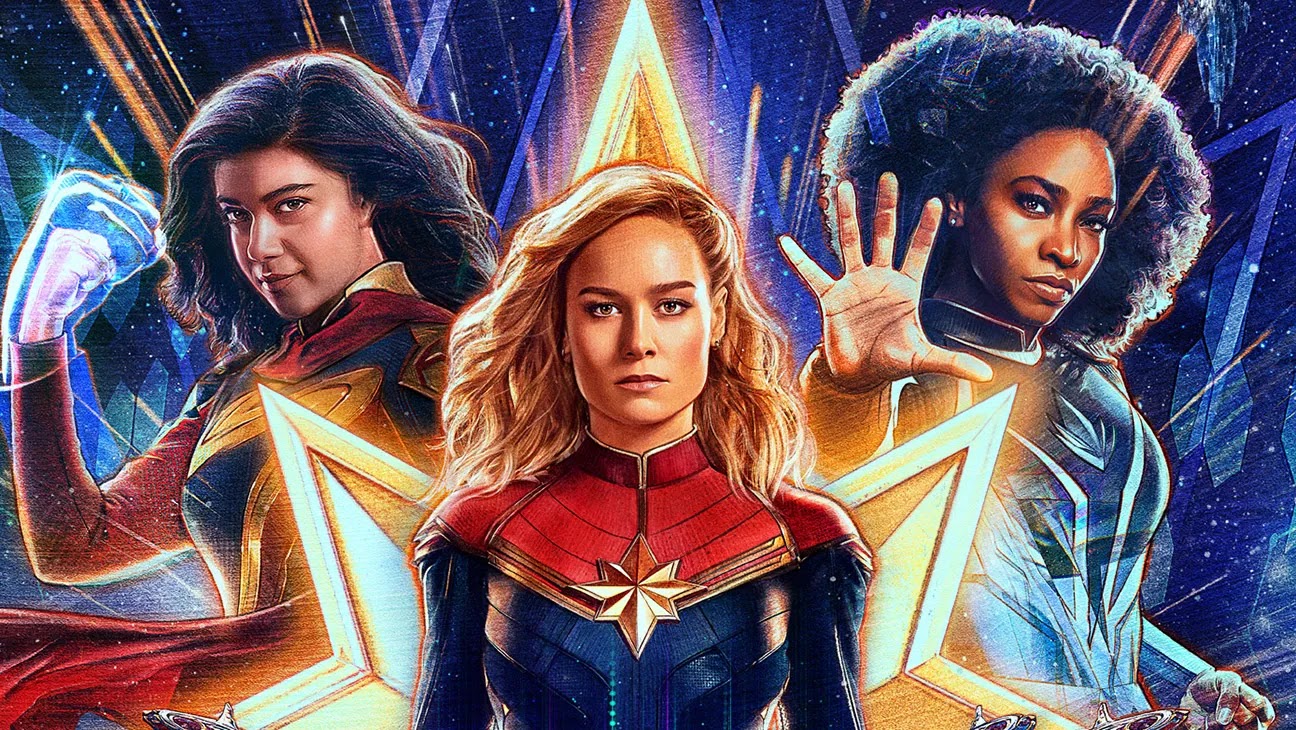
Putting aside its box office performance and the predictable toxic complaints from the incel crowd, The Marvels—the sequel to 2019’s Captain Marvel starring Brie Larson in the title role—is a fun, action-packed romp that’s a fine addition to the Marvel Comics Universe (MCU) franchise. The movie brings together Captain Marvel, Monica Rambeau and Ms. Marvel (introduced in the Disney+ streaming series of the same name) as they begin involuntarily switching places through teleportation during a Kree attack on different fronts. The Krees are led by a warlord named Dar-Benn, who is out to rebuild her dead home planet, Hala, and exact revenge against Captain Marvel who was responsible for the world’s near destruction (for reasons explained later in the film). Samuel Jackson also shows up as Nick Fury, lending important assistance and helping to ground the Marvels team as well as the film.


I must admit this was the first Marvel film that made me feel a little behind the curve having not watched the Ms. Marvel and Secret Invasion Disney+ series. But the story never lost me and provided enough information to bring me up to speed.

The movie features the usual artful blend of character development, slam bang action, heart and humor that have made the MCU films crowd pleasers. Of course, given the studio’s output at this point, not every film or series can be a winner—and there is always the risk of fatigue and overexposure—but The Marvels proves there is still plenty of magic left to be mined. It was great fun, particularly the performances and chemistry of the main leads.

Ms. Marvel (Disney+)
Watching The Marvels inspired me to watch the Ms. Marvel series on Disney+. When the series first aired, I initially couldn’t get past the show’s youthful exuberance and decided I wasn’t the target audience for the series. But after picking up where I left off, I ended up loving it. As the child of immigrant parents, I particularly found the family scenes and the relationship of lead character Kamal Khan (played with exuberance by Imam Vellani) very relatable. The show weaves some of the character’s mythology into Khan’s Pakistani culture and heritage, sometimes movingly. The final episode even has a bit of a Home Alone vibe, as Kamala and friends from high school—after defeating the show’s main other-dimension baddies— face off against rogue federal agents. The post-credits scene of the final episode also has a quick scene that tees up The Marvels movie, reviewed above.

Tetris (AppleTV)
Tetris
is the somewhat true and fascinating story of the birth of the popular and iconic video game. Invented by a Russian computer programmer in the Soviet Union, an American software developer based in Japan (played by Taron Edgerton) soon finds himself in the middle of intrigue worthy of a twisty spy thriller as he tries to obtain and unwind the licensing rights to the game. Though he cuts a deal to get the rights for Nintendo, he must also face off against Sega and media baron and cutthroat businessman Robert Maxwell and his son—as well as corrupt Soviet apparatchiks who attempt to use the power of the state to line their own pockets, turning into a nifty thriller at the end. Though some of the story's details have been exaggerated and heightened for dramatic effect, it's a fascinating and fun tale.

It Ain't Over (Netflix)
This great documentary of Yankee icon Yogi Berra gives the star catcher his due as one of professional baseball’s finest players. Somewhat overshadowed by his penchant for pithy malapropisms and a cuddly tv cartoon persona, this documentary—made with the participation of his family and children, as well as many of his peers and baseball greats who followed him—paints a more fuller picture of the man, the ball player, and the loving husband and family man. 

He was a D-Day veteran who was on the right side of history when baseball integrated. He also was an individual with principles and pride, who did not step foot in Yankee Stadium for nearly 15 years, after team owner George Steinbrenner reneged on promises made to him. But above all, the documentary serves to restore Berra's place in history as one of baseball’s true greats. His record 10 World Series championship rings as a player—more than any other player in Major League Baseball history—is just a tip of the iceberg of Berra’s achievements. This tribute to Berra’s overlooked legacy is long overdue.

Friday, April 2, 2021

Capusle Reviews in the Time of Coronavirus (7)

Mike Nichols: A Life

I like to say I’ve been a fan of Mike Nichols since I saw the Graduate, one of my favorite films of all time, but after reading this book, I have to admit I found I was not as fully aware of the breadth of his film efforts and, particularly, his stage work, for which he’s won 9 Tonys (in fact, he’s an EGOT!).

I was already familiar with most of the broad outlines of his biography as a Jewish refugee from Europe, a groundbreaking improv and skit comedian with his comedy team partner-in-crime Elaine May, and a film director. But this book, written by Mark Harris—who also wrote the terrific Pictures at a Revolution and Five Came Back—showed me the full breadth of his work, encompassing pictures he directed that I’ve seen and/or had forgotten, such as Who’s Afraid of Virginia Wolf, Silkwood, and the Birdcage. And there were several I was shocked I had never heard of (or didn’t recall) like Day of the Dolphin, Wolf, and the Fortune!

But it was the breadth of his theater work that was a revelation, ranging from “Barefoot in the Park” and “The Odd Couple” in the 1960s (pairing with Neil Simon on several occasions) to “Spamalot” in 2006.

Of special interest to me, of course, is his cartooning connection—one of the first plays he tackled as a director was by cartoonist Jules Fieffer, who discovered that Nichols and May were fans of his own work (upon seeing them on stage, Feiffer found them to be kindred spirits, doing work similar to his own “but better”). Nichols would later go on to direct the film, Carnal Knowledge, on which he had Feiffer on set for most of the shoot.

As I noted in my review a few years back of Feiffer’s memoir, Backing into Forward, Feiffer (and Nichols) grew up during a fascinating era in the 1950s and ‘60s when artists, entertainers and actors, intellectuals, playwrights, movie directors and, yes, cartoonists like Feiffer seemed to mingle and cross-pollinate. I’m not sure if this was a reflection of the era or particular to the New York City social scene, but Nichols’ friendships with Feiffer and others like Simon, Richard Avedon, Leonard Bernstein, Jackie Kennedy, Gloria Steinem and, as he transitioned to Hollywood, Richard Burton and Elizabeth Taylor (first befriending the former along with Julie Andrews when his show with Elaine May was at the Broadway theater next door to where Camelot played), Jack Nicholson, Warren Beatty, Whoopi Goldberg and more demonstrate his wide circle of connections that span decades.

While for some reason I thought Nichols to be a genial sort, like a lot of gifted artists, his personal life and demons belie that. Born to an unloving mother, prone to depression and (most surprising) addicted to coke and crack at various times in his life, he could be cruel to actors and crew on set. Like many immigrants and performers, he also was someone who reinvented himself – a Russian-Jewish immigrant by way of Germany with the birth name of Igor Mikhail Peschkowsky, he escaped Germany before the Holocaust. As he faced his demons as he got older—internalizing his guilt as a Jew who escaped Europe before the Holocaust—Nichols found a measure of peace. This was due in large part to his happy marriage to television broadcaster Diane Sawyer, who generously worked to ensure he maintained a healthy relationship with his previous wife and children. I found the book to be a compelling read about a comedian and director who had a huge impact on both the film industry and stage, and the book offers fascinating glimpses into the art that went into this work, with plenty of great anecdotes about the great figures (and their eccentricities) of the time.

Some Nichols and May, in one of their most famous sketches:

Justice League: The Snyder Cut

Director Zack Snyder is a divisive figure among movie and comics fans. While I was incredibly impressed by his film adaptation of Watchmen, like many, I’ve been put off by his incredibly dark approach to the DC Comics film universe as reflected by Man of Steel and Batman v. Superman: Dawn of Justice, a tone that has permeated many of DC’s other films. While it’s perhaps not fair to compare Marvel’s films to DC’s/Warner Brothers, Marvel has admirably built a franchise brand that exists as an interconnected and cohesive movie universe where the films share a common DNA yet still allow for a wide range of variety and expression, ranging from period pieces like Captain America: First Avenger, to political thrillers with Captain America: The Winter Soldier, to near-comedies like Thor: Ragnarok and Ant-Man. It’s a world-building approach they are now expanding into their DisneyPlus streaming shows, such as WandaVision and Falcon and Winter Soldier. Ultimately, most of the Marvel films have a sense of fun and are great popcorn movies. Their success also is the result in the complete conviction and faith in the strength of their intellectual properties.

While DC’s characters are just as rich, without the single guiding hand of someone like Kevin Feige, DC has never shown the same conviction and belief in their characters and universe as Marvel did at the very outset. A case in hand is the fate of Justice League. After Snyder and his producer-wife left the project following the tragic suicide of his daughter, Warner Brothers Studio hired Joss Whedon, who played an early role in Marvel’s success, having directed the Avengers and Avengers 2, to complete the film. As it was eventually revealed, Whedon significantly revised and simplified Snyder’s script and vision, and it may have been partly the result of Warner Brothers getting cold feet (again) over the density of the mythology.

I won’t say that I disliked Whedon’s Justice League as some fans, but neither did it make much of an impression on me nor was I among those clamoring for the “Snyder Cut.” That said, now having seen it, I must agree it’s a somewhat better movie — while I’m still not convinced that Snyder’s dark somewhat joyless approach to the characters is the way to go, at least this film reflects his singular vision and it’s  better for it. Not only did he get a mulligan to improve the CGI design and character arc for the film’s original villain, Steppenwolf, but he gives him a richer back story and motivation (as opposed to simply wishing to take over the world); in fact, in this version, he is actually a low-level toady to an even bigger villain, Darkseid, that expands the DC film Universe further.

The film’s plot is also slightly re-jiggered, with Cyborg playing a more central role to the plot and having a clear character arc, which Whedon completely wrote this out of his version. We also see a little bit more of Superman and more of an origin background for Flash.

Of course to accomplish this, Snyder also made it a longer movie with a running length of 4 hours. For the most part though, the movie moves along, notwithstanding the excessive use of slow-mo.

But at least the Snyder Cut is finally out there for the world to see. While it doesn’t appear that Warner Brothers has any plans to continue the path that Snyder began with this movie – and tries to tease with epilogue scenes — at least his vision has been realized.

Tuesday, October 3, 2017

Remembering the King


Cartoonists Alex Toth and Jack “The King” Kirby are often held up as the cartoonists who represented the two main competing “schools” in comic-books—at the risk of oversimplifying, Toth was more naturalistic while Kirby more operatic. When the superhero genre came to dominate the industry, Kirby’s more immediate, hard-hitting style—coupled with Marvel editor and writer Stan Lee’s chummy banter—became the template for the comic-book industry for a generation or more.

Toth came from the “school” of cartooning that has its roots in the newspaper adventure strips, most notably studio-mates Noel Sickles and Alex Toth, who themselves were preceded by Roy Crane (to whom Toth equally credits as an inspiration). I’ve written about Toth, Sickles, Caniff, and Crane extensively over the years, so it’s no secret where my own stylistic influences lie.

But this year marks the centenary of Kirby’s birth (August 28), so I thought I’d add my own tribute and appreciation—the San Diego Comic-Con celebrated Kirby’s centennial birth this year (as it did cartoonist Will Eisner, born the same year) and numerous articles and tributes appeared on his birthday.

Having been born in the early 1960s, I was a little young to see Kirby’s heyday at Marvel in the mid-to-late ‘60s when, in a dazzling burst of creativity, with cohort Stan Lee, he created the Fantastic Four, the Hulk, Thor, Iron Man, the X-Men, Spider- Man, and more (he had already co-created Captain America with then-partner Joe Simon in 1941, right before the U.S. entered World War II). And by time I was fully into comics, in addition to my fascination with classic newspaper adventure strips by the artists mentioned above, my comic-book reading gravitated more towards characters and series like Batman and Sgt. Rock than to Kirby’s more cosmic work.

With that said, as someone with an interest in the history of comics, I was nevertheless very familiar with Kirby’s place in comics history, particularly through Stan Lee’s take-it-with-a-grain-of-salt memoir, Origin of Marvel Comics (1974). I have a vague memory of being fascinated around this time by some back issue of the Fantastic Four and, as a World War II buff at the time, reprints of the Boy Commandos that were reissued by DC Comics during the ‘70s. It was during my personal “Golden Age” of comics reading (i.e., age 12) when Kirby left Marvel for DC to create his Fourth World/New Gods meta-series, Kamandi, the Last Boy on Earth, and work on other books like Jimmy Olsen. The New Gods series was not a hit at DC and Kirby would eventually move on for greener pastures to work in animated television as a concept designer and return later to do more work at Marvel, DC and even the independent market.

But anyone with even a minimal interest in comics—or who has seen a recent superhero movie—has been touched by Kirby. Aside from his creations and origin stories being the foundation for the Marvel films, his New Gods creations appear to be the source for the next phase of DC’s films as well, with the confirmation of a New Gods character, Steppenwolf, as the villain for the upcoming Justice League film. (I actually first became more familiar with the New Gods through the Superman and Justice League animated series, which I thought was a stroke of genius because they were characters who could finally give the nearly invincible Superman and his super friends a real run for their money.) So it’s remarkable to note that the major story arcs of both current Marvel and DC film franchises carry Kirby’s creative DNA.

Like many of the great cartoonists of his generation, Kirby was respected but never fully appreciated—nor fairly compensated—for his work or creations. Indeed, when comics companies began returning original artwork to artists, Kirby’s art was essentially held hostage by Marvel as it tried to impose stipulations on his work’s return. Then after Kirby’s death, his family, through his estate, pursued litigation against Marvel, which involved an effort to regain ownership of Captain America.

However, in 2014, days before the U.S. Supreme Court was scheduled to discuss whether it would review the case, Marvel and the Kirby Estate jointly announced that it had amicably settled the matter. Though the terms have never been disclosed, Kirby has since received much deserved and overdue credit on the films and comics, and it is assumed that there was a significant financial settlement. Further cementing the reach of his contributions is the fact that the Disney Company, now the owner of Marvel Comics and the de facto beneficiaries of Kirby’s genius, this year named the artist a “Disney Legend.”

Like many comic-book artists of his generation, Kirby came from hardscrabble Jewish immigrant roots and was focused on providing financial security for his family, often becoming frustrated that he did not receive proper credit for his work, let alone a fair share of the profits generated by his creative work. While Kirby was a visionary, like many cartoonists, he was a poor businessman. Nevertheless, while Kirby did not see these wrongs made right in his lifetime, thanks to the overdue credit and financial settlement to him and his family, Kirby’s legacy and contributions have been firmly cemented in history.

For a couple of excellent comprehensive overviews of Kirby's career and legacy on his 100th birthday, see Mark Evanier's blog and Jeet Heer's New Republic article.


Thursday, April 14, 2016

REVIEWS: SW and BvS


With Star Wars: The Force Awakens now available on BluRay/DVD, and Batman vs. Superman: Dawn of Justice well into its theatrical run, I thought I’d weigh in on these two films that are tentpoles for two major franchises….

Star Wars: The Force Awakens

After successfully revitalizing and updating Star Trek, Abrams was persuaded (with some prodding) to tackle Star Wars. In some quarters—particularly among older fans—there was the feeling that the prequel trilogy that George Lucas produced (Episodes I-III) had somewhat tarnished the brand. With Disney now the owner of Lucafilm—and Lucas’s handpicked successor, Kathleen Kennedy, now running the studio—there was a lot riding on plans to continue the series. Abrams had the (seemingly) unenviable task of pleasing the old guard while introducing new characters that would hopefully in the same way capture the hearts and imaginations of a new generation of fans as the original iconic cast of characters.

Most reviewers and fans have agreed that Abrams achieved this goal and then some. Like many, the film for me brought back that same feeling I had after seeing the original Star Wars (now Episode IV: A New Hope) when I was 14 years old. To be frank, it’s not a feeling I’ve had for a long time.

While some have noted that the plot of the new Star Wars film echoes the beats of the original, it nevertheless is a successful melding of old and new, with the original characters (and actors) passing the baton to a new generation.

At the heart of this, for me, is actress Ridley Daisy, as Rey. The extent of her popularity among audiences (even among males who are often thought to be resistant to a female action lead) reportedly even surprised Disney. Daisy gives a remarkable performance — Rey’s facial expressions and reactions can break your heart and though lonely and wounded, she is a strong figure who has been universally embraced because of her strength, courage and resilience, not because of her gender. Starting with Rey, with this film Abrams has also brought greater diversity to the Star Wars cast and universe, which is essential to reflect the realities of our own world, as well an acknowledgment of a more diverse and international media market. However, by no means has the series’ new direction meant that the original characters are being cast aside—as the last shot of the film demonstrates, Luke Skywalker clearly will play a central role in the next installment.

In terms of production value, Abrams (along with screenwriter Lawrence Kasdan, who wrote Episodes V—considered the best in the current canon—and VI), wanted to bring back the gritty, analog quality to the films that Lucas displayed in the first trilogy but strangely eschewed when he worked on the prequels trilogy. His over-reliance on CGI and green screen on the later movies made them antiseptic, sleek and hard to relate to.

Abrams is a true fan who gave the franchise back its heart. The most important goal was to make audiences feel as invested in the new cast as the original. And it appears he has succeeded—so here’s to the coming SW: Rogue I and Episode VIII!

Batman vs. Superman: Dawn of Justice

Like Abrams, filmmaker Zack Snyder faced a daunting challenge with Batman vs. Superman: Dawn of Justice. Though a simple sequel was initially planned to 2013’s Man of Steel, not wanting to be left behind by Marvel Studios’ success with its series of universe-building franchises—anchored by the Avengers films but ably supported by a satellite of successful films featuring A- and B-list properties ranging from Captain America and Thor to Ant-Man and Guardians of the Galaxy—the film soon represented Warner Bros. (DC Comics’ owners) nascent steps down the path of building its own integrated movie universe.


Towards that end, DC decided to start off with a bang and strong statement by teaming the two eldest statesmen of comics properties, Batman and Superman, on film for the first time. And if that were not enough, they also introduced Wonder Woman and included brief cameos of Aquaman, the Flash, and Cyborg, as a preview to the upcoming Justice League film, which will also be preceded by some satellite films featuring, at least, Wonder Woman and Aquaman, as well as ancillary characters like the upcoming Suicide Squad.

It was a tall order and the film has a lot to squeeze in. As a result, as some critics have noted, the film is overwrought at times. The epic, climactic battle between Batman and Superman—which itself would have been the fitting end of any big-budget film—turns out to be only a bit of a prelude to an even bigger battle with a super being named Doomsday created by iconic Superman arch nemesis Lex Luthor.

Reviews have been mixed to savage, but to tell you the truth, I liked the film (and there has been a bit of a backlash to the backlash). To be fair, in many ways, this film is more faithful to the comics than many other superhero films—however, that also may be its weakness because it speaks more to the hardcore geek audience/comics fans than it does to mainstream audiences.(In contrast, Marvel has been incredibly effective in balancing the need to please existing comics fans while also producing appealing, mainstream “popcorn” films.)

Despite all the business in the film, and perhaps aided by the film’s 2 hour and 45 minute length, I never found any of the characters shortchanged (though I did feel it took awhile for Batman to appear onscreen).

Among the highlights: Affleck is great as Batman/Bruce Wayne; the connection that finally makes Batman see Superman’s humanity is a clever and effective moment that reaches deeply into the characters’ history; Gal Gadot makes a totally kick-ass Wonder Woman, making the shot of Superman, Batman and Wonder Woman itself worth the price of admission. (Like Star Wars' Rey, Wonder Woman has been a breakout female hero that has been universally embraced by geeks of all genders.) And the ending was a surprise, setting up, presumably, the upcoming Justice League film.

There have been some complaints about Jesse Eisenberg’s performance as Lex Luthor, some feeling that he didn’t even seem to be in the same film. Personally, I thought his performance was fine; if nothing else, his Lex Luthor certainly was a more serious villain than the ones portrayed by Gene Hackman and Kevin Spacey on film, where their obsession with real estate bordered on comic relief. In contrast, in BvS, Luthor is a man jealous of Superman’s godlike power and uses the same feelings of fear and awe he shares with Batman/Bruce Wayne shares to exploit the animosity between Superman and Batman. I'm glad that the film ends in a respect between the two characters, unlike the ongoing dislike between the characters in the current comics.

Perhaps my one negative response was this is a Batman that certainly kills a lot of people. This did seem a bit at odds with the character’s history, but I guess it is a reflection of the times we live in.

Uber-Batman fan Kevin Smith felt there wasn’t a lot of heart or humor in the film. Frankly, the lack of humor in the DC Universe films has always been an issue – while it’s probably unfair to compare the WB/DC films to the Marvel films when both acknowledge they have taken different approaches, Marvel nevertheless has found a way to have fun and be humorous while not sacrificing spectacle or the integrity of the characters; in contrast, DC’s films tend more humorless and take themselves a bit too seriously.

But I do believe there was heart in the film; it just takes some digging to get there.

Wednesday, January 23, 2013

REVIEW: Marvel Comics: The Untold Story


The blogger with Stan The Man himself (2003)

A few years back, I reviewed Gerard Jones’ 2004 book, Men of Tomorrow: Geeks, Gangsters, and the Birth of the Comic Book, about the early days of the comic-book industry, as told through the prism of the creation of Superman, generally considered to be the first comic-book superhero. That book exposed the seedy early days of the comic-book industry and, particularly DC Comics, now a division of Warner Brothers / Time Warner. Originally a back alley, lowbrow publisher, DC is now a multi-national media company, its fortune built on the successful exploitation of the iconic character’s two young and naive creators by opportunistic and street-smart businessmen. So reading the recently-released Marvel Comics: The Untold Story, by Sean Howe, seemed to be a natural follow up. (For the uninitiated, DC is the home of the “grand-daddy” of comic-book characters like Superman, Batman and Wonder Woman, most of whom were created in the 1930s and ‘40s, while Marvel is the younger rival upstart, consisting of Captain America, Spider-Man, the Hulk, and Iron Man, which hit its stride in the 1960s.)

Like DC, Marvel Comics — originally founded as Timely Publications, which later morphed into Atlas Comics — rose from the pulps. As the well known story goes, its owner and publisher, Martin Goodman, hired his wife’s cousin, Stanley Lieber, as a general office assistant. Lieber, wishing to protect his dream to pursue a career as a writer and novelist, decided to use the pseudonym “Stan Lee” and, after a few false starts, eventually turned the struggling comic-book company into the “House of Ideas” known as Marvel Comics, home to the above-mentioned characters and others like Wolverine, the X-Men and the Avengers. The company achieved a degree of legitimacy and validation in 2009 when the Walt Disney Company purchased Marvel for $4 billion. 

Though Lee is one of the main protagonists in the book, Marvel Comics: The Untold Story is somewhat more sprawling compared to Men of Tomorrow, which focused primarily on the parallel and intertwined stories of the naive, inexperienced creators of Superman and the street-smart publishers who exploited them and their character. In contrast, Marvel Comics: The Untold Story is an all-encompassing history of the company, covering its beginnings as an off-shoot of a publishing house that initially made more money from its adult men’s magazines; several false starts that more than once brought the company to the brink of bankruptcy, partly due to mismanagement and the disinterest of its owners; and, of course, the eventual success of Marvel Studios’ film franchises and the purchase of the company by the Walt Disney Company in 2009.

From this....
Along the way, author Sean Howe provides plenty of interesting and juicy anecdotes and stories, which includes glimpses into the animal house antics of the early days of the bullpen and the behind-the-scenes politicking and maneuverings among the staff. He also provides a good overview of the idiosyncrocies of its various corporate owners over the years, including the legendarily tight-fisted and publicity-shy Ike Perlmutter who, with Marvel’s acquisition by Disney, became one of Disney’s largest single shareholders (and a vocal one at that).  At the same time, Howe provides context throughout the book by giving overviews of the storylines and plot developments that were being told in the comics as the Marvel “universe” grew and became more complex.

Though Stan Lee is, of course, a major recurring figure in the book, one of the most revelatory aspects of the book for me is how little authority the legend seemed to actually wield in the company. Lee’s name remains synonymous with Marvel and is rightfully credited for creating a powerful brand that connected strongly with fans. Yet as much as he is an acknowledged “company man,” the book suggests that though he guided Marvel’s creative and editorial direction in the early years, for the most part he seemed otherwise beholden to the publishers and the owners he reported to, wielding little real fiduciary authority, often uncomfortably straddling a gray area between management and freelancer. (In later years, he seemed to become more disengaged as he went off to pursue various Marvel-related opportunities in Hollywood on the west coast.) Underscoring this observation is the fact that Lee has resorted to suing the company to receive what he felt was rightfully owed to him, while paradoxically remaining a loyal soldier and unofficial ambassador of the company. Admittedly, his assertion that he wielded no real authority sometimes seemed a matter of expediency when dealing with upstart freelancers, as an easy way to say “no”; in truth, he seemed to benefit from having it both ways.

While not quite as lyrically told as Men of Tomorrow, Marvel Comics: The Untold Story is a  breezy yet comprehensive read that kept me engaged, competently covering both the creative and business side of a company that has become a treasure trove of ideas and intellectual properties for Marvel and now its parent company Disney.

...to this! 'Nuff said!


Monday, August 22, 2011

REVIEW: Captain America: First Avenger

One of Marvel Comics’ goals in launching Marvel Studios was to gain control over the film adaptations of its properties. Up until the launch of the Sam Raimi-directed Spider-Man franchise (which was produced prior to Marvel Studios’ founding), Marvel had a very spotty record going from comics to film. Earlier adaptations of the Fantastic Four (1994) by Roger Corman (which was produced only for business reasons and never intended for release) and Captain America (1990) were barely B-level productions and never received official U.S. releases.

The Iron Man films, Thor, and now Captain America: First Avenger are the fruit of this gamble. They’re films done on Marvel’s terms that have remained faithful to the “Marvel universe” the company has built upon since the early 1960s. Rather than watering down the material to appeal to a mainstream audience, the company has instead embraced the rich history of its characters and storylines and allowed audiences to come to them.

Captain America: First Avenger is a perfect example of this approach. While the film wasn’t quite the “event” film I expected, it’s nevertheless a solidly crafted piece of popcorn entertainment that satisfies. It takes the original Captain America origin (about 8 pages originally, with many layers of continuity added over years) and amps it up with the help of state-of-the-art CGI and special effects. It’s perhaps one of the best examples of a comic-book sensibility brought to life on film.

The film’s heart, of course, is Steve Rogers—the man behind Cap’s mask—who through the wizardry of film magic and a solid performance by Chris Evans goes from 90-pound weakling underdog to a World War II super-soldier hero fighting for democracy and the American way.

As with the other Marvel films, Captain America benefits from solid performances from accomplished character actors who know how to breathe life into their roles like Tommy Lee Jones, Stanley Tucci, and Hugo Weaving (who is terrific as the movie’s bigger-than-life pulp villain, Red Skull). As the lead, Evans believably inhabits his character, portraying Rogers as a scrawny sad sack with dreams and a big heart who, after his transformation into Captain America retains his sense of innocence, his integrity, and his commitment to the little guy. Marvel also has been smart in gambling on accomplished directors with solid resumes who are in need of a hit like Joe Johnston for this film, Thor’s Kenneth Branagh, and Iron Man’s Jon Favreau.

Though Marvel is notorious for not paying top-of-the-scale salaries, audiences benefit from seeing the budget all on screen: The art direction and cinematography in Captain America—from its 1940s futuristic design to the seedy tenements of Depression era New York—is outstanding in its detail, beautifully conveying the era. The seamlessness of the special effects—particularly in superimposing Evans’ head on a smaller body early in the film—is jaw-dropping and thoroughly convincing.

And while there’s more than enough for mainstream audiences to enjoy, fanboys can relish in the in-jokes and nods to Marvel continuity, such as seeing Iron Man Tony Stark’s father playing a leading role in the film as eccentric Howard Hughes-like inventor showman Howard Stark; a nod to the original Captain America uniform; introducing Cap’s sidekick from the comics, Bucky, into the series (the character reportedly is due to return on film, as he did in the comics); and bringing into the movie some of Marvel’s World War II characters, the Howling Commandos—including red-headed derby hat-wearing Dum Dum Dugan—into the film for the fanboys. (Sadly, the Howling Commandos don’t appear with their World War II era leader, Sgt. Nick Fury, who of course has been brought into modern Marvel continuity as a modern-day spymaster, played in the films by Samuel L. Jackson).

At the end of the movie, Marvel inserts an “Easter egg” that has become standard in all its films—in this case, a preview of the Avengers, a superhero team group that culminates what was set up in the preceding Iron Man, Hulk, Thor, and Captain America films and brings these characters (and some new ones) together, in accordance with Marvel continuity.

The success of the preceding films has raised expectations for the Avengers, scheduled for release in 2012. The film will no doubt have a lot of eyes on it, particularly as studios begin thinking of bringing other team books to screen. It will be interesting to see whether “more is more” or, whether instead, more is less”—in other words, will a team series exponentially raise excitement (and box office) for Marvel or will it serve to only dilute the properties? We’ll find out, I guess, in 2012!

Thursday, March 18, 2010

News links....

Here's a "news dump" for a couple of links of note....

Kirby Heirs Sue for Copyright
From one of my primary comics/pop culture news sources, Heidi MacDonald's Comics Beat, comes the news that the heirs of the late Jack "King" Kirby, who is credited with creating or co-creating many of Marvel Comics' most iconic characters including Spider-Man, the Hulk, Iron Man, Thor, etc., have filed for partial copyright ownership of the characters.

This was not unexpected and has been part of a broader trend. This action is based on copyright law revisions made decades ago that gave creators an opportunity to terminate transfers of copyright 35 years after the transfer in order to re-claim ownership of a property. The action by the Kirby estate follows similar action taken by the heirs to Superman creators Jerry Siegel and Joe Shuster against DC Comics/Warner Brothers, which remains ongoing and unresolved. (The heirs recently received some ownership of Superboy.)

Adding to the drama, of course, is the fact that Disney recently purchased Marvel, and has a history of aggressively protecting their properties. (They recently won a major judgment against the Winnie the Pooh estate.)

Interview with Disney Director Don Hahn
The Animation Magazine website has posted from the print publication an interview with Disney animation director Don Hahn, who played a role in Disney's animation feature renaissance during the 1980s that began with Little Mermaid and Beauty and the Beast, and which Pixar has continued in spirit.

The interview coincides with a documentary that Hahn actively participated in called Waking Sleeping Beauty about the intense backstage politics and maneuverings the directors, artists and creative talent had to navigate within the Disney studio to get their features made. Though Hahn clearly looks back at those days with pride and fondness, there nevertheless was a lot of the kind of intensity and competition Hollywood is famous for—understandable given the amount of money at stake—that involved even the people at the very top including Michael Eisner, Jeffrey Katzenberg, and Roy Disney. Nevertheless, with hindsight Hahn is able to say something positive about nearly everyone and even learned new things himself about what was happening behind the scenes during the making of the documentary.


Backing into Forward
Last Sunday's Los Angeles Times Arts and Culture section had a nice article on Jules Feiffer, coinciding with the release of an autobiography, Backing Into Forward: A Memoir. I'll be picking it up at some point, if for not other reason than to read about his years working with Will Eisner (which the L.A. Times article mentions).

Thursday, September 10, 2009

"I always wondered when Warner Brothers would figure out that they owned DC Comics?"

Shortly after I had scheduled to publish my comments below about the Disney/Marvel announcement, another huge entertainment-related news story broke which threatened to overshadow the Disney/Marvel story....

I'm speaking, of course, about the announcement that Ellen Degeneres is joining "American Idol."

I'm kidding, of course—I'm actually referring to the shakeup over at DC Comics, in which in a move similar to Disney/Marvel, the venerable comic-book publisher of Superman, Batman and Wonder Woman now becomes DC Entertainment and more fully integrated within its parent company at Warner Brothers.

To be fair, a move like this takes a lot of planning so it's likely been on the boards for awhile. The timing of the announcement, however, was no doubt precipitated by Disney's action, perhaps in an attempt to suck some of the air out of the excitement over Disney's move. While I personally found the timing poor, conveying a sense of desperation, I guess WB felt that if it waited longer (or until the new year), they might otherwise look like total also-rans that were copycatting Disney. By making the announcement sooner than later, they can say they meant to do it all along.

Indeed, such a move was expected at some point. It was generally agreed that WB had never done a good job of managing or fully exploiting its superhero properties—an example being the fitful way the company dealt with the re-launch of the Superman franchise earlier in this decade (at one point, a Batman/Superman film was on the boards), and the off-and-on again Wonder Woman movie.

WB has owned DC since the '70s, but the huge conglomerate generally kept the comic-book company at arm's distance, meddling little in its affairs, and licensing out its characters piecemeal, no doubt seeing the company as a minor licenseable property within its multimedia empire. (As one columnist noted, "I always wondered when Warner Brothers would figure out that they owned DC Comics?")

Marvel, too, had similar problems maximizing the potential of its properties—witness two on-the-cheap film adaptations of Captain America and the Fantastic Four from the '90s that the studio paid to bury so embarrassing were the results. But when the Spider-Man films proved the worth of their properties, Marvel—being a bit smaller and, hence, nimbler than the WB-owned DC—moved to clamp down on its properties and assert greater creative say and control by establishing its own movie studio. With comic-book properties now becoming the source of highly successful tent-pole franchises, WB has clearly seen the light, and is now hoping to emulate this integrated approach that creates some continuity and synergy in the way DC's characters are handled.

To echo what I wrote below about the Disney/Marvel partnership (and written before WB's announcement), it’s likely that new DC Entertainment President Diane Nelson—who self-admittedly is not "by nature a comic fan"—does not plan to manage DC Comics or its comic-book publishing operations on a day-to-day basis. Like Disney with Marvel, as long as DC makes money and supports its own operations, DC likely will be allowed to continue publishing its comics as it sees fit, if for no other reason than to continue producing the content that will be the source for other more lucrative new media platforms. Nelson’s job is not to run a comic-book company, but to migrate those characters and their decades of content to films and new media.

While I would prefer to avoid the term "winners" and "losers," in such shakeups there invariably always will be collatoral damage. Chief among them is now-former DC Comics President and Publisher Paul Levitz. Levitz is a true-blue fanboy, starting at DC in his teens (particularly known for his writing on the Legion of Super-Heroes), who got an MBA while he remained working with the company, and rose to the position of president and publisher. Generally recognized as one of the "good guys," Levitz will return to writing (including Legion) and work as a "special consultant" due to his extensive knowledge of the DC universe. While it's not clear whether Levitz was given an opportunity to remain in a management position at DC, the change likely would have made him a mid-level person in the new new DC Entertainment chain of command, so he likely opted to exit as gracefully as possible.


With much of the dust now settled, I thought I might as well weigh in on my own thoughts about what likely will be one of the biggest comics/movie/entertainment news stories of the year: Disney's acquisition of Marvel Comics for $4 billion.

Though there have been a few reported predictable fanboy rants like the one below (quoted at The Beat)—
This is like disgusting in many levels......

Disney has always been in their entire existence to buy out the competition or aquire it and then ruin the foundations it was based on. Although it may be a “sweet deal” to everyone who has stock Marvel will forever be a Disney product and I will not buy anything from Marvel again. 4 billion is “chump change” to Disney, Marvel will “lose” out again in making more money on their own!!!!!!

I think this is a “bad” idea for Marvel to “sell out” to Disney I mean the reason Marvel is doing well is because of us “kids” who are now in to their 40’s and 50’s who still appreciate the characters we grew up with and totally support all of the merchandise involved with Marvel heroes.
—for the most part, I doubt the average person (or, indeed, even most comic-book fans) will see much of a difference. (The above rant typifies the distorted view of some fans who equate emotional investment of a product with actual ownership.)

Marvel Comics will undoubtedly continue to produce their comics—and probably even their films—under the Marvel Comics imprint, with little if any meddling by Disney. Disney acquired Marvel for the strength of its brand, and I doubt Disney would do anything to risk damaging that brand, under the "why fix what ain't broke" axiom. Disney will likely grant Marvel the same degree of independence it has given Pixar, leaving well enough alone (keeping in mind this never would have been possible under former Disney CEO Michael Eisner's stewardship).

So if Disney isn't interested in directly running a comic-book publishing company, what do both sides get out of the bargain?

The $4 billion Disney paid for Marvel wasn't for the joy of publishing comic books, but rather for Marvel's rich goldmine of 7,000 characters and 70 years of story continuity. So while Marvel will continue to publish its comics as it always has done, no doubt Disney will work with Marvel to bring its characters to new, more lucrative platforms.

With this acquisition, Disney also finally has an instant, credible foothold in a market that so far has eluded the house of mouse: young male adolescents. While Disney Channel has evolved into the de facto channel for tween girls, Disney has met with less success finding ways to appeal to boys (witness Disney's launch earlier this year of the XD Channel). Marvel solves that problem.

And on top of all this, of course, any profits generated by Marvel will trickle upwards towards Disney's coffers.

For its part, Marvel gets the muscle and access to the deep pockets of one of the most recognized and largest multimedia companies in the world. Despite its success, Marvel has struggled finding adequate resources to achieve its goal to self-finance its films—witness the embarrassing attempts to save money that nearly resulted in the exit of director Jon Favreau from the Iron Man sequel and of Samuel L. Jackson as recurring character Nick Fury.

Yes, this is a sea change—but remember that Marvel's main competitor, DC Comics (publisher of Superman, Batman and Wonder Woman), is itself owned by Warner Brothers. Most changes will be transparent to consumers, and will occur more on the business/platform side of things rather than content, particularly as Hollywood continues exploring new media platforms as traditional print, television and film struggle to re-invent themselves. Marvel's established characters and fan base will give Disney recognizable content to more aggressively explore new arenas.

To me, aside from the actual acquisition, the real story behind the announcement was that it was such a well kept secret. The news took everyone by surprise, turning it into an even bigger story as news outlets scrambled to get up to speed. Most observers quickly saw the great genius of the partnership, and even rival companies found themselves kicking themselves for not thinking of it first.

For a detailed report on how the deal happened and an assessment of the Marvel acquisition, I recommend entertainment blogger Nikki Finke's recent coverage of the news.

Thursday, November 15, 2007

Honoring Stan the Man


Over this past Veterans' Day weekend, I had the pleasure of attending a memorable event honoring comic-book legend Stan Lee. The occasion was the annual banquet of CAPS (the Comic Art Professional Society), an association of primarily Southern California cartoonists that meets monthly (I'm a member). As the guest of honor, Lee was receiving the group's annual achievement award, recently re-christened the Sergio, after one of CAPS co-founders, Sergio Aragones. (Sergio designed the award's statuette. As a surprise for him last year, CAPS renamed the annual award in his honor and presented the award to him (along with Jack Davis) in recognition of his contributions as one of the group's founding members and biggest boosters.)

CAPS' annual semi-formal banquet is always one of the group's highlights of the year. Past honorees include Will Eisner, Jonathan Winters, Ray Bradbury, Mell Lazarus, Bill Melendez, and many others.

The evening was fun and full of laughter. MC'd by Mark Evanier (a founding member of CAPS), the evening's speakers also included CAPS members Bill Morrison (the group's current president) and Scott Shaw!, as well as Marv Wolfman. Two professional-quality video presentations featuring personal photos and home movie footage were also shown. All the speakers are personal friends of Stan's, so the evening included some good-natured ribbing as well. In addition to the many regular CAPS members who attended like Stan Sakai and Gary Owens, other guests included many of Lee's friends and families.

The evening culminated, of course, with the presentation of the Sergio Award. Stan expressed heartfelt appreciation for the award, and in a touching moment made a special point of graciously acknowledging by name the outstanding cartoonists he had the fortune to collaborate with over the years, including Jack Kirby, Steve Ditko, John Romita, and Gene Colan.

Stan ended his remarks, of course, with a hearty "Excelsior!"

(This was not the first time I had the opportunity to meet Stan at a CAPS event. Back in 2003, Stan was the featured guest speaker at a CAPS meeting. Due to a last-minute snafu, the group had to move the meeting to a restaurant across the street that kindly opened its doors for us at our request. After we re-located, I sat down, felt a tap on my shoulder, and heard someone ask, "Is this seat taken?" It turned out to be Lee! I said "Sure!", which sure made it easy for me to ask him to autograph my copy of Drawing Comics the Marvel Way, which I had brought along for the occasion. A photo from the evening of me with Stan is posted below (courtesy of David Folkman).

From 2003 CAPS meeting (photo courtesy of David Folkman)