
Saturday, August 16, 2025

Tuesday, July 1, 2025
RIP Jim Shooter

But during this time, Shooter also emerged as a "villain" in the industry. These included defending Marvel's indefensible position of not returning Jack Kirby's artwork in order to leverage a promise that he not ever attempt to claim ownership of the characters he had a big hand in creating for the company (they didn't call it "The House that Jack Built" for nothing), and issuing edicts on the creator side that people chafed under so much that many left.
Starting around that time, I became as interested in the business of comics as much as the comics themselves and, during these days before the Internet, much of this was covered breathlessly in the weekly and monthly comics media press. So though much of my impression of Shooter was shaped by comics industry media coverage (particularly that of the Comics Journal), since I had no real skin in the game—and given the insular nature of the industry—I tended to read such reports with a grain of salt and almost solely for the entertainment value in a soapy sort of way. (There's an old adage about academia that probably applies to comics at this time—the politics are so vicious because the stakes are so low.)
In any case, I have to admit it's been touching to read so many fascinating stories and personal anecdotes at his passing, which provide a warmer and more rounded view of the man. Despite some of his notoriety, he clearly could be warm and generous, and clearly did much to benefit and protect creators, and it's good to know that he was nevertheless respected and appreciated by many of his peers, many of whom found opportunities to share their sentiments with him over the years. At the end of the day, he leaves behind a solid legacy, so it's nice to hear so many remembering him fondly.
For a nice overview of some of these stories, see the Comics Beat coverage.

Tuesday, January 21, 2025
Friday, December 13, 2024
CAPS Farewell

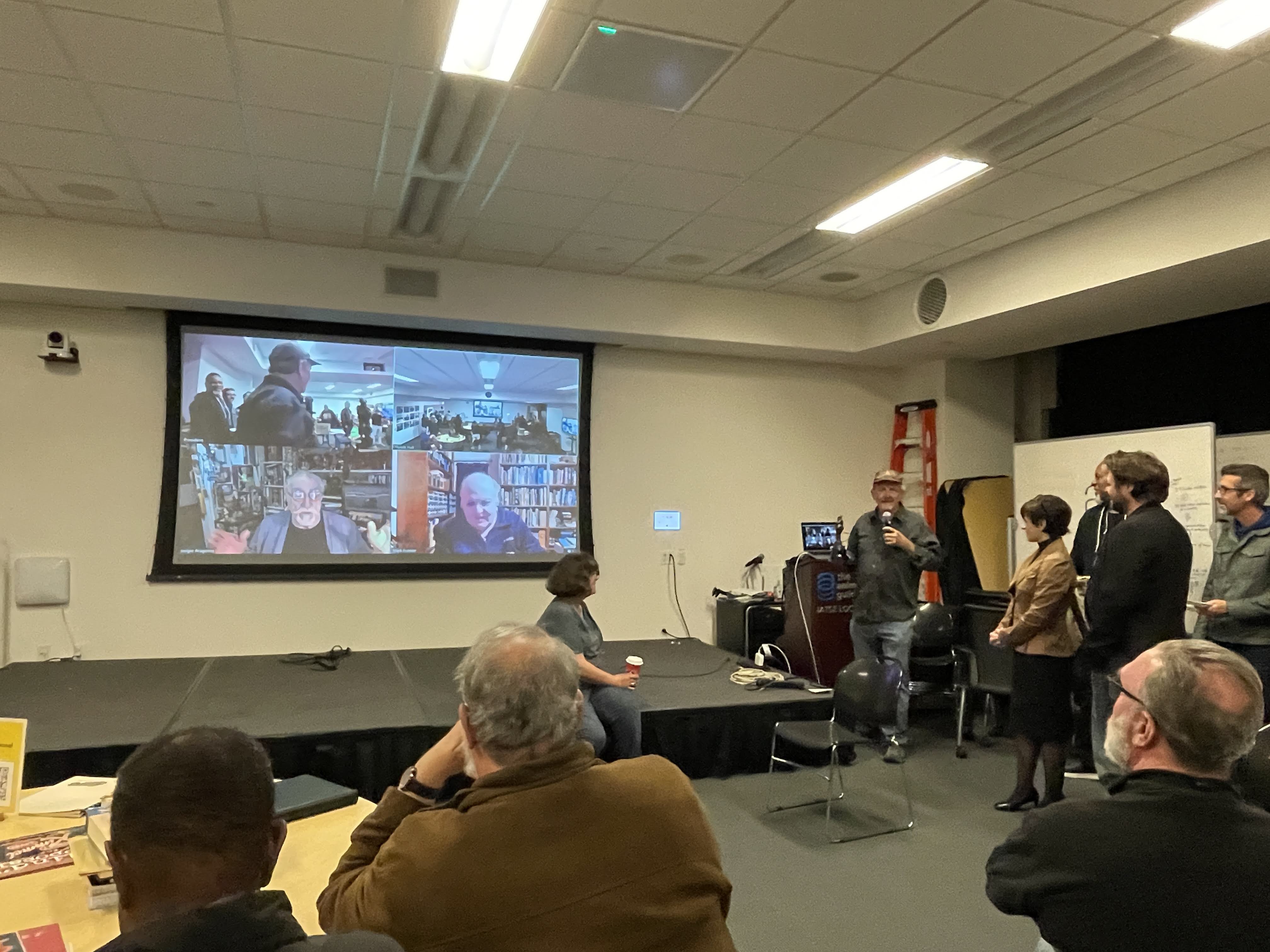
Earlier this week, as promised, the outgoing Board organized a farewell meeting and gathering at the Animation Guild in Burbank, CA, where the group had held its monthly meeting for many years. In truth, given the low participation of recent years, I wasn’t sure what the turnout would be like. Due to the pandemic, in-person meetings had disappeared and Zoom meetings gradually attracted less and less participants—I attended one Zoom CAPS meeting where it was literally just me and another member (though we had a great time!). I also volunteered in an effort to create an in-person component of the meeting where some members could gather together at a site to Zoom in on the meeting with others, but this also didn't gain any traction.
But happily, people turned out in fulil force. In fact, it reminded me of a CAPS meeting from the old days! It was the first time the group had gathered together in person since before the pandemic, with longtime and more recent members in attendance. I saw people I hadn’t seen in years and, in at least one case, more than a decade. Some new members told me that, having recently joined, this was the first time they had ever attended a meeting and seen so many other members!
The centerpiece of the evening’s program included the participation of two of the three founding members via Zoom—Sergio Aragones and Mark Evanier (the third founding member, Don Rico, passed away in 1985). There was lots of reminiscing, expressions of appreciation and laughter.


The event also reminded me of another reason I found CAPS so beneficial—after socializing with other pros, talking shop and sharing work, I always left meetings feeling incredibly energized. That feeling was there when I drove home afterwards as well. It was the perfect send off for CAPS.




Wednesday, October 2, 2024
Sunday, December 11, 2022
Attending the L.A. Comic-Con
 I’m finally getting around to posting photos from the L.A. Comic-Con from the beginning of the month. I attended the last day, opting to take the Metro into downtown L.A., only a 35 minute ride. The L.A. Convention Center is next door to the Crypto.com arena, home to the L.A. Lakers, Clippers and the L.A. Kings. (Crypto.com is also a concert arena—we saw the Go-Gos there in March.)
I was glad to see plenty of comics dealers at the show and there’s a vibrant Artist’s Alley, where I saw many comics pals (see photos). Perhaps I’ll give it a shot as an exhibitor next year—a few years back, I exhibited at WonderCon, when it was held at the same venue, so I have experience at the site.
A confession: I wanted to attend because Elijah Wood and Sean Aston were appearing on a panel presumably for the 20th anniversary of the Lord of the Rings films—but I somehow got the date wrong and missed it the day before. D’OH! Oh, well, I still had a great time at the show (and even got to provide lunch to my daughter and her roommate!).

 |
| Lonnie Millsap |

 |
| Comic Art Professional Society (CAPS) table. |
 |
| Eddie DeAngelini |


Friday, August 5, 2022
Funky Dinner

Prior to this year’s Comic-Con, Tom reached out to me and said he had been invited as a special guest to this year’s show and asked if I’d be up for having dinner one night. He came by my table the first day of the show and we confirmed it for that evening. We ended up taking a cab up to Little Italy where we had a lovely dinner. We talked shop, about the strip business (and contracts!), old comics, the comic book industry, family, and much more. It was truly an evening I’ll remember with great fondness (regrettably, my wife couldn’t join us since there was a panel she wanted to attend). Tom has a real love of comic books as well as comic strips, having initially looked for work at Marvel and DC when he was starting out—in fact, he has commissioned a number of comic book artists (with far more greater name recognition than me!) to do similar kinds of work in his strip. Tom has always been generous in telling me that he loved the piece I did for him, as I had clearly understood what he was aiming for and that I then ran with it; he kindly mentioned that again during dinner!

Shortly after hearing from Tom before Comic-Con, I decided to re-visit the strip and discovered that it is currently being collected in its entirety by the university press of Tom’s alma mater, Kent State. I picked up the first volume and, upon learning that the strip decades later had “time jumped” several years so that Tom could age the characters and tackle new kinds of stories, I picked up a later volume as well (as a surprise, Tom kindly also sent me another volume!). I have greatly enjoyed the strips and am still in awe of the skill to come up with fresh gags every day and the "world building" needed to keep them coming! Tom, of course, succeeds in doing so by tapping into the memories most people share of their high school years, particularly the awkwardness of trying to fit in.
Anyway, our get-together made this year’s San Diego Comic-Con especially memorable and fun.


Friday, April 29, 2022
Remembering Neal Adams

Just as importantly, he was a significant activist and champion for social issues as well as artist’s rights: he helped bring “relevance” to comics (also often with O’Neil) and tried to create a union for comics professionals. He also successfully fought for the return of artist’s work (including that of Jack Kirby’s) and, along with cartoonist Jerry Robinson and others, on the eve of the release of the 1978 Superman film, persuaded (or, rather, shamed) DC Comics/Warner Brothers into providing Superman’s impoverished creators—Jerry Siegel and Joe Shuster—a pension and modicum of financial security, as well as creator credit, by using the attention to the movie as leverage.

Adams also provided work and mentorship to many cartoonists, especially through his comics and illustration studio, Continuity Studios.
Though I’d often go by his table at comics conventions, I had the opportunity to meet him back in 2019 at an event organized by local cartoonists that he kindly hosted at his L.A. Continuity office. After his talk, he invited me to sit with him and was delighted to learn that I was Filipino (he asked)—he spoke about how much he admired the great Philippine-based cartoonists who broke into the industry in the 1970s.
I had intended to also bring my copy of Muhammad Ali vs. Superman for his autograph (pictured above), but told him that I had forgotten it. He laughed, slapped my back and said, “Next time!”
Being on the eve of the pandemic, I didn’t find the right time to follow up, but regardless it was a thrill to get these memorable few moments with him and this photo. He always seemed so hale and active, so the news was a bit of a surprise to me. My condolences to his wife and widow; the news of his passing is giving his legacy and influence the attention it deserves.
Tuesday, September 15, 2020
More Capsule Reviews in the Time of Coronavirus (4)
Batman and Bill

Finger’s involvement with Batman has always been an open secret in the industry—though Kane came up with the initial idea of the character, Finger wrote most if not all of the earliest stories and reportedly suggested many of the elements that became a signature of the character, such as the cowl, dark colors, scalloped cape, the batcave, batmobile, and many of the villains. Finger was essentially considered an early member of Kane’s shop—a ghost who also did other work for DC—and died in obscurity in 1974.
Unlike the more naive Jerry Siegel and Joe Shuster, who created Superman and notoriously gave away the rights to the character for $130, Kane shrewdly leveraged a sweetheart deal with DC Comics that gave him sole creator credit and a share of the licensing and profits. As far as I know, the contract has never been made public, which the documentary seems to confirm.

(Kane himself does not come off well—while in moments of guilt he acknowledged Finger’s work, including in his memoir, at the end he seemed to double-down on the myth that he was Batman’s sole creator.)

I found the documentary moving—after Siegel and Shuster (and, over at Marvel Comics, Jack Kirby), Finger’s story ranks among the great injustices in the comics industry. Fittingly, an award presented annually at the San Diego Comic-Con that recognizes comics writers—one deceased and one still living each year—who have not been adequate recognition during their lifetimes for their work was named the Bill Finger Award.

Though the family has dismissed the details of the story—which the filmmakers acknowledge is based on conjecture—it is nevertheless, at times, a moving account of their complex relationship and arrangement. The story is less successful when portraying their sexual life—though rated R due to subject matter, the film nevertheless keeps the portrayals relatively tame and in good taste; however, given that their relationship may have involved BDSM (which is partly relevant because the early Wonder Woman comics notoriously featured such acts explicitly in the comic book), these scenes sometimes unintentionally come off as humorous. While all the actors are fine, including Luke Evans as Marston and Bella Heathcote as Olive, Rebecca Hall particularly shines as Elizabeth.


What’s striking about the film is that they are similarly about two writers who were deeply scarred psychology by war, which manifested itself in their writing: Tolkien was gassed in World War I whereas Salinger saw combat on D-Day, the Battle of the Bulge and other skirmishes in World War II (which included liberating the Dachau Nazi concentration camp).
Of the two, I found Rebel in the Rye to be the slightly better film, though it only lightly touches on Salinger’s questionable behavior related to pursuing (and perhaps grooming) much younger women. (The film came out about the time the #metoo movement was born.) In contrast, Tolkien focuses more on his relationship with the woman who would become his wife. Nevertheless, both are fine movies that provide some insight into the writers and the experiences that informed their writing.
Margin Call
I want to give a shout out to the outstanding film Margin Call, a perennial favorite of mine which I have watched several times over the years (meaning it’s shown up more than once in my end of year Entertainment Roundups!)

The film itself feels like a taut suspenseful thriller. At first, this might sound like hyperbole since the movie itself consists of talking heads (in fact, the film feels like it could be produced as a stage play), until one remembers that ordinary people’s very livelihoods and futures throughout the country and around the world were very much impacted by the over-exposure to risky investments and their collapse.

The cast is equally excellent all around, but Irons as the somewhat amoral head of the company is particularly delicious in a relatively small role—underscoring how complex and inscrutable high finance can be even to the people running the companies, at one point asking that the problem be explained to him as simply as possible: “Speak to me as you would a two-year old or a golden retriever.”
I always enjoy such these financial drama, though they vary widely in quality. I count Margin Call and 2015’s the Big Short among the very best of these (one could also include the influential Glengarry Glen Ross here, though the financial shenanigans there are more incidental to the plot rather than the centerpiece). Wall Street, the Boiler Room, and Too Big to Fail are additional films in this category that are less successful. Wall Street certainly hit the zeitgeist of the time, and while it's a great time capsule of the ‘80s financial world, I don’t feel it’s aged well.
Sunday, June 7, 2020
Comics Distribution War

It’s for this reason I thought I’d weigh in on the momentous announcement by DC Comics to sever its ties with Diamond Comics Distribution and partner with two other distributors.
This move has potential serious consequences for Diamond, for comics retailers, as well as the stability of the market as a whole.
First, DC—home to the “granddaddy” of comics superheroes like Superman, Batman and Wonder Woman—commands just under less than a third of the share comics market. That essentially means Diamond will lose that percentage of their sales income, at least in new comics.
For comics retailers, this means having to sign up with new distributors if they are going to sell DC’s comics. Many retailers are upset and concerned that this will increase their shipping costs for products that already have razor thing profit margins. It’s important to note that most if not nearly all comic-book retailers (usually referred to as the “direct market”) are essentially mom-and-pop operations. Overseas retailers are also concerned because the new distributors do not appear yet to have the same system in place as Diamond to affordably ship comics overseas.
Regarding the stability of the market—DC made this announcement in the middle of a pandemic, with some stores already currently shuttered; on top of that, Diamond temporarily had suspended shipments due to the pandemic, which disrupted flow of both comics and income. Indeed, Diamond suspended payments during this time. During the closure, DC temporarily sought new distribution channels, which may have partly led to this decision.

While I’m not enough of an expert to comment on this, I will say that making such a surprise announcement, in the middle of a pandemic and with virtually no leadtime doesn’t seem very prudent or fair. (The announcement, which was a surprise to Diamond as well, is effective the end of this month.)
As a bit of background, the last time there was this much of a seismic shift in the distribution system was in 1994. At the time, there were several competing and regional distribution systems that served the direct market. However, under new ownership, Marvel Comics similarly made the decision to distribute exclusively with a company called Heroes World. This led to the subsequent realignment of the distribution system—anxious to ensure its financial viability, Diamond signed DC to an exclusive contract. In an effort to ensure continued competition in the direct market distribution system, many of the remaining alternative publishers signed exclusive deals with a rival, Capital City Distribution. However, these alternatives did not have enough market share to keep Capital City viable, leading to that company’s eventual collapse and the alternatives flocking to Diamond. Marvel’s experiment with Heroes World failed for similar reasons and ended up with Diamond, making the distributor the sole surviving company. While the federal government did look into whether Diamond was a monopoly it ultimately took no action—I have always thought it was because the market was relatively too small to merit such action.
So here we are, in the middle of a pandemic and a seismic change in the comics industries. It’s anyone’s guess how it will play out, but there is understandably a lot of concern, given that it’s on top of a devastating pandemic that has led to store shutdowns and curtailed sales—when the economy tanks, it is usually “luxury” non-necessity items like comics that are the first to go.
For ongoing coverage of this, see Bleeding Cool here, here and here. A good history of the distribution market to 2011 can be found at the Delusional Honesty website.
Wednesday, November 13, 2019
Saturday, September 14, 2019
Meeting Neal Adams
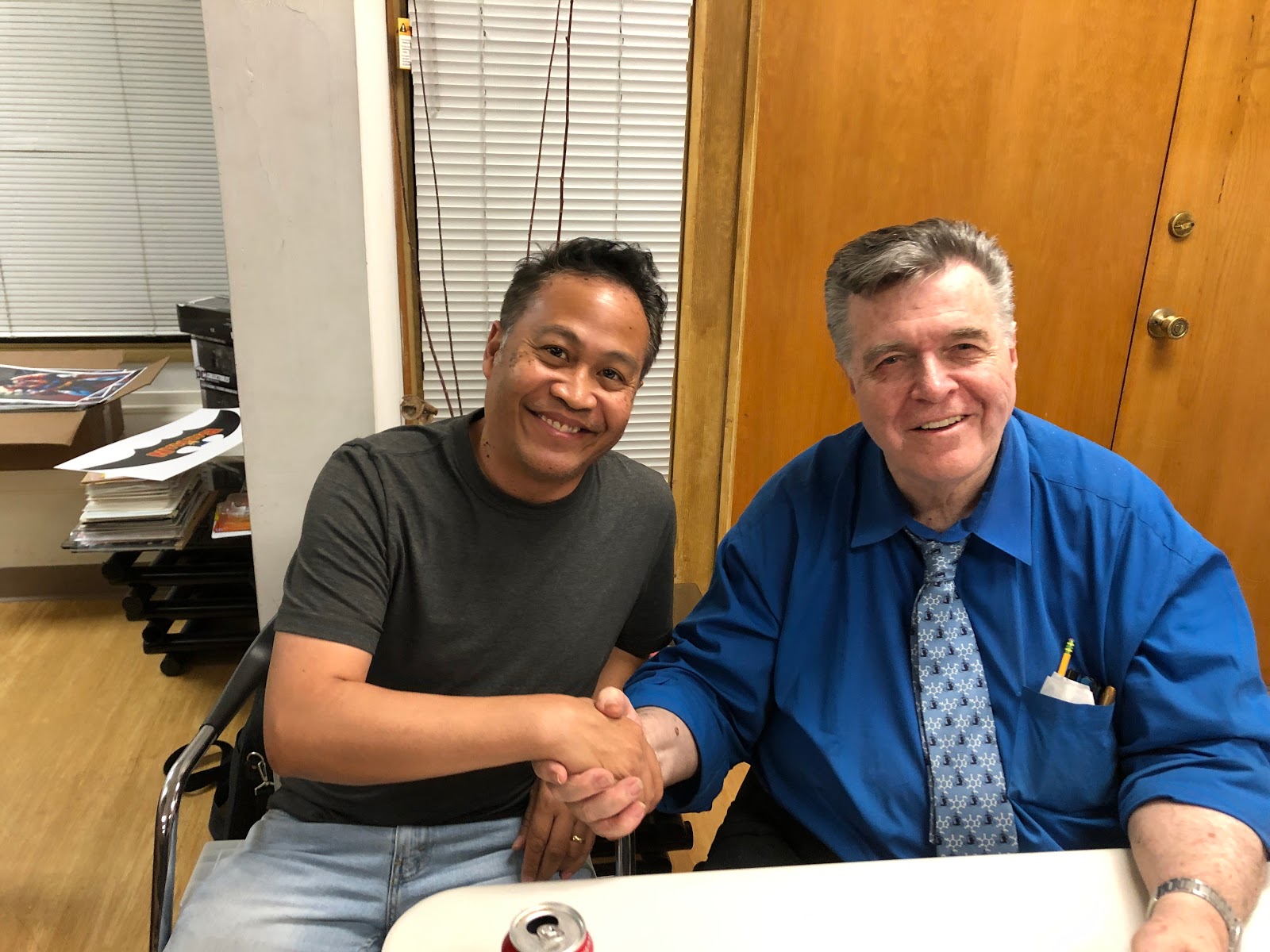

(I’ve previously written about him on my blog here, regarding 1978’s Superman versus Muhammad Ali comic-book. Though I intended to bring my copy, pictured at right, to the event for him to sign, I forgot it at home! When I first walked in and introduced myself, I mentioned this to him—we both laughed and I told him, “Next time!")
Adams is a pivotal figure in the industry, in that he was one of the artists who pulled comics into the modern era. He came into the industry at the perfect time, when radical change was needed. A shift had already begun in the early 1960s, with the debuts of the Fantastic Four at Marvel Comics and the modern-day version of the Flash at DC. Prior to that, comics had been in a period of doldrums—while remembered fondly by many (some feel it’s time for the pendulum to swing back), with some exceptions, comics generally had become too safe, fantastical and, in some cases, even silly. This was in large part due to the scare the industry had gone through during the early 1950s, following complaints (and Senate hearings) that comics had become too violent and inappropriate for children, and a cause of juvenile delinquency.

Adams also was an early vocal advocate of artists' rights. He was among the first proponents for a union and was instrumental (along with fellow cartoonist Jerry Robinson) in getting recognition and a pension for the creators of Superman, Jerry Shuster and Jerry Siegel, who were both living in poverty when the Christopher Reeve Superman film hit theaters in 1979. Adams and Robinson shrewdly used the film's release as leverage to shame Warner Brothers, the parent company of DC Comics, into doing the right thing.
So of course you can imagine what a thrill it was to see and meet Adams at an event organized by local L.A. area cartoonists, at Adams’ new comic-book store, the Crusty Bunkers, in a building that also has served as the home office for his Continuity Studios West. Adams’ studio over the years has been involved in comics, advertising and animation; as those activities have wound down in recent years, Adams decided to open a comic book store/boutique in the space.

As alluded above, Adams first tried to break into the industry at a moment of transition in the industry when everyone told him that the business “would be dead in a year.” He talked about wanting to break into comics while even in high school, where even his teachers (one of whom was a professional cartoonist) discouraged him.
Because of these "lost years," as he and others have noted, at one point when he started in the business, everyone was either five years older or five years younger than him, making him a bridge of sorts between the old guard of cartoonists and industry professionals and the new guard.
As a result, Adams had plenty of funny and juicy stories (and opinions) about comics pros who loom large in the history of comics, such as Mort Weisenger, Julius Schwartz, Robert Kanigher, Jack Kirby, Joe Kubert, Alex Toth, Frank Frazetta, and Stan Lee, as well as his contemporaries and some of the cartoonists who have followed, like Archie Goodwin, Murphy Anderson, Wendy Pini, and Dave Sim. He particularly had kind words about Jack Kirby and Stan Lee, acknowledging and talking about their role in revitalizing the industry in the early 1960s.

Though Adams could have kept going with a willing and captive audience, the evening eventually came to a natural conclusion—ever the gracious host, he invited people to take photos with him. This gave me a few moments to speak a little more with him. He was extremely kind and generous with his time, and clearly enjoyed being among fans and fellow professionals.


