
Tuesday, August 5, 2025

Thursday, July 18, 2024
Monday, July 15, 2024
Tuesday, December 27, 2022
Saturday, January 30, 2021
Cartoonist Shows You "How to Murder Your Wife"

The primary reason for my curiosity in this film is that it's about a successful cartoonist named Stanley Ford, played by the great Jack Lemmon, whose profession and comic strip in the film (an action-adventure secret agent series called Bash Brannigan) are integral to the story. The film was directed by journeyman director Richard Quine and written by screenwriter George Axelrod.
In addition to being a cartoonist man-about-town, Ford is a confirmed bachelor who keeps a man servant in residence named Charles (the great character actor Terry Thomas) and lives in a pretty cool upscale multi-level bachelor pad studio in Manhattan. The film is racy for it’s time and it’s why I call it a “sex comedy”—Ford is pretty successful with the ladies and Charles, rather creepily, revels in his employer’s romantic escapades. (I’m glad now I never caught this film when I was young or it would have given me very skewed expectations of life as a cartoonist!)
The film opens cleverly with Ford in the middle of an exotic adventure with foreign-looking villains (one of whom is reminiscent of Odd Job from Goldfinger from the year before) that takes you through the streets and docks of Manhattan, as his man servant takes photos—it turns out these are reference photos for the comic strip. (While I’m pretty sure most cartoonists didn’t go to this extent to achieve verisimilitude, Ford notes later in the film that this is what makes his strip so popular—readers knew Bash wouldn't do anything he hasn't done himself. It's a conceit that becomes important later in the film.)

Of course, wackiness ensues. While Ford seems to settle into the highs and lows of married life—the sex is great and she’s a great cook, keeps house, and takes care of him, she also keeps him up all night watching TV (to improve her English), has re-decorated his bachelor pad, and put a crimp in his carefree routine. As a result of his new domesticity, his comic strip turns into a gag strip about married life called The Brannigans.

I’ll leave it at that so as not to spoil the rest of the film, but this is where I offer the caveat that the film, of course, is “of it’s time”—an era that popularized the trope that husbands and the American male are hen-pecked and women only want to marry so that they can spend their spouse's money shopping.

That said, I've always enjoyed these 1960s' breezy PG "sex comedies" when I was a kid, such as Goodbye Charlie and Sex and the Single Girl (which Quine also directed, along with another personal favorite film of mine from the period, Paris When It Sizzles). The actors are great and the film looks terrific—Lemmon, of course, is always Lemmon and he engages in quite a bit of physical comedy that is impressive and considerable even for him.

And while, of course, not intended to be an accurate portrayal of cartoonists and comics, I nevertheless enjoyed the representation of the profession. You get to see him at the drawing board and inking. It should be added that the strips in the movie are terrific, done by professional cartoonist Mel Keefer, an experienced newspaper comic strip artist on titles like Perry Mason and Rick O'Shay.
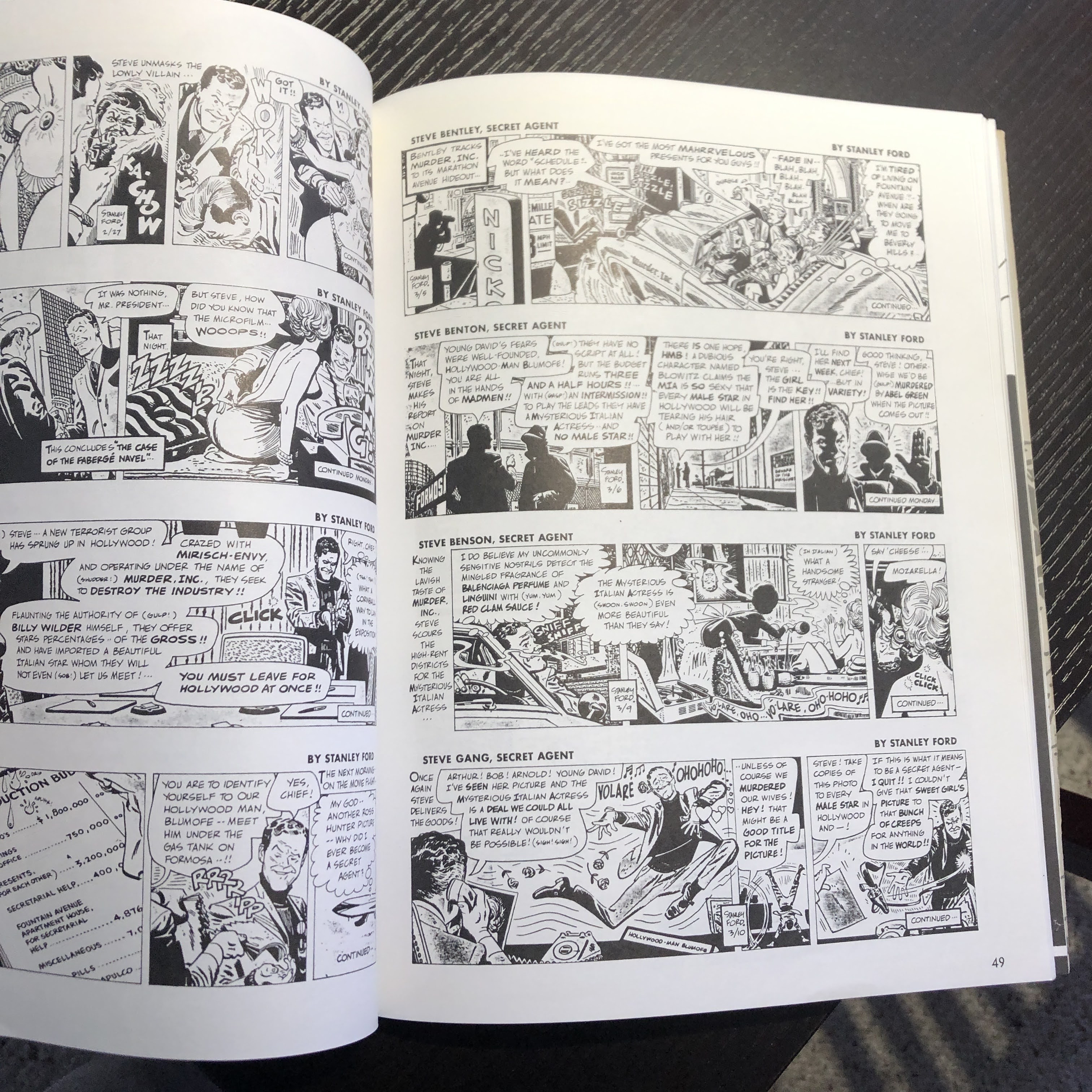
I also discovered years later that one of my favorite cartoonists of all time—the great Alex Toth— did a series of teaser strips to promote the series in the Hollywood Reporter (signed “Stanley Ford,” natch) and include samples of that work below!


Tuesday, October 3, 2017
Remembering the King

 Cartoonists Alex Toth and Jack “The King” Kirby are often held up as the cartoonists who represented the two main competing “schools” in comic-books—at the risk of oversimplifying, Toth was more naturalistic while Kirby more operatic. When the superhero genre came to dominate the industry, Kirby’s more immediate, hard-hitting style—coupled with Marvel editor and writer Stan Lee’s chummy banter—became the template for the comic-book industry for a generation or more.
Toth came from the “school” of cartooning that has its roots in the newspaper adventure strips, most notably studio-mates Noel Sickles and Alex Toth, who themselves were preceded by Roy Crane (to whom Toth equally credits as an inspiration). I’ve written about Toth, Sickles, Caniff, and Crane extensively over the years, so it’s no secret where my own stylistic influences lie.
But this year marks the centenary of Kirby’s birth (August 28), so I thought I’d add my own tribute and appreciation—the San Diego Comic-Con celebrated Kirby’s centennial birth this year (as it did cartoonist Will Eisner, born the same year) and numerous articles and tributes appeared on his birthday.

With that said, as someone with an interest in the history of comics, I was nevertheless very familiar with Kirby’s place in comics history, particularly through Stan Lee’s take-it-with-a-grain-of-salt memoir, Origin of Marvel Comics (1974). I have a vague memory of being fascinated around this time by some back issue of the Fantastic Four and, as a World War II buff at the time, reprints of the Boy Commandos that were reissued by DC Comics during the ‘70s. It was during my personal “Golden Age” of comics reading (i.e., age 12) when Kirby left Marvel for DC to create his Fourth World/New Gods meta-series, Kamandi, the Last Boy on Earth, and work on other books like Jimmy Olsen. The New Gods series was not a hit at DC and Kirby would eventually move on for greener pastures to work in animated television as a concept designer and return later to do more work at Marvel, DC and even the independent market.

Like many of the great cartoonists of his generation, Kirby was respected but never fully appreciated—nor fairly compensated—for his work or creations. Indeed, when comics companies began returning original artwork to artists, Kirby’s art was essentially held hostage by Marvel as it tried to impose stipulations on his work’s return. Then after Kirby’s death, his family, through his estate, pursued litigation against Marvel, which involved an effort to regain ownership of Captain America.

Like many comic-book artists of his generation, Kirby came from hardscrabble Jewish immigrant roots and was focused on providing financial security for his family, often becoming frustrated that he did not receive proper credit for his work, let alone a fair share of the profits generated by his creative work. While Kirby was a visionary, like many cartoonists, he was a poor businessman. Nevertheless, while Kirby did not see these wrongs made right in his lifetime, thanks to the overdue credit and financial settlement to him and his family, Kirby’s legacy and contributions have been firmly cemented in history.
For a couple of excellent comprehensive overviews of Kirby's career and legacy on his 100th birthday, see Mark Evanier's blog and Jeet Heer's New Republic article.


Monday, August 14, 2017
REVIEW: Creepy Presents Alex Toth

Over the years, there have been numerous collections of his work, particularly his romance and war comics work at Standard, DC and other publishers from the 1950s and ‘60s—as well as in the definitive three-volume illustrated coffee-table biography, which I have reviewed.
So I was happy to come across this definitive compilation, Creepy Presents Alex Toth, collecting his little-seen horror work in the pages of Creepy and Eerie magazines from Warren Publishing, dating from the late 1960s, ‘70s and early ‘80s. (Creepy and Eerie were black-and-white magazine-sized newsstand comics, inspired by the well-regarded but notorious EC Comics of the 1950s.) The stories in these pages show that Toth always worked at the top of his game, even in his later years.
The collection shows a different side of Toth. An old school romantic, Toth greatly enjoyed doing romance comics. Aside from the occasional gem, the stories were often formulaic and arguably beneath someone as talented as Toth, though Toth’s work invariably gave them some emotional heft, raising the writing and stories to a higher level.

I was expecting to dismiss the stories as schlock but was pleasantly surprised that the stories were uniformly well written and high concept. It helps of course that Toth is paired with some great writers, such as the legendary Archie Goodwin, which no doubt inspired Toth in turn.
Toth is often referred to as an “artist’s artist” because other artists study his work—and this volume too is a great classroom for cartooning and comics storytelling. But the stories are entertaining as well as short story pieces, so anyone interested in seeing what all the fuss is about with Toth would do well picking up this collection.


Monday, June 16, 2014
REVIEW: Genius, Animated


 |
| Character model sheet for Jonny Quest |

Wednesday, May 25, 2011
REVIEWS: Alex Toth -- Genius, Isolated

It's a tribute to Toth's continuing influence and the enduring quality of his work that, since his death in 2006, the artist's life and career continue to be examined despite the fact that he remains relatively unknown compared to more well known and commercially successful cartoonists like Charles Schulz and Milton Caniff who themselves have recently been the subject of serious biographies. New collections of Toth's work, like Setting the Standard: Comics by Alex Toth 1952-1954, continue to be published and he already has been the subject of an excellent documentary I reviewed previously, entitled "Simplicity” that was included on the DVD collection, Space Boy and Dino Boy: The Complete Series.
So though I’ve already written about Toth at the time of his death in 2006 and in places like the above-mentioned review, I’ll do my best to offer a quick overview of this first volume without going over old territory...
This first volume, entitled Genius, Isolated: The Life and Art of Alex Toth, by Dean Mullaney and Bruce Canwell, covers the period from the artist’s birth and childhood to his work at comic-book companies like National Periodicals (DC), Dell, Gold Key, Standard, and Western in the 1940s and ‘50s when Toth’s work fully matured and began to gain the notice and admiration of his fellow cartoonists, many of whom began trying to emulate him. (This was a time when comics distribution and creator credits were spotty, so few readers probably took notice until years later when Toth’s work became more sought after.) The volume concludes in the early 1960s when Toth—always his own worst enemy—left the industry in a pique one day when he entered the editorial offices of Western Comics and angrily read aloud his list of grievances. Understandably feeling that he had burned all bridges behind him, he stormed out of the office, likely believing his career in comics was over.
 |
| Above: First two pages of Toth's groundbreaking "The Crushed Gardena" from 1953 |
This is all well covered in the narrative, which included the participation of his four children and former spouses. Toth’s difficult personality is discussed candidly—though he was never medically diagnosed, it’s clear he likely suffered from some sort of personality disorder or clinical depression. Toth's personal life and his development and views as an artist are also discussed.
 |
| Above: Original art from a 1950's romance story. Toth did some of his best work in these stories, which he personally enjoyed doing as well, and other artists took notice. |
The next volume of the series, Genius, Illustrated, will likely cover his years “in the wilderness” as a journeyman cartoonist, which will be followed by Genius, Animated, about his years in animation, particularly Hanna Barbera, where he became the company’s go-to man in conceptualizing and storyboarding iconic animated shows like Super Friends, Jonny Quest, Space Ghost, and many others.
Given the loving care and attention to this stunning new volume, there’s much to look forward to in volumes II and III. Meanwhile, anyone with an interest in Toth or comics art in general should savor this outstanding first volume.
* Beating them to the punch by a few months is a full-color reprint collection of JON FURY IN JAPAN by Paul Power Publications, which I recently mentioned here.
Saturday, March 26, 2011
Treasure Trove

While searching for the Adventures of Jon Fury in Japan—a collection of a previously unreprinted series by “artist’s artist” Alex Toth that was not carried by my local comic-book store—I discovered it was available online at Stuart Ng Books. Fortunately, the company’s storefront is not too far from me in the Southbay area of L.A., so I was glad to save the shipping and take a trip down to the store to pick up the issue. This also was a perfect excuse for me to visit the store for the first time.
 |
| Cover to Jon Fury in Japan |
Though no longer really the norm, comic-book stores used to have the reputation of looking like a boys’ clubhouse, with comics and magazines stored haphazardly in boxes or stacked to the ceiling. (Believe me, I’m not dissing this—the first comic-book stores I frequented back in the 1970s definitely fit this profile, and I have nothing but fond memories of my weekly pilgrimmages to these stores).
In contrast, by any standard, Ng’s store is extraordinarily clean, professional, and well-maintained. Located in a newish, non-descript business park in Torrance, a Southbay community in Los Angeles, the bookstore is airy and inviting, conducive to browsing.
In addition to artbooks that feature the work of a wide range of cartoonists and illustrators, there are also plenty of European graphic albums (many imported, meaning they’re not translated), sketchbooks by fan-favorite artists, and classic comics collections. Many of the items are rare and hard to find—indeed, I was interested to discover items I personally already own for sale at prices that reflect their rarity and desirability. Along the same lines, I spotted a book available there that was out of print at Amazon.
Anyone with an interest in cartooning, comics, commercial art, and illustration definitely owe it to themselves to visit the store if they are local or the website for hard to find items and collections.
Visit the Stuart Ng Books website for address information and directions.
Tuesday, February 9, 2010
In Time for Valentine's Day....

The story appeared in Love in Tights #2, a quarterly superhero–romance anthology series published by Slave Labor Graphics that appeared in February 1999. When I was invited to submit a story by the editor, J. Torres, I leapt at the chance. Around that time, I had become enthralled by the romance comics work of one of my favorite cartoonists, Alex Toth—Toth had done extensive work in the romance field and the work was finally being more widely seen thanks to a series of compilations devoted to this respected artist's artist. Toth was well suited to the naturalistic, illustrative tone of romance comics (versus the more operatic superhero comics), and said he enjoyed working on such stories when they were well written. Toth was very much on my mind when I produced "Julianne Love." I enjoyed the opportunity to do a romance story as well as work in a superhero adventure of sorts—and all within just 8 pages!
So I am pleased to re-present the story in time for Valentine's Day. Enjoy!
* Updated 10/2019: The webcomic link is no longer active, but new links have been inserted that takes you to preview pages of the story.
Below: Toth romance story page.

Thursday, August 30, 2007
Alex Toth Documentary
 In an earlier post, I reviewed the excellent biography of Milton Caniff and wondered whether any artist as devoid of personal demons or dark secrets as Caniff could be an engaging subject (the answer was yes).
On the other side of the coin is the legendary Alex Toth, an "artist's artist" who worked in comics and the animation industry (where he worked on seminal programs like Space Ghost and Jonny Quest), and whose prodigious talent earned the admiration of his peers and continues to influence cartoonists today. Greatly admired and respected (and even beloved), many people sought his friendship despite his reputation as a cantankerous and combative individual. His complex personality and tortured genius makes him the perfect subject for a biography.
Buried in a recent 2-disc DVD release of Space Boy and Dino Boy: The Complete Series is an excellent 80-minute documentary on the cartoonist entitled "Simplicity: The Art and Life of Alex Toth." Previewed at the Comic-Con International: San Diego in July 2007, the documentary has everything one would want for a project focusing on an important figure in comics history: it's polished, professionally done, and has high production values. (As more than one person has noted, it easily would work well as an episode of PBS' American Masters series.) More importantly, it is a wonderful and well-deserved tribute to Toth's legacy and commitment to his art.
 The documentary includes extensive interviews with friends and admirers, including Mark Chiarello, John Hancock, Irwin Hasen, Joe Kubert, Bruce Timm, Paul Pope, and others, as well as his four children. The documentary also touches an emotional nerve, particularly since Toth found some measure of peace, contentment and redemption in his final days.
Since I wrote a tribute to Toth at the time of his passing, I won't bother repeating myself here to talk about the man. But anyone with a serious interest in comics would do well to watch the documentary—the DVD already is a bargain, and frankly the documentary itself is worth the price of the DVD. (I purchased the DVD solely for the documentary!)
All I'll say is that I regret that I did not try to pursue knowing the artist more aggressively myself. As noted in my tribute to him, I occasionally sent him comps of my own comics, and always received postcards back. Given my personality, I likely would have been too intimidated to seek him out cold and unsolicited as many did (including some of those interviewed in the documentary), but I certainly would have corresponded with him more frequently if I had known--as the documentary makes clear--that he loved exchanging letters. Regardless, those notes I have from Toth are prized possessions.
It's a bit of a crime (and a puzzle) why this documentary has not received more attention, but I hope this review helps spread the word a bit.