Pages

Showing posts with label Comics History. Show all posts

Monday, September 15, 2025

Tuesday, July 1, 2025

RIP Jim Shooter

I was sorry to hear about the passing of comics writer, creator and editor Jim Shooter. Though I never met him personally, he loomed large in comics during a period I became serious about entering the industry. To say that he was polarizing would be an understatement. His tenure and influence as editor in chief of Marvel Comics from 1978–87 was both legendary and notorious. He got the company back on track and oversaw some great series and ushered in new talent (encompassing Chris Claremont's run on X-Men, John Byrne on the Fantastic Four, and Frank Miller's Daredevil) and implemented a royalty program. Shooter would occasionally go on to found and/or start several other companies, such as Valiant and Defiant, neither of which lasted long.

But during this time, Shooter also emerged as a "villain" in the industry. These included defending Marvel's indefensible position of not returning Jack Kirby's artwork in order to leverage a promise that he not ever attempt to claim ownership of the characters he had a big hand in creating for the company (they didn't call it "The House that Jack Built" for nothing), and issuing edicts on the creator side that people chafed under so much that many left.

Starting around that time, I became as interested in the business of comics as much as the comics themselves and, during these days before the Internet, much of this was covered breathlessly in the weekly and monthly comics media press. So though much of my impression of Shooter was shaped by comics industry media coverage (particularly that of the Comics Journal), since I had no real skin in the game—and given the insular nature of the industry—I tended to read such reports with a grain of salt and almost solely for the entertainment value in a soapy sort of way. (There's an old adage about academia that probably applies to comics at this time—the politics are so vicious because the stakes are so low.) 

In any case, I have to admit it's been touching to read so many fascinating stories and personal anecdotes at his passing, which provide a warmer and more rounded view of the man. Despite some of his notoriety, he clearly could be warm and generous, and clearly did much to benefit and protect creators, and it's good to know that he was nevertheless respected and appreciated by many of his peers, many of whom found opportunities to share their sentiments with him over the years. At the end of the day, he leaves behind a solid legacy, so it's nice to hear so many remembering him fondly.

For a nice overview of some of these stories, see the Comics Beat coverage


Wednesday, April 2, 2025

Sunday, December 29, 2024

78 Years Ago Today...

As many people know, the comic strip that initially inspired my own work is Milton Caniff’s Terry and the Pirates. Caniff created the strip for the Chicago Tribune New York News Syndicate and worked on the strip from 1934 until 1946. He left Terry to create a new adventure strip, Steve Canyon, for full ownership and creative control.

On this day, Dec. 29, in 1946 (a Sunday like today!), Caniff ran his final strip—reproduced below, it’s a beaut and an amazing culmination of his work on Terry. Caniff had announced that he was leaving Terry many months before, but made a point not to let up in the home stretch. (Canyon would debut on January 13, 1947.)


I’m partly running this because I missed the opportunity to mark the 60th anniversary of Terry's debut on October 22, 1934. Building on some groundbreaking work by others—most notably Roy Crane (Wash Tubbs) and Caniff’s studio-mate and friend, Noel Sickles (Scorchy Smith)—Caniff started a whole school of cartooning whose style influenced several generations of cartoonists.  I’ve included a strip from Caniff’s first year to demonstrate how much he had grown artistically. At the point of oversimplifying, much of it was based on the use of heavy black, chiaroscuro/impressionistic effect, rather than for decorative purposes.


In issue 25 of Rob Hanes Adventures, I paid homage to Caniff, as well as to Terry and Canyon, and to many of his peers and their characters, by having him travel back in time to the 1940s and team up with dopplegangers of the soldiers of fortune and other characters from the era. And I carried over this tribute in my recent holiday greeting where a sign in the image reads, “Ring Out the Old, Ring in the New” as Caniff cleverly did in the final panel he drew in the Terry strip on the eve of a new year. 

Cartoonist George Wunder picked up the reins on Terry and continued the strip to its end in 1973. Canyon ended its run with the passing of Caniff in 1988.


Friday, December 13, 2024

CAPS Farewell

Back in September, I mentioned that CAPS (the Comic Art Professional Society, founded in 1977) had announced that it was calling it a day. 

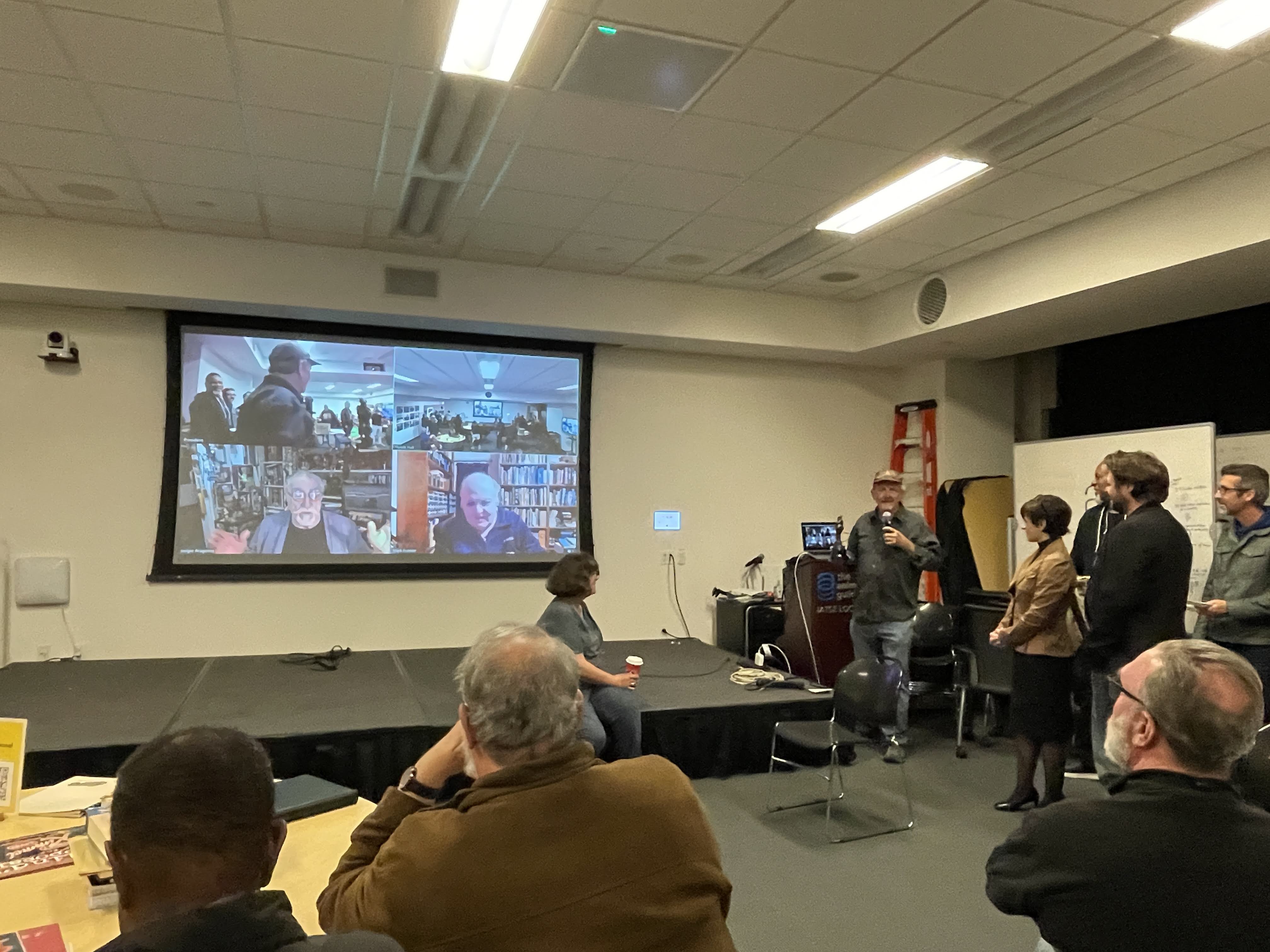
Earlier this week, as promised, the outgoing Board organized a farewell meeting and gathering at the Animation Guild in Burbank, CA, where the group had held its monthly meeting for many years. In truth, given the low participation of recent years, I wasn’t sure what the turnout would be like. Due to the pandemic, in-person meetings had disappeared and Zoom meetings gradually attracted less and less participants—I attended one Zoom CAPS meeting where it was literally just me and another member (though we had a great time!). I also volunteered in an effort to create an in-person component of the meeting where some members could gather together at a site to Zoom in on the meeting with others, but this also didn't gain any traction.

But happily, people turned out in fulil force. In fact, it reminded me of a CAPS meeting from the old days! It was the first time the group had gathered together in person since before the pandemic, with longtime and more recent members in attendance. I saw people I hadn’t seen in years and, in at least one case, more than a decade. Some new members told me that, having recently joined, this was the first time they had ever attended a meeting and seen so many other members!

The centerpiece of the evening’s program included the participation of two of the three founding members via Zoom—Sergio Aragones and Mark Evanier (the third founding member, Don Rico, passed away in 1985). There was lots of reminiscing, expressions of appreciation and laughter. 


In its later years, a highlight of the group’s activities was an annual banquet that featured the presentation of the Sergio Award, named for founding member Sergio Aragones. Since there were several statues left, the award’s namesake was given the honor to present the remaining trophies to deserving members of the group—in this case, he made the awards to members who were there at or near CAP's founding and played key roles in raising the group's profiles, often serving as early presidents: Mark Evanier, Scott Shaw, Bill Stout and an honorary one to Stan Sakai. (Though I'd seen the award statuette at banquets in the past, I'd never held one. As show in the photo below, after the meeting, I took the opportunity to inspect it up close. I also picked it up and found that it was surprisingly heavy!)

While everyone expressed regret for the group’s demise, people were clear eyed and philosophical about its passing. Pandemic aside, the industry has changed greatly in recent years and the group's demands made it difficult for working professionals to commit the time and effort needed to sustain the group and its activities. And with so many opportunities like multiple comics conventions, shows and other activities that give people a chance to see each other, perhaps CAPS’ time had passed. 

The event also reminded me of another reason I found CAPS so beneficial—after socializing with other pros, talking shop and sharing work, I always left meetings feeling incredibly energized. That feeling was there when I drove home afterwards as well. It was the perfect send off for CAPS. 

(That said, no doubt due to the positive energy at the event, people raised the possibility of the group getting together again in the future in some form in more informal ways—so we’ll see!)


Saturday, May 4, 2024

My Favorite Star Wars Comic

For this Star Wars celebration day, I thought I’d highlight one of my favorite single comic book issues of all time—Star Wars #38, drawn by the great Mike Golden and written by the legendary late Archie Goodwin.

Aside from the terrific art, I felt that Golden really cracked the code in drawing Star Wars. There already was great work in the series, but Golden’s work was less pulpish and more stylish and sleek—I especially dug the way he portrayed blaster fire and other crackle.

I know I’m not alone in admiring this issue—at WonderCon last month, when I went by Golden’s booth, this issue (bagged) was on display. I asked his assistant at the booth what it was going for—she said $100. I really don’t know the street value of the book, but I assume you’d get Golden’s signature on it too. I keep my copy of the issue sitting on a shelf nearby on its own (also bagged) just because I like having it closeby and readily accessible.

I recently re-read the issue for the first time in a long time. The story is a bit thin, though a solid science fiction tale. To be fair, however, it was literally a filler issue—I did not remember until I just re-read it that this issue was supposed to see the start of the adaptation of The Empire Strikes Back—but for some reason, Marvel had to delay it a month and published this one-off issue in place.

So the six-issue adaptation of Empire started next issue, drawn by the late Al Williamson (and adapted by Goodwin), who of course is considered one of the best and most definitive Star Wars artists—he’d go on to also draw the Star Wars syndicated comic strip and the adaptation of The Return of the Jedi as well.

May the 4th Be With You!


Monday, April 8, 2024

Ed Piskor RIP

I was saddened—and like most people, a bit shocked—to hear of the passing of cartoonist and podcaster Ed Piskor on April 1.

Though Piskor has been an active and prolific professional cartoonist for many years, I only stumbled across him during the pandemic, through his podcast/YouTube channel, Cartoonist Kayfabe, produced with his partner and fellow cartoonist Jim Rugg. I didn't think I'd cotton to what initially felt like a "bro vibe" on the show, but I soon came to appreciate their deep and broad knowledge, love and respect for comics and cartooning history and a wide array of comics genres and styles, from Robert Crumb, to Image, to Moebius/Jean Girard, Dick Tracy and more. Their podcasts were diverse, ranging from appreciations and overviews of specific comics and magazines, comics history and of  cartoonists and characters. They also conducted interviews of many great figures from comics, such as Todd McFarlane and Gary Groth. While Rugg seemed the more genial and diplomatic of the two (and a family man), Piskor came off as more of a blue collar bad boy/rebel with a strong Hip Hop vibe. But though it was certainly part of his authentic and genuine self, his enthusiasm and passion always came through, and even when citing work he didn't necessarily like, he never came off as rude or mean-spirited. They were very prolific podcasters—although I didn't listen to them religiously, their channel was a go-to when I was looking for something to listen to and watch while drawing.

What I partly admired about the show was what started as an exercise for the two friends and fellow pros to talk about comics as they no doubt did all the time in private, it clearly turned into a great promotional tool. Their subscriber base was very devoted and they were successful in mobilizing them to support and order their comics through traditional comic book stores and online. More power to them! In fact, in 2023, I even sent both a sample of my comics to put me on their radar. 

Piskor particularly seemed to be incredibly hard working and prolific. A Kubert School for Cartooning alum, I appreciated that he made no bones about the fact that he may not have been the most naturally gifted artist and cartoonist, but he certainly worked hard on his craft, showing that commitment and discipline can go a long way (the fact that he did this while also producing a podcast on a regular schedule was particularly admirable).

At left: When I visited the Fantagraphics Comics bookstore back in October 2023, I took this photo of a bookshelf that featured Piskor's work.

When news emerged of the allegations of misconduct and grooming came to light, I was saddened and disappointed. But, of course, not having any personal connection or familiarity with Piskor or the situation, I felt no need to weigh in or express an opinion and, like I would with any developing news story, waited to see how it would play out as more information emerged.

On April 1, when I first heard news of his death, my initial thought was that it might be some kind of sick April Fool's joke. But quick verification proved it was not.

Regardless of the truth, of course, Piskor and no one else deserved this kind of end or the kind of social media (and traditional media) pressure he received. I do agree that, ultimately, it was Piskor's decision and actions that led to his passing...but it may also have been a reflection of personal mental health issues as well as the fact that his self-identity was so wrapped up and defined by his profession.

In recent days, just by chance, some of their shows looking at the work of French cartoonist Moebius popped up on my feed recently, which I watched. Listening to them express their appreciation of Moebius was a joy and informative—though not much of what they observed was new to me, they helped me look at the work with fresh eyes, with a level of admiration and enthusiasm that was infectious. It's not clear whether Rugg plans to continue the channel in some way on his own, but Piskor, and his chemistry with Piskor, will be greatly missed.

Below: A sample of their show. 

Thursday, February 1, 2024

Happy 95th Birthday, Jules Feiffer
Comic Book Heroes Cover

I’m a little late, but I wanted to mark the 95th birthday (on Jan. 26th) of cartoonist, author, children’s book writer, comics historian, playwright, and screenwriter Jules Feiffer! 

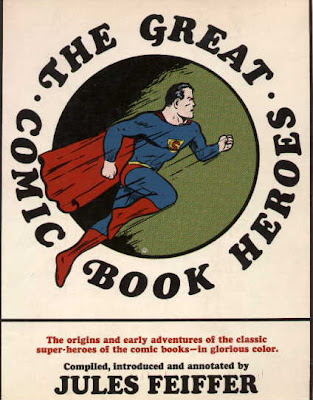
I’ve always been aware of Feiffer when I was growing up, occasionally seeing his Feiffer strip that appeared in the Village Voice. And like many people my age, he introduced me to golden age comic book work through his seminal book, The Great Comic Book Heroes (1965), which I came across in the '70s. Though I was familiar with most of the classic comic book heroes featured, it was through this book that I first learned of the Spirit by Will Eisner—with whom Feiffer famously got his start in comics as an assistant (and eventually a writer) on the series, which ran as a syndicated Sunday newspaper comic book insert from 1940 to 1952.* About 10 years ago, I also read Feiffer's wonderful memoir, Backing Into Forward, which I reviewed here. It was a great read, though I initially read it out of curiosity about his years in Eisner’s shop!

The Great Comic Book Heroes also served as a bit of an early personal memoir for him—I loved how he included a cover shot of one of his own home made comics made as a child (included in the accompanying photo gallery), which was a comfort knowing I wasn’t the only one who did that!

I had the opportunity to see and meet Feiffer in 1994 when he spoke as part of an "American Comix" lecture series sponsored by the Los Angeles Central Public Library. Afterwards, when I asked him to sign my copy of his book, The Man on the Ceiling, I brought up an anecdote from The Great Comic Book Heroes—one of his first assignments as Eisner’s assistant was signing the artist’s name on the stories, claiming he was immediately better than Eisner himself. So Feiffer chuckled when I asked him to sign in Eisner’s name, inscribing my book, “Jules Feiffer aka Will Eisner.”)

Feiffer is an old-school lefty, who came of age professionally during a heady time in New York when the city was still the center of much of the art, entertainment and publishing worlds. Intellectuals, playwrights, actors, movie directors and, yes, cartoonists like Feiffer mingled and cross-pollinated at parties and salons in those days. On stage, he worked with people like Alan Arkin, and on film, Mike Nichols (Carnal Knowledge) and Robert Altman (Popeye). (I recently rewatched a documentary about Nichols and May, and was delighted to see Feiffer included among the talking heads throughout the piece.)

Feiffer is a talented hyphenated artist, but proudly a cartoonist first—in his twilight years he has returned to producing graphic novels, being one of the first to dabble in the form, with 1979’s Tantrum.

I’ve heard that Feiffer also wrote a never-produced screenplay for a film adaption of Milton Caniff’s Terry and the Pirates—that screenplay has always been a bit of a holy grail of mine.

Anyway, happy birthday to one of the greats.