Tags: Alex Toth, Lucky Luke

Showing posts with label European comics. Show all posts
Showing posts with label European comics. Show all posts
Tuesday, December 27, 2022

Sunday, June 12, 2022
Review: The Mighty Return of Ric Hochet (Vols 1–3) (Kindle edition)

Ric Hochet is a Franco-Belgian comics series that debuted in 1955, created by cartoonist Tibet (pen name for Gilbert Gascard) and writer André-Paul Duchâteau. Reminiscent of Hergé’s Tintin, Ric is an investigative journalist/detective who often works with (and sometimes at odds with) the police on cases. Though it’s been translated into many languages, it’s had limited exposure in the U.S. The original series appeared to have ended with Tibet’s death in 2010.
(I also didn’t miss the fact that my own Rob Hanes Adventures character bears a slight resemblance to Ric!)
That said, these latest albums I’m reviewing are new adventures and a revival of the series by writer Zidrou and artist Van Liemt Simon that have been translated into English. The new stories appear to be very faithful to the look and spirit of the original series, down to the late 1960s/early 1970s setting. They are entertaining mysteries grounded in reality with a dash of humor that sometimes lightly touch on social issues. I should add that I purchased the Kindle edition of these albums. Ric is a reporter devoted to his work and solving mysteries, but fallible, good humored and relatable.
Though entertaining, I found that the first volume, R.I.P. Ric, was an odd way to re-boot the series since Ric himself actually isn’t in it much since he’s been replaced by a doppleganger (that’s a bit of a spoiler, though to be fair it is revealed nearly at the very start of the story). But it turned out to be a suspenseful adventure nonetheless as Ric tries to foil his doppleganger's plans, leading to an exciting finish.
The other volumes were also great fun—in the second volume, Murder in the Gardens, Ric becomes involved in a murder mystery involving a group of radical leftists of the kind that ran rampant Europe in the 1970s and '80s; and in the third volume, titled How to Commit the Perfect Murder, the series displays some cheekiness and dark humor as Ric and the police investigate a series of murders that appear to have been encouraged by a how-to book on murder planted in book markets.
These are fun, rainy day reads, perfect comfort food for those who like mysteries with a dash of humor and PG-13 sex appeal, that show off the flair and solid storytelling and draftsmanship that are typical of many European comics. Though these are technically set in a prior era, I nevertheless enjoyed the authentic peak the series offered into everyday life and the lives of ordinary people suddenly caught up in a bit of danger and mystery in the city and suburbs of France.


Tuesday, January 25, 2022
Friday, November 5, 2021
The Real Corto Maltese

But the name is actually a direct homage and shout out to one of the great adventure comics series of the same name, Corto Maltese, by Italian cartoonist Hugo Pratt.
Published from 1967 to 1989 (Pratt passed away in 1995) and set in the early 20th century in the years prior to and through World War I, Corto was a mysterious seafaring soldier of fortune who always found himself on the side of the underdog in remote far-away (and historical) settings like the Congo, the Russo-Japanese War, the Russian Revolution and early fascist Italy, where he often encountered rogues and historical figures like Ernest Hemingway, Jack London and others along the way.
Pratt's writing fused high adventure with lyricism and magic realism. His black and white art is evocative, striking and powerful even today, in the same tradition as some of my favorite cartoonists like Caniff and Toth, but even more stark and expressionistic.
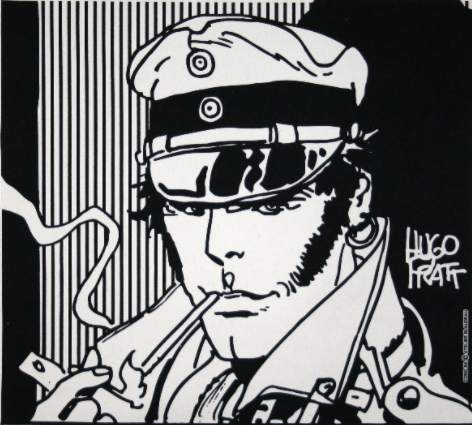


 |
| Hugo Pratt |
Subscribe to:
Posts (Atom)