Pages

Saturday, July 18, 2015

What Comic-Con Dreams are Made Of


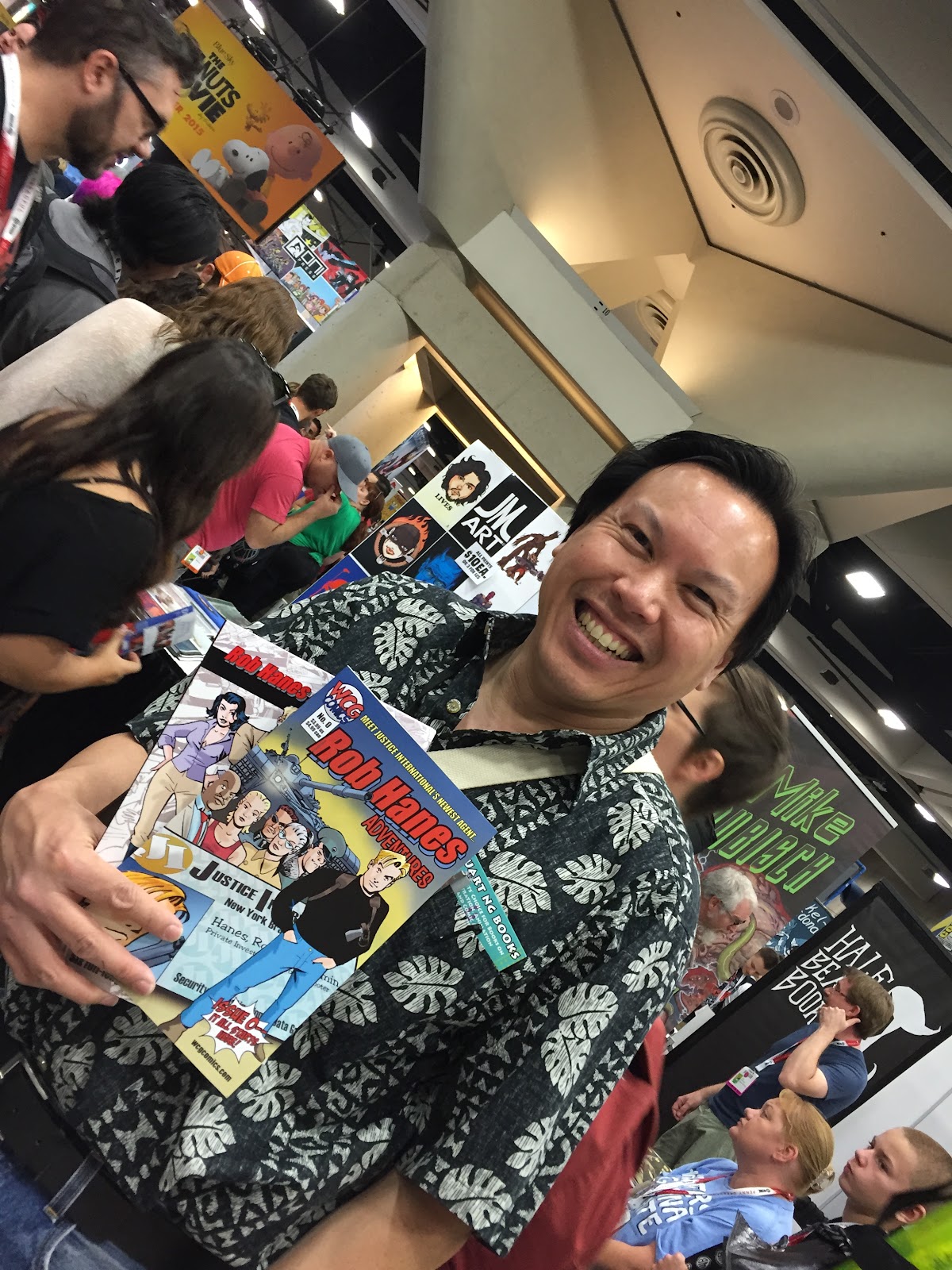
Here's my report from the floor of the 2015 San Diego Comic-Con. To go straight to the photogallery from the show, click here.


As a longtime exhibitor and attendee of the San Diego Comic-Con, the words that come to mind to describe the show are exhausting and invigorating. For exhibitors—especially those like me who are  a one-man operation and tethered to a table for pretty much the duration of the show—the 4-plus days of the convention is a bit of an endurance test. But it is not much easier for the attendees either, who are running around all day, standing in lines, or sitting in a darkened exhibition hall for hours, or sometimes all day. At the end of the show, when the announcement is made that Comic-Con has come to a close, cheers go up around the floor—not simply because another successful show has hit the books, but also out of relief.

But, of course, the show is also incredibly invigorating. Originally created as a comic-book convention for hardcore fans in 1970, the show has morphed into the world’s largest mainstream pop culture mega-event that embraces all things geek, bringing under one umbrella movies, television, gaming, cosplaying, books, science fiction, art, comics, and more. Movie studios have been known to shut down their sets to bring their cast and crew to the show and no other event gives fans such close access to the artists and performers who are responsible for their favorite movies, shows and comics.

At its core, Comic-Con is a consumer show—but the palpable excitement of everyone in attendance makes it also feel like a big celebration with a crowded party atmosphere (as evidenced by the bagpipe players who snaked around the convention floor at various times), which spills over into the streets of the Gaslamp District outside the convention center, both during the day and night. The comparison people have made of Comic-Con to Mardi Gras is no exaggeration.

Some of the stories that came out of this year’s show served as a reminder why Comic-Con is the ultimate fan experience. Perhaps the most indelible was the Star Wars panel in the infamous 6,500-seat Hall H. After a surprise appearance by Harrison Ford at the panel, who joined the film’s director, J.J. Abrams, and cast, including fellow Star Wars original cast members Mark Hamill and Carrie Fisher on stage, at the end of the presentation, the entire hall was escorted outside and treated to a surprise concert by the San Diego Symphony of composer John Williams’ Star Wars score outside the convention center by the San Diego Bay, which culminated with a fireworks show. It was, of course, a deft piece of promotional showmanship, but also a genuine gift to the fans.

It’s what Comic-Con dreams are made of….

Life as an Exhibitor
As a small press exhibitor, my table is just a small spec in a sea of booths on the immense convention hall main floor, which provides one with a rather narrow view of the show. I’ve written in the past that the show's changing nature has made it quite a challenge to be a pure small press comic-book publisher at Comic-Con, which others have now reported. Not everyone who attends Comic-Con is there for comics any longer and it’s hard work trying to get noticed among the sensory overload that’s Comic-Con. Many small press exhibitors rely on other merchandise to amp up sales, such as prints and t-shirts, often featuring characters and properties that have nothing to do with their comics. And while it’s still heartening to have attendees be instantly drawn to my comic-book by the art, being at Comic-Con requires strong salesmanship and the drive to put yourself out there. It’s not a role I’m entirely comfortable with, but fortunately my enthusiasm for the series still comes through as I hawk my work. I feel fortunate Rob Hanes Adventures has developed a modest fan base at the convention—many from overseas—and I enjoy the opportunity to introduce the series to new readers every year.
Below: I'm not in this report on the status of the small press at Comic-Con, but my booth can be prominently seen in the background during the interview with my booth neighbor, Lonnie Millsap!


It’s been oft said that Comic-Con is what you make of it—with so many programs and activities running concurrently and 24/7, there’s no single Comic-Con experience and it would be literally impossible to attend and see everything. As an exhibiting self-publisher, I’m bound to my table for most of the show. I’m fortunate to have friends and family to watch the booth when I’m away, but as the single artist-writer of my series, I’m beholden to be at my booth most of the time. I usually explore the floor in the hour or so I arrive at the convention hall before the doors open, taking photos and scoping out what I might want to purchase so that I can do so quickly on breaks during the show.

Some other general impressions and comments:
  • I resolved to be a bit more present on social media this Comic-Con. My limited presence in the past was partly technological: posting on Facebook and Twitter prematurely drained my mobile device’s battery, so this year I invested in an external battery booster for the show. My social media skills, however, continues to be a work in progress—I can see that I need to plan my social media strategy in advance as much as I do the other logistical elements of the show.
  • While my work has always appealed to an international audience, it seemed especially so this year. Classic adventure comics like Rob Hanes Adventures are a particularly popular genre overseas, and this year readers both new and old from the Netherlands, Italy, Brazil, and Saudi Arabia were among those I had the pleasure to meet.
  • This year was the first time I wholly embraced the Comic-Con app on my mobile device rather than used the traditional print program, and found it incredibly convenient. It was easy to peruse the daily program and save specific items as a customized list, as well as to find other exhibitors and pin-point them on a map in the app. Having an aisle booth, I often had attendees requesting directions who didn’t know to use the program to find their way around. The app made helping them much easier! Having said that, I attended few panels due to the need to man my table—I simply saved those scheduled panels I might want to see or bring to the attention of my wife and children.
  • In the last year or so, the harassment of female cosplayers has been an issue that has come to the fore. I noticed that one woman cosplaying as Elastigirl from the film the Incredibles pointedly said politely, “Thank you for asking” to everyone who asked to take her photo—a gentle way to remind attendees of respecting cosplayers.
  • However, I didn’t take as many photos as I have in the past because, having attended so many shows, I thought it was getting a bit repetitive. (It also felt like there were fewer cosplayers.) In writing about this year’s Comic-Con, writer Mark Evanier wrote, “It always amazes me each year the first time I enter the exhibit hall that everything is exactly where it was when I left here a year ago.” A lot of the exhibitors (even in the small press, including myself) maintain their same location year to year, creating a comforting familiarity for those who attend every year (in fact, my kids, who have become old enough to walk the floor now on their own know how to navigate the floor because of the familiarity of the booths).
  • Nevertheless, there were a few photos I wished I had taken: a trio of female Ghostbusters; a gentleman cosplaying as the old man from the Pixar film, Up; and, one night in the Gaslamp, a group of guys I’m pretty sure were cosplaying as the crew from the film, the Life Aquatic with Steve Zissou. Obscure cosplaying references are the most fun!
  • I heard various, conflicting reports that the floor felt less or more crowded this year. Personally, overall, this show felt fairly mellow and the walk across the street from the convention center into the Gaslamp District on Friday and Saturday evenings were way less crowded than I've experienced in past years. There had to be at least the same number of attendees as in past years (if not more), so I suspect this is primarily due to good programming that spread out the crowds and skillful crowd control by the Comic-Con staff. (Starting years ago, the organizers snaked many of the lines of attendees in the mornings to the upper levels, which helps greatly reduce the congestion at the front of the convention center. Nevertheless, there seemed to be more lines than ever for signings and exclusives—even lines for the privilege to stand in a line later. Just in front of my own booth every morning, people lined up past my table at the Peanuts booth.
  • Being tied to my table during show hours—and too tired to party after hours—makes it difficult to catch up with colleagues and friends. Nevertheless, people who stopped by included the maestro himself, Sergio Aragones, syndicated Funky Winkerbean cartoonist Tom Batuik, Andrew Pepoy, cartoonist and historian R.C. Harvey, writer Bill Shelly, Diamond Distribution’s Steve Leaf, and others. The sole celebrity I saw was Cameron Diaz. She seemed so relaxed, I decided not to intrude by asking for a photo when she walked by.
  •  When I do get a chance to walk around, one of my favorite pastimes is to visit the various boutique comic-book/graphic novel publishers like Fantagraphics Books, Bud Plant, First Second Books, and the original art areas.
    • As usual, the weather was great in San Diego. It had been unseasonably humid in Los Angeles leading up to the convention, but San Diego was cool and pleasant. The immense convention center, of course, maintains its own weather patterns—even with the crowds, it is kept fairly well air conditioned, so I always keep a hoodie at my booth.
    Being held earlier than usual, just after the July 4 weekend, was a bit disorienting for folks, but for 2016 the show will return to its more traditional spot on the calendar later in the month, July 21-24, 2016.

    See you there!

    Below is a sampling of photos from the show, but to see the full gallery, click here.




    Monday, July 6, 2015

    Comic-Con Tips


    With the San Diego Comic-Con nearly upon us, now is the time of year when bloggers and others offer sage advice for attending the show. I’ve resisted doing so over the years because most of them are already pretty comprehensive, if not simple, good common sense—i.e., wear comfortable shoes; bring at least snacks and water with you to avoid the long lines, high prices, and poor quality of convention center food; leave extra space in your backpack/shoulder bag for purchases; plan your schedule ahead of time; and that old standby, wear deodorant as a courtesy to others (hygiene used to be a serious issue back in the day among fanboys). In addition, as an exhibitor and attending professional, my circumstances were usually a bit different—a booth gives me the luxury of a base of operations during the show.

    Nevertheless, I thought it would be fun to write some of my thoughts down, partly to see how things have changed over the years...

    Driving down: When I was growing up, my parents always liked to get an early start on our vacation road trips, usually leaving the house just before dawn. Though I have fond memories of this, it’s not a tradition I’ve been able to pass on to my own family, none of whom are early risers. So my drive down every year to Comic-Con to set up my booth—with my wife and two kids following later in the day to join me—is one of the rare times I can hit the road in the early morning. I usually arrive in San Diego just as the convention center is opening up for exhibitors and, after years of doing this, I know exactly where to park so that I am directly below my booth on the convention floor and close to the elevators and stairs that take me upstairs. (My brother has also gotten into the habit of flying down early from where he lives from Northern California to join me and help me set up.) By late morning, my booth is usually set up, leaving my brother and I free to watch the convention center take shape, grab breakfast and check in to our hotel prior to that evening’s preview night. Two observations: one, It’s surprising how much still needs to be done in the convention center before the show begins that evening; and, two, although I’m pretty much going full speed on the way down, it’s surprising how busy the freeway is early in the morning! But the early bird definitely gets the worm.

    Getting around the convention floor: In the old days, I used to methodically walk up and down each aisle and see every booth. Even with the show running four days (plus a preview night), I’m not sure that’s tenable nowadays given the size of the floor, let alone if one spends a lot of time attending panels. Indeed, its the crowds on the floor that usually dictate what aisles I’ll go down since some can get extremely bottlenecked. Fortunately, the convention floor is generally organized with like-minded booths and exhibitors grouped together: publishers, back issue comics dealers, original art dealers, Artist’s Alley, gaming, book publishers, entertainment companies and studios, and, of course, my own area, the Small Press. This makes it a bit easier to explore the floor, especially if you have specific interests, and avoid those areas you’re not interested in.

    If you must get from one end of the convention center to the other, it’s often easiest to simply go out into the front lobby, walk down the length of the convention center, and pop back in where you need to be; or even to use a route using the upper flow levels. There will still be crowds, but not the kind of bottlenecks you’ll find on the main floor, even with the wider main aisles that are supposed to allow for better egress.

    One of the perks of being an exhibitor is that I get to explore the floor prior to the doors opening to the public each morning without the crowds, which gives me a chance to scope out the booths and merchandise.

    24-Hour Shuttle: The complimentary 24-hour shuttle and its various routes throughout the area are one of the great services at Comic-Con, which give attendees some flexibility in choosing where to stay and the opportunity to enjoy the 24-hour programming. It might be a bit of a hassle to be up at Hotel Circle or further out, but it’s certainly cheaper and the shuttles makes it feasible. But if you need to make a panel at a specific time, be sure to allow yourself plenty of time—at least an hour-and-a-half if not more—to get to the room. The wait for the bus, the many stops and especially the traffic can throw your schedule way off. Comic-Con actually does a good job deploying more buses during times of high demand, but you still need to take travel time into account when planning your schedule.

    Attending Panels: I really have no words of advice here especially since, as an exhibitor, I actually spend most of my time stuck at my booth trying to make sales. Back in the day, I could stroll into any panel at leisure. You can still do that on some panels, but for the most part, expect to wait on a line to get in. And, of course, if you’re trying to get into the dreaded Hall H or one of the other larger, popular panels, expect to pretty much spend all day waiting in line or in the room.

    One tip I have given people who tell me they wish they could attend certain panels about their favorite comics or television shows: many of the panels make their way online pretty much in their entirety (officially) not too long after the show (if not sooner). The only items usually not included in the videos are any clips/previews played, for copyright reasons. I often half-joke that I have to look at the feeds like everyone else to know what announcements or surprises have happened at Comic-Con. But in this era of social media and 24/7 news cycles, there's no need to feel left out whether or not you're at the show.

    Food: As I’ve gotten older, food has become more important to me during Comic-Con. Being at the convention for long hours, a good meal is one of the few times to relax with friends and enjoy a respite, so fast food doesn’t cut it for me! The convention center is notorious for its overpriced, mediocre food selection. Hot dogs, pizza and stale, pre-packaged deli sandwiches are the main choices. There is a rather hidden restaurant at the convention center that is surprisingly not too crowded so you can find a seat, but again the food selection isn’t anything to write home about. There used to be a few small food vendors (I recall one place where you could find some pretty good gyros), but those disappeared years ago. Though the walk is a hassle, your best bet during convention hours is going to the Gaslamp District or one of the adjacent hotels for slightly better and a more diverse selection of food. Comic-Con also occasionally offers food trucks, but that varies from year to hear. There’s a Ralphs grocery market across the street that’s also convenient.

    I especially like a relaxing sit-down dinner afterwards. Although the main drag of the Gaslamp—5th Street—is packed at dinnertime, going one block over in either direction you can actually find places that can seat you right away. These are generally nice, sit-down restaurants that are mid- to high-priced. I actually have compiled a list of places I regularly visit while at Comic-Con. This includes Little Italy–it’s a little too far to walk (but doable for those who don’t mind) and, again, it’s a bit more relaxing than just being outside the convention center.

    I also always have a pretty solid breakfast in the morning because you really need the energy to keep you going through the day.

    Money: Bringing plenty of cash used to be always important, especially since the lines at the ATMs at the convention center could get really long (assuming they didn’t run out of cash).. But the advent of pay services like Square and PayPal—which allows even the smallest vendor (like myself) with a mobile device to accept credit and debit card payments—has been a great boon that has lessened the need to have a lot of cash on hand. But it’s still probably wise to have some pocket money to be safe. Bank ATMs are easily available across the street from the convention center.

    Mobile Devices/Battery Charger: I remember the old days when Comic-Con had a message board to allow attendees to leave messages for friends! It’s way overdue, but this year I finally invested in an external battery charger for my iPhone. I’ve had to limit my social media participation during the show because by the end of the long day—with no close access to a wall plug—my device ran dangerously low on juice. The heavy-duty charger I purchased should now solve the problem!

    Camera: After years of putting it off, I finally purchased a higher-quality digital camera with a powerful zoom lens. The main reason was because I realized I needed something a bit better for my kids’ Little League games and graduation events, but of course the potential to take better pictures at Comic-Con (and vacations) is a plus. And I went ahead and got extra battery packs too!

    Life Outside the Convention Center: Though I wouldn’t do it myself, one can conceivably enjoy some of the Comic-Con experience without even having a badge! There are a lot of “off-site” events for both badge holders and Comic-Con “crashers”—indeed, the whole of downtown San Diego and the Gaslamp District feels like one extended Comic-Con party at all times of the day and night, including the now-traditional Zombie Walk down the Gaslamp, the NerdHQ event, co-founded by Zachary Levi (Chuck), which features alternative programming and high-profile guests while also raising money for Operation Smile (sited this year at the New Children’s Museum across the street.

    Back in the day, I recall there would be after-hours parties that were a must. These days, especially with the entertainment industry dominating so much of the show, parties have become more fragmented and exclusive, at locations like the Hard Rock Hotel. Nevertheless, cartoonist and comic-book professionals still have their favorite after-hour watering holes to hang out, talk shop, and network.

    As for myself, with a family in tow, and exhausted after a full day on the floor, I tend to get a late dinner with friends as soon as the main floor closes, which is when I primarily get to see some of the craziness of the Gaslamp, and then go back to the hotel to catch up with the family and hit the hay.
     

    Monday, June 22, 2015

    For Immediate Release - 2015 San Diego Comic-Con

    Rob Hanes Adventures #0 to Debut at 2015 San Diego Comic-Con

    Visit WCG Comics at Booth #K1 in the Small Press Area


    Following the May 15 announcement that the next issue of the long-running comic-book indie series Rob Hanes Adventures will feature a “soft re-boot” with a special “zero” issue, WCG Comics has confirmed that the issue will debut at the 2015 San Diego Comic-Con, scheduled July 9-12, 2015.

    Publisher-writer-artist Randy Reynaldo, under his WCG Comics imprint, will be at exhibitor’s booth #K1 in the Small Press Area (off aisle 1400—see maps below). WCG has been a regular fixture at Comic-Con, with this year’s show marking WCG’s 12th consecutive appearance as an exhibitor and 18th overall since the founding of the Small Press Area in 1993.

    While the new issue 0 provides new readers with a fresh entry point for the series, Reynaldo noted that every issue in the series is self-contained and can be enjoyed without prior knowledge of the series. Fifteen issues of the series have been published to date as well as two trade paperback collections of earlier material, and all remain in print and available for purchase.

    In addition to the new issue, the series’ full back catalog will be available in its entirety for $45 or in specially-priced value packs of four issues. Free give-aways will also be available with every purchase.

    Inspired by the classic adventure comic strips like Milton Caniff's Terry and the Pirates and Roy Crane's Buz Sawyer but set in the modern day—with dashes of light-hearted humor reminiscent of Will Eisner's Spirit—readers and fans alike have lauded Rob Hanes Adventures for carrying on the spirit of the classic adventure strip genre for modern day audiences. Rob Hanes Adventures has been reviewed, spotlighted and featured in numerous respected comics industry news publications and websites, including the Comics Buyer’s Guide, Newsarama, Comic Book Resources, and Bleeding Cool. The series also was featured at wired.com and included in 1000 Comic Books You Must Read by Tony Isabella (Krause Publications, 2009). The year 2014 marked WCG’s twentieth anniversary as a comic-book publisher.

    Click here for the May 4 press release announcing Rob Hanes Adventures #0 and to see sample pages.

    The permanent link for this press release is http://wcgcomics.blogspot.com/2015/06/2015SDCC.html


    #  #  #

    Where to find the WCG Comics booth at the San Diego Comic-Con (Booth K1):

    Below is a map to the full floor, followed by a closeup map.


    Tuesday, June 2, 2015

    A Look Back: Electric Dreams

    This is the second in a series of posts about some of my favorite films.

    As some of my closest friends know, one of my most idiosyncratic “favorite films” is a little known romantic comedy/”date movie” from 1984 called Electric Dreams. The movie features the near film debuts of actors Lenny von Dohlen (later best known for a small recurring role in the Twin Peaks television show and its follow up film, as well as the movie Home Alone 3) and the lovely Virginia Madsen. Its tagline—a love story about a boy, a girl, and a computer—says it all. (Bud Cort voiced the computer.)

    Underscoring the obscurity of this film is the fact that it’s never even been available on DVD (aside from non-U.S. formats), let alone BluRay. Electric Dreams was one of my earliest VHS purchases, bought used from a video store at a time before VHS tapes were relatively affordable. For years I viewed that tape multiple times and had the foresight a few years ago to transfer it onto a recordable DVD before the VHS copy finally gave out (the picture was already quite faded – but I’ve since discovered the film available in its entirety on YouTube!).

    Though in many ways a product of the ‘80s—with a score by synth disco and electronic dance music impressario Giorgio Moroder and songs featuring the likes of Boy George and Jeff Lynne—the concept was actually very much ahead of its time.


    Set in San Francisco, von Dohlen plays Miles, a milquetoast architect (who the actor has said he partly modeled on Cary Grant’s character in the screwball comedy, Bringing Up Baby), while Madsen plays a cellist named Madeline who has just joined a classical symphony orchestra and becomes the object of Miles’ attention when she moves into the apartment above his own. After Miles purchases a computer to help organize his life and to computer-model an earthquake-resistant brick he’s designing, the PC comes to life through a convergence of mishaps after it is connected to the nascent internet via a phone modem, involving an overloaded information dump and strategically spilled champagne on the motherboard. (This was technically prior to the Internet, though the film takes pains to show how there was already a lot of connectivity at the financial services level.)

    Through television, the computer soon learns to speak—and to impress Madeline, Miles asks the computer to compose a song for her. However, the computer (who we later learn is named Edgar) soon falls in love with Madeline itself and becomes increasingly jealous of Miles. Madeline, of course, is unaware of any of this, but in the climactic scene of the film, Edgar tries to ruin Miles’ life by attacking him through the electronic networks, by cancelling his credit cards and reporting him as a wanted felon in the system.

    At the time of its release, the film certainly stretched credibility since there was no World Wide Web or Internet yet, and modem communication networks were very much in their infancy. Nevertheless, the film in retrospect is quite prescient in predicting the potential of using the communications grid to hijack identities and hack the system.


    Having said that, the film is hardly intended to be a cautionary tale—at its heart, it’s a simple romantic comedy involving a love triangle in which one of the parties happens to be a computer. (A relatively recent interview with the screenwriter said that it was basically a re-tooling of the classic story of Cyrano de Bergerac.)

    The film’s director was a successful early music video director and the movie definitely reflects that sensibility. Nevertheless, having re-watched the movie again recently, the film’s camera work, edit cuts and montage sequences never overwhelm the story and, in fact, serve the story well. Aside from the music, it helps too that the film was not too immersed in trendy ‘80s fashions, so it doesn’t look or feel too dated. I’m happy to say, that the movie actually still holds up well.

    Frankly, the main reason I enjoyed this film was because I found it very romantic—in fact, I used to watch it when I felt a bit down in my love life and needed cheering up. The filmmakers use San Francisco effectively as the backdrop, giving the movie some character and a strong sense of place. (Ironically, with the exception of some exterior sequences, the film was mostly filmed in Great Britain.) Even for its time—and especially in today’s era of self-awareness and snarkiness—the characters and their story project a sweetness and innocence you rarely find in films these days, and the two leads have great chemistry as two lonely young singles who not yet cynical or too experienced in love; and actor Bud Cort brings the computer to animated life with voicework that makes the character, by turns, funny, scary and threatening; but also childlike in trying to deal with its emotions and understanding the concept of love. At the end of the film, Edgar the computer’s epiphany about the meaning of love gives the film its heart.

    Anyway, it’s a film that came into my life at the right moment and remained a touchstone for me for many years as a young single.

    Postscript: In doing some research into the movie, I was glad to come across some interviews that note that both lead actors continued to have happy memories making the film. It was a kick to see other like-minded people on Amazon asking the powers-that-be to release it on DVD.

    Related links:

    Wednesday, May 13, 2015

    Field of Dreams

     photo d-DSC_2620_zpsbaxflnfw.jpg

    Last year, my son started playing Little League at age 8. As someone who played a lot of sandlot as a kid, it was a happy surprise for me. Though like any good dad I had purchased a glove for him and his sister (when she was younger), and periodically took them out for catches, they were usually ready to pack it in after about five minutes. But in the summer of 2013, while playing catch with him one day, I noticed he suddenly had an arm. Later that fall, out of left field (ha ha), he told me he wanted to try Little League that spring.

     photo 47a5dd31b3127cce9854a6df4d7800000035108AZOGLlk3aNg_zpsaazvvl3y.jpgUnsure of how serious he was since he hadn’t ever really played the game (nor did he watch it), I put off paying registration as long as I could. Fortunately, right before the deadline, our local high school held a series of clinics for kids. I bought him some cleats and, the night before the first clinic, bought him a bat and tossed him some pitches for his first batting lessons. After the first clinic, when I asked how he liked it, he said enthusiastically, “It was great!” So it was on!

    Given he came from nothing (versus some of his teammates who started as young as 4 or younger), it’s not with a little bit of pride that I say that the kid turned out to be a bit of a natural. His coaches this year and last have called him a “coach’s dream”—he’s focused, he listens, plays smart (he learned the importance of coverage early on), and makes adjustments based on the feedback he gets. Both seasons, he’s been a dependable utility player since the coaches knew they could put him anywhere and depend on him. He’s also a bit of a playmaker—as catcher, he’s thrown out runners trying to steal second and third (the only one to do that on his team), and he’s made several plays at the plate on his own and in concert with teammates; he’s fielded tough ground balls at third (making an accurate long throw); and as centerfielder made a few catches, including one on a dive. His pitching is a work in progress, but he did hold a team to no runs one inning due to great defense by him and his team.

    While he needs to be more aggressive at the plate, he actually has a batting average of over .400 (he gets walked a lot, which says much about his discipline at the plate) and an on base percentage (OBP) of .500!


    A little over a week ago, my son’s Little League team—the Minor Yankees—clinched first place for the regular season with one game still remaining, earning a bye the first round of the playoffs. Believe me, all the teams look solid and the game results show that nearly every team can beat another on any given day. Having said that, my son’s team earned first place in the standings pretty handily, with a 12-3 record for a winning percentage of .800. The second place team managed 9 wins and a .695 winning percentage. But it's now a clean slate as they head into playoffs and all teams have really improved their play over the season.

    What’s been amazing in the last games of the season, however, is how solid the team has become defensively—the kids executed great plays in the infield, and no one in the outfield let a ball get past them and got it back into the infield quickly—meaning that nearly all hard hit balls that went into the outfield were kept to only a single. That’s quite impressive at this level of play.

     photo d-slide1-DSC_2634_zpss2ff9vg5.jpg

    Along the way, I also re-discovered my love of baseball. While I played a lot of sandlot baseball (and football) as a kid, and a bit with friends after college, I’ve never watched a lot of sports. Watching my son play—and realizing that watching a lot of baseball growing up helped improve my play, I’ve gotten back into baseball. I help out quite a bit in practices, always ready with cleats and my glove, and it’s fun to know I still play pretty well (though I certainly feel it more afterwards) and know enough to be able to help coach the kids.

    As I draw in the evenings, I often have the Major League Baseball network on in the background. Though I certainly feel I grew up during a great time to be a baseball fan (I lived in New York in the ‘70s when the Yanks fielded the likes of Reggie Jackson and Thurmon Munson), I’m amazed at the athleticism of today’s players—given the amount of money players today are paid, I’m sure their training and modern sports science have upped the skill level. Anyway, it certainly has been a great bonding experience for my son and me.

    Below are additional shots of my son in action, scroll down. For additional pics, see Little League Gallery 1 and Gallery 2.


     photo d-atbat-DSC_9134_zpsz9rq1cmh.jpg

     photo d-atbat2-DSC_9135_zps2qlibdq2.jpg

     photo DSC_2467_zpsprniyskb.jpg

     photo d-slide2-DSC_2635_zpsel8gjiph.jpg

     photo d-home-DSC_2763_zpsvspdztmm.jpg

    Monday, May 4, 2015


    For Immediate Release

    Rob Hanes Adventures Returns to Basics with “Zero Issue”


    Cartoonist Randy Reynaldo, writer-artist of the long-running indy comic-book Rob Hanes Adventures, announced that the next issue of the globetrotting adventure series will be a “zero issue” that brings the character back to its roots and serves as a fresh entry point for new readers. Rob Hanes Adventures #0 is slated for release in summer 2015, with a specific release date to be announced.

    Issue 0 follows Rob Hanes Adventures #15, published in 2014, which marked the twentieth anniversary of Reynaldo’s publishing imprint, WCG Comics. WCG first published the series in comic-book format in 1994 as Adventure Strip Digest. (The series was re-launched in 2000 as Rob Hanes Adventures.)

    "Little has been shown about how Rob started at Justice International or first met some of the key characters in the series,” Reynaldo added. “This is a chance to fill in some of those blanks and bring in new readers.”

    The new stories will reveal Rob’s family background, the events that led to his joining Justice International (or JI), some of his early challenges as a JI agent, and re-introduce some key characters, including villains and love interests.

    Rob Hanes Adventures follows the exploits of a young globetrotting adventurer and troubleshooter who works for worldwide Justice International, a private investigation, security and mercenary agency. Set in the modern day, the long-running indie series follows in the tradition of classic adventure comic strips like Milton Caniff's Terry and the Pirates and Roy Crane's Buz Sawyer — with dashes of light-hearted humor reminiscent of Will Eisner's Spirit.

    Reynaldo added that there is a strong possibility that issue 0 would be followed by issue ½ and, perhaps, issue ¾, to cover stories he wants to tell that fill in the gaps from the character’s early days as a private investigator and globetrotting troubleshooter. Reynaldo stressed, however, that this is not a complete “re-boot”—the series will eventually resume its regular numbering and all prior continuity, for the most part, remains in place. Nevertheless, Reynaldo said that some of the early stories and characters may be slightly tweaked in what he describes to be a “soft” re-boot.

    All issues of Rob Hanes Adventures are self-contained, so readers always have the ability to jump in with any issue. However, Reynaldo recognizes that some people seeing an “issue 15” on the cover might feel a bit reluctant to try out a new series and hopes the planned “issue 0” will appeal to new readers.

    “Given the anniversary and how long the series has been running, I thought it was a good time to re-introduce the series to new readers and get back to roots,” said Reynaldo. “It will also be a nice re-fresh and change of direction for myself.”

    About the series:

    To date, 15 issues of Rob Hanes Adventures and two trade paperback collections of earlier work—Rob Hanes Adventures, Vol. 0 and the Rob Hanes Archives—have been released and remain in print. Over its run, Rob Hanes Adventures has been reviewed, spotlighted and featured in numerous respected comics industry news publications and websites, including the Comics Buyer’s Guide, Newsarama, Comic Book Resources, and Bleeding Cool. The series also was featured at wired.com and included in 1000 Comic Books You Must Read by Tony Isabella (Krause Publications, 2009). The year 2014 marked WCG’s twentieth anniversary as a comic-book publisher.

    For more information, visit wcgcomics.com or facebook.com/rhadventures.

    #     #     #

    The permanent link for this press release is http://wcgcomics.blogspot.com/2015/05/issue0.html

    Below are sample pages (without word balloons) from Rob Hanes Adventures #0: