Pages

Sunday, March 20, 2022

Cutting the Adobe Cord

For several years, I’ve looked for viable substitutes to the Adobe Creative Adobe Suite (Adobe CS) of products, particularly Photoshop, Illustrator, InDesign, and Dreamweaver. These graphic design applications are industry standards but were discontinued as standalone desktop applications in 2013 in favor of a monthly cloud subscription model. Like many other users, I’ve not migrated to the online Adobe application to avoid the monthly premium subscription fee; however, as a result, I also have not upgraded my iMac operating system since the discontinued Adobe CS does not work on newer operating systems (I stopped updating with MacOS Sierra.)

These Adobe applications have been essential to my comics work: Illustrator for lettering; Photoshop for coloring, zipatone graytone/dot patterns, corrections, and assembling and saving the final pages in digital form (i.e., TIF files); InDesign for print projects like flyers and the text pages of my publications; and Dreamweaver for my website.

Knowing my days with these applications were numbered, in recent years I intermittently explored potential alternatives, including open source software like Gimp (for Photoshop) and Ink (for InDesign). Initially, none seemed ready for prime time or as robust as Adobe’s products…that is, until late last year, when I finally came across programs that fit the bill and, nearly as importantly, allowed me to access older files created with Adobe.

I’ve now nearly fully migrated to the following applications:

Clip Studio Paint (CSP)

I purchased an earlier iteration of this software application years ago for my daughter, when it was known as Manga Studio 5. Over the years, it obviously has become more robust, but for some reason, probably because of its initial manga focus, I never seriously considered it an option. So while exploring other graphics programs, on a lark, I downloaded the trial version. The more I played with it and learned its features, however, I was quickly won over.

CSP is a fairly full-featured program geared towards comics professionals and artists, combining together functions for which I traditionally used Photoshop and Illustrator, such as coloring, dot shading, post-production corrections and lettering. I feared the learning curve was going to be a lot steeper, but felt fairly comfortable and proficient within a few days. It helped that I decided to jump into it feet first with a whole new issue of Rob Hanes Adventures. I also had to color some commissions in full color and used it for these jobs. 

Among its advantages, CSP has a more direct way of applying classic dot patterns and the ability to directly apply special effects (both built in and as add-ons). With Photoshop, I often had multiple files for a single project (or comics page) that was later saved into a master document, so that I could easily go back and make changes; this was on top of a separate lettering layer created in Illustrator. Now, I pretty much can do it all within a single file with Clip Studio Paint!


Affinity
During my research, I also discovered a U.K. company called Affinity that offers three applications that are clearly intended to be affordable alternatives to Photoshop, Illustrator and InDesign: respectively, Photo, Designer and Publisher.

They are very reminiscent of the early editions of Photoshop, Illustrator and InDesign when they were standalone programs. But they nevertheless have their own little quirks and approaches, which can be occasionally frustrating and non-intuitive. So thank goodness for YouTube (which also has been helpful in learning Clip Studio Paint).

Better yet, I discovered that Photo preserved all my layers of my old Photoshop files, which was the tipping point, and a priority for me. Strangely, this was not the case with the trial version of the application, which was an initial concern and possible deal breaker; but when I purchased and downloaded the full version, discovering this capability was an incredibly happy surprise.

A minor tick is that Clip Studio Paint for some reason does not like TIFF or EPS files created within Affinity, so the two programs don’t play well together. Fortunately, a workaround is to save the file as a PNG instead, which can then be imported into Clip Studio Paint.

I also subsequently learned that Publisher can't open older InDesign files. This is not as high a priority and something I can live with. 

That said, although Photo still comes in handy for other types of projects and for opening old files—as does Designer for more customized lettering that CSP can’t handle—CSP is now my primary comics post production tool.

Bonus Workaround Programs

BlueGriffon

My WCG Comics website was built from the ground up, using Adobe CS's Dreamweaver, a web design editor that allows for both WYSIWYG and html code editing. After downloading and playing with trial versions of other software, I found BlueGriffon to be a pretty good alternative. Though not quite as comprehensive as Dreamweaver, and also a bit quirky and clunky, it nevertheless has a similar feel and features, and it enables me to edit and tweak pages as needed. 

That said, I’m not sure the software is as conducive as Dreamweaver in building a website from scratch. But for now, I simply need a program to help maintain my current site, so I’ll cross that bridge later. (I last gave my website a major design overhaul in 2017.)

UPDATE (July 2022): Researching this application more, I subsequently learned that it has not been updated since 2019 and, worse, also likely would not work on newer iMac operating systems. I've since migrated my entire site to WordPress.

LibreOffice

Though I’ve moved most of my writing and spreadsheets to GoogleDocs, like many people, I am a longtime Microsoft Word user and occasionally still need a dedicated word processor for writing and opening old documents. (GoogleDocs also can't access the fonts on my computer, which is an occasional need of mine on some projects, and only uses only a standard family of fonts within the program.) Word also now has an online version, but it's not as full-featured as the regular program and is too dependent for my taste to Microsoft's cloud service, OneDrive.

Again, while looking into ways to free myself from the Microsoft Word environment, I came across by happenstance a terrific open source program called LibreOffice which can seamlessly open my existing Word (as well as Excel) documents (including password protected documents!) And not only can it save documents as native Word and Excel files, I was even able to open old WordPerfect documents that I hadn’t been able to open in years! Wow, score!


Tuesday, March 1, 2022

A Visit to the New Academy Museum of Motion Pictures

To celebrate my recent birthday, I toyed with the idea of a trip to the ski slopes but better sense (and laziness) prevailed—instead, my wife and I visited the Academy Museum of Motion Pictures that opened late last year. It had been on our radar since it opened and I thought my birthday, which fell on an off-day in the middle of the week, would be a great time to visit. I was particularly impressed by how well art and artists were represented, particularly animation, character and costume design, and storyboard art.

The museum is located on L.A.’s “Museum Row” on property that’s contiguous with the Los Angeles County Museum of Art next door (which itself is undergoing major reconstruction from the ground up) and directly across the street from the Peterson Automotive Museum, which I visited and posted about in December. (The famous La Brea Tar Pits, which also has its own museum, sits on the other side of the county museum.) The Academy Museum itself occupies the former space of a prominent L.A. landmark, a May Company department store that was built in the 1930s, which was designated a historic landmark for its legacy and modern deco architectural design. Although the building has been completely overhauled, the museum kept the original distinctive street-facing facade. (The store closed in 1992 and I’m certain I visited that store at least once in the ‘80s.)

Otherwise, the building’s interior has been completely renovated, comprised of six stories of loft and exhibition spaces, as well as a 1000–seat theater and gala space, including an open air rooftop deck. And befitting a museum devoted to motion pictures, the Hollywood sign is visible from the building, as you can see in one of the pictures in the photogallery. (Fortunately, it was a beautiful clear day when we visited!)

The exhibitions were varied, encompassing classic, modern and international cinema, as well as the artistry and technology of the film industry. Reflecting the current climate, there also was an emphasis on diversity, equity and inclusion, such as the contributions of women and people of color, as well as the lack thereof throughout Hollywood's history. Spike Lee and Pedro Almodovar were among the filmmakers showcased during my visit, as were many of the artists and early technological innovators of the industry. There also was an exhibit featuring the technological precursors of film, such as magic lanterns and flip books dating to the 18th and 19th centuries, and the work of Georges Méliès, the French illusionist and filmmaker who is considered the first film director, famous for films like A Trip to the Moon. The exhibits were multimedia, with many exhibit spaces and rooms full of multiple large flat screens showcasing highlights from numerous films and filmmakers. 

(I should add that Spike Lee's exhibit showed what a true movie fan he is. The exhibit featured many movie posters from his collection that were influences, often inscribed to Lee by the actors and directors, such as Sidney Poitier and Paul Newman.)

And, of course, many familiar and classic film artifacts and costumes were also on display, such as miniatures and space suits from Stanley Kubrick’s 2001: A Space Odyssey: Judy Garland’s ruby slippers from the Wizard of Oz; life masks of actors Grace Kelly, Clark Gable, Mel Brooks, Don Cheadle, and Eddie Murphy (used for pre-production hair design and fittings); the notorious Rosebud sled from Citizen Kane; and costumes and clothes, including the dude’s robe from the Big Lebowski (worn by actor Jeff Bridges) and Brad Pitt’s iconic outfit from Once Upon a Time in Hollywood.

As someone involved in comics and cartooning, I was particularly impressed by the focus on art and artists. One of the exhibitions, among the first announced more than a year before the museum opened, was devoted to influential Japanese animator, director, producer, screenwriter, author, and manga artist Hayao Miyazaki, responsible for beloved and respected animated films like Castle in the Sky (1986), My Neighbor Totoro (1988), Kiki's Delivery Service (1989), Ponyo, and many more. Concept art, storyboards, manga pages, and more were part of the exhibit (however, no photography or video was allowed at this specific exhibit whatsoever!).

In addition to an exhibit devoted to the art of matte painting, storyboard art was prominently featured throughout the museum, such as the storyboards from the shower scene from Alfred Hitchcock’s Psycho.

Another exhibit was devoted to animation—the animator’s desk that belonged to Frank Thomas—one of Disney’s “Nine Old Men”—was a prominent display at the exhibit (which seemed partially curated by Pixar director Richard Docter—a fan letter he wrote to Thomas as a teen was on display as well). Diverse animated movies and shorts were represented, ranging from Wallace and Gromit to Bugs Bunny.

The history of the Academy Awards was featured—one room provided a timeline of the ceremonies by year (along with a list of the nominees and winners), with clips of memorable award acceptance speeches continuously being shown. There also was a room devoted to displaying quite a number of Oscar statuettes, both on loan and from the Academy's collection. Included in the collection was the first one ever given for best picture and Clark Gable’s Best Actor Award for It Happened One Night.

The Museum includes on site an elegant and upscale bistro/café  (named Fanny’s, after Fanny Brice) and a museum store with additional “pop up” stores inside—such as a “Spike’s Joint” store with paraphernalia from his films and a pop up for Amoeba Records, a well known California boutique music store chain, which featured vinyl pressings of movie scores, like Star Wars scores from Japan and scores from a variety of films like Singin’ in the Rain, the Hateful Eight, West Side Story, and Psycho.

By the way, an opportunity at the museum (for an extra fee) includes “The Oscar Experience,” which offers visitors the opportunity to hear their name announced and to “accept” an award at a simulated Oscars Show at the Dolby Theatre (where the award show is now held) that is recorded for you! I have no interest in such a souvenir, though I joked with my wife that we should sign up for it and show up at the museum in a tux and evening wear lol.

Anyway, this is just a taste of what I saw at the museum—as a movie fan (who happens to live in property that used to be part of the old MGM lot, which is now Sony Studios and up the road from me!), it was a treat to finally visit.

Below are additional photos from the visit...click here to see the full photogallery.


Tuesday, February 22, 2022

REVIEWS: Death on the Nile and Uncharted

This past weekend, I saw two films in theaters! The first, on Saturday with my wife, was Death on the Nile, which we enjoyed quite immensely. Relative to other films, I wouldn't think seeing this in a theater versus at home would be much of a difference, but I have to say, the 70mm cinematography, sound and music in the theater all added to the experience and fun. (We saw it at a giant screen in L.A. and it must have been an "event" showing—there was absolutely no preview or anything else before the movie when the lights went down, which was a big startling and a welcome change of pace!)

We enjoyed Branagh's earlier Murder on the Orient Express fine, but whereas that film seemed cool and methodical, this one had more of a fiery passion that fit both the story and the setting. There even was an "origin" story for both Poirot and his 'stash, which was hinted at in the first film and is slightly fleshed out more in this entry. I wonder if Branagh's plan is to reveal more if he does another. Between this and Belfast, Branagh has had quite a past few months!

One of the main leads looked a lot like Margot Robbie, but I couldn't place her...after the film, I looked up the cast list, and it turns out she's the female lead in the Netflix series, Sex Education, whose first two seasons I binged last year. So it was fun to see her step up into an "adult" role with such a starry cast.

The second film was Uncharted... my son is a big fan of the game (and has even walked me through parts of it to show it off to me), so he wanted to see it with me, though the casting of Tom Holland and Mark Wahlberg made him apprehensive. He ended up liking it fine, while still having his reservations about the actors. I hoped to be pleasantly surprised, but despite some ambitious big action set pieces and Holland's genial presence, it still felt like typical action fare that didn't particularly enthrall me or come together.


Tuesday, February 15, 2022

First Look at the Rings of Power

As I've mentioned before on this blog, I've been a huge fan of J.R.R. Tolkien's Lord of the Rings since discovering it around the age of 12 or so. And seeing the books come to life with loving care and a firm sense of conviction in the material in Peter Jackson's Lord of the Rings films (2001–03) was certainly a dream come true for this kid's still beating fanboy heart—the films not only surpassed my expectations (as well as most people's), they received critical acclaim and validated my love of the books by being embraced by mainstream audiences. (While I have fondness for the Hobbit film trilogy (2011–14) and even the Ralph Bakshi Lord of the Rings film, Jackson's films were the pinnacle of adaptations).

So it's with some interest that I look forward to the upcoming Amazon Studios series, the Rings of Power, that will cover the "Second Age" of Middle Earth, which set the stage for the climax of the Third Age, as told in the original trilogy.

With the series due to drop in September 2022, Amazon dropped a well done dramatic title reveal in mid-January...


...followed by advance coverage in the form of a behind the scenes first look in Vanity Fair and the drop of its first trailer during the Super Bowl:


As always, it all lies in the execution—only after the series drops will we know whether the new series stays true to the books (and fans' expectations). That said, I appreciate the scale of the world of Middle Earth they've shown in the teaser, as well as the sophistication of the special effects; both show epic action and quiet thoughtful character moments that hopefully will be part of the series.

To add my own two cents though, I do hope that there will be a modicum of humor in the series as well. While Jackson stayed true to the books, what's sometimes overlooked is that he also smartly added occasional humor to the proceedings, both to "humanize" the usually very un-human characters but also to take off the edge off of the solemnity that are indeed part of the mythic story. By doing so, Jackson deftly subtly reminded modern audiences that this was still all meant to be entertaining (he also satisfied the impish sense of humor that has always been part of this filmography), while fully showing respect for the story and characters. He approached the material very seriously without making it feel self-important. So let's hope the show runners of the new series keeps that in mind as well.

Fingers crossed!


Thursday, February 10, 2022

Capsule Reviews in the Time of Coronavirus (12)

Lone Rider: The First British Woman to Motorcycle Around the World
by Elspeth Beard (Kindle edition)

During my recent visit to the Peterson Art Museum, an exhibit called “Adventure: Overland” featured motorcycles ridden around the world or cross country. Among the bikes on display was a BMW R60/6, which the remarkable Elspeth Beard rode solo around the world in the early 1980s over a two-and-a-half year period. Starting from her native England, she traveled across the continental U.S., then through New Zealand, Australia, Indonesia, Malaysia, Thailand, India, Nepal, Pakistan, Iran, Turkey, Greece, and Europe until her return to England. One of the first women to undertake such a trip, she traveled more than 35,000 miles. Based on a mention of the book at the exhibit, I purchased her 2017 memoir of her adventure, Lone Rider. Partly thanks to this book, Beard's accomplishment has finally received overdue recognition.

Like the best travelogues, the book is as much about her personal journey as her geographic one. Though she had been toying with the idea of the trip for awhile, she partly decided to embark on the adventure after breaking up with a boyfriend. Because of her gender, no one took her plan seriously—these included her own family (classic English eccentrics) as well as several magazines that not only declined her request for sponsorship or coverage, but even mocked her. Of course, this only motivated her more.

Part of her plan was to find work for a brief while in Australia, preferably at an architectural firm, to earn money for the journey as well as academic credit for her college architectural degree. Her experience also exposed the best and worst of the national character of many of the countries she visited—such as the nearly senseless devotion to colonial bureaucracy in India to the ruggedness of the terrain and people of Australia (of all the countries, Oz’s outback seemed to be the most harsh and inhospitable). As a woman traveling alone, she of course on occasion had to fend off unwanted advances. many physical—the men in one country I won’t name here seemed to feel particularly entitled, though they seemed to simply back off when clearly rebuffed. Along the way, she also met up with like-minded riders and traveling companions, including a potential beau who traveled from England to spend some time with her on the road. As one could imagine, she faced a variety of serious obstacles, such as serious illness and motorcycle breakdowns in remote areas.

Beard wrote the book partly due to interest in Hollywood, so it was written with the advantage of hindsight, bringing readers up to date on her life in the years following her accomplishment (she had a child and became a successful architect) and how her experience and some of the people she befriended on the road had a lasting impact on her.

It is a remarkable story of growth and resilience, and a fascinating look at an earlier time that has disappeared as the world has become “smaller” with the advent of tourism, mobile phones and the Internet.

Around the World in Eighty Days and North Korea from the Inside by Michael Palin

Beard’s memoir put me to mind to read a couple of other travelogue books, both by Monty Python troupe member Michael Palin: Around the World in Eighty Days (2010) and North Korea from the Inside (2019). Both are companion books to his BBC travelogue series of the same names. The former is an updated edition of his 1990 book, released after his 1989 circumnavigation of the globe, in which he followed the footsteps of Jules Verne’s Phileas Fogg in the novel of the same name. (The 1989 show was the first of what would become a series of trips by the comedian-actor around the globe.)

Like Beard’s memoir, Palin’s trip was undertaken just before the dawn of mobile phones and the web, giving travelers willing to go off the beaten track a sense of exotic romanticism and adventure. Nevertheless, Palin’s well known patience and good humor always shines through.

People sometimes ask where I get my ideas from for my comic-book series. Though news stories “ripped from the headlines” often are a source of inspiration, so are travelogues like these, which encompass other diverse work, such as Anthony Bourdain’s No Reservations and the original Top Gear British series.

Don’t Look Up (Netflix)

I’m a huge fan of director Adam McCay’s film the Big Short, which used comedy and bravura filmmaking devices to tell the story and explain the reasons for the 2008 global financial meltdown. Though not to the same degree, I also enjoyed Vice, his biopic on former Vice President Dick Cheney.

Given those films, I looked forward to Don’t Look Up, his farce starring Leo DiCaprio, Jennifer Lawrence and a supporting cast of other well known actors, including Meryl Streep, about the dysfunctional role that politics, media and social platforms play today in addressing global crises. McCay wrote and directed Don’t Look Up out of alarm and personal frustration over the way people and institutions have responded to the threat of climate change and the environment. Dropping the movie in the midst of the COVID-19 pandemic crisis also gives it a sense of immediacy and relevancy.

Nevertheless, I felt the movie fell short. It preaches to the choir and, in my view, is too shrill and goes too over the top. Nearly all the characters live up to our lowest expectations, existing as stereotypes of the worst of what people believe about the media and our political leaders. In contrast, in the Big Short, nearly all the characters (most based on real people) had some self-awareness, and a healthy amount of cynicism, for what they were doing, even as they tried to exploit the situation for financial gain. In contrast, nearly all the characters in Don’t Look Up seem to be one-note types with no such inner life or introspection. McCay portrays these figures as buffoons—in the real world, the people who run things often indeed act out of self-interest and some personal or political agenda, but in actuality, are much smarter and canny (and, hence, evil), which makes them more dangerous. I’m not sure what McCay is trying to accomplish or tell us, other than perhaps shame those in positions of power? Don’t Look Up doesn’t really tell us anything we don’t already know or suspect, which I think ultimately makes it toothless and a disappointment.

A Very Punchable Face by Colin Jost

Staten Island, one of the five boroughs that make New York City, has received more than its usual share of attention in recent years, partly due to the fact that two members of the cast of the NBC show, Saturday Night Live—Colin Jost and Pete Davidson—famously hail from there. (This was particularly hammered home recently when news emerged that the two had invested in an effort to purchase a Staten Island ferry with the goal of turning it into a nightspot.)

Staten Island often gets knocked because its vibe differs so much from the rest of New York City. Much more suburban (even bucolic for a time) compared to “The City,” it is physically twice the size of Manhattan, but houses less than 500,000 of the city’s nearly 9 million total residents. Perhaps more notoriously, Staten Island’s political makeup is radically different than the rest of New York as well.

This was the main reason I was curious about Colin Jost’s memoir, A Very Punchable Face. Jost, too, is well aware of Staten Island’s reputation—his chapter on growing up there is even titled, “Wait, You're from Staten Island?” echoing the response he often receives when people found out.

While Jost quickly acknowledges all the negative aspects, he also embraces the positive, both sometimes two sides of the same coin. Staten Island is well known to be home of many of New York’s firefighters and police officer—as well as high profile mobsters. Indeed, Jost comes from a family of firefighters—his mother was a doctor who worked for the city and he tells harrowing stories of his mom arriving at the World Trade Center just as the towers collapsed, probably being saved by fellow firefighters who had the wherewithal to find shelter for her moments before. (Davidson’s father died at the World Trade Center.)

Born in Brooklyn, I lived on Staten Island from the ages of 2 to 16, during the prime “golden age” of childhood. Growing up there, I've often said in retrospect that I had the best of both worlds—a Tom Sawyer childhood, with Manhattan just a ferry ride away. I lived on a dead end street, half of which was still wooded. So summers were spent playing ball in the streets and sandlots, and building forts (often multi-story and up in the trees!), with winters spent playing “guns” in snow-covered woods and playing ice hockey at nearby ponds. (I last visited in 2009 and found that families and friends from my childhood still live there—though my street has long since been paved through and fully developed, I was surprised how many woods still exist on the island itself, including by my old public schools.)

Jost has led a charmed (and, yes, privileged) life, which to his credit he’s well aware of. He attended a well-regarded private Catholic High School which led him to, like many comedy writers, Harvard, where he edited the Harvard Lampoon.

Whether or not Jost has reached a level of achievement or celebrity to warrant a memoir, A Very Punchable Face is genial and self-effacing.

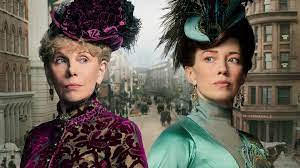
The Gilded Age (HBOMax)

For better or worse, I'm a fan of the Downton Abby franchise, so this new series from the same creator, Julian Fellowes, intrigued me. The series takes place in 1880s New York, as new money (such as the railroad robber barons) clashed with old money. Like Downton Abby, the Gilded Age tackles the immense social change that society (and high society) underwent, with all of the families very conscious of social class. 

Though Downton Abbey was more subtle about it, the Gilded Age is soapy and even trashier, but Fellowes nevertheless does a good job of swiftly engaging the audience and investing you in the characters. In this era of limited series, some shows sometimes take awhile to pick up steam, but Fellowes covers a lot of ground in just the first two episodes that were available when I began watching and drew me in nearly immediately. As times, the characters' dialogue and self-awareness are usually a too on point, but the show skillfully keeps you engaged nonetheless.

No Time to Die

I have to say, I haven’t been as enamored of the Daniel Craig Bond films as others. While I understand it wouldn't be desirable nor likely possible to recapture the Connery Bond era—the gold standard of the series—I feel the lightness, charm and panache of those films have disappeared. I'm glad that Bond remains a viable juggernaut, but nevertheless it is simply another action franchise (that, frankly, I feel has been matched if not surpassed by the Mission: Impossible films, which I feel have gotten better with each successive movie.) 

That said, without giving anything away, No Time to Die serves as a fitting end and capstone to Craig's enormously successful run as Bond. I look forward to seeing the series being refreshed and, perhaps, reinvented once again with a new Bond. 

Taking Paris: The Epic Battle for the City of Lights by Martin Dugard

Taking Paris is an easy and breezy read of the taking, occupation and recapture of Paris during World War II. Like a thriller, the story is filled with good guys and bad, the latter of which are particularly repugnant when one thinks of the death and destruction some left in their wake, especially when betraying people who trusted them. Worse, many of them didn't receive the kind of punishment they deserved. 

The book, though, goes beyond Paris, but also to the soul of France itself, best embodied during the war by the somewhat remote Charles DeGaulle, who became the de facto leader of free France despite the best efforts of President Roosevelt. It's well told.