Pages

Tuesday, September 9, 2008

Issue 11 Now Available!

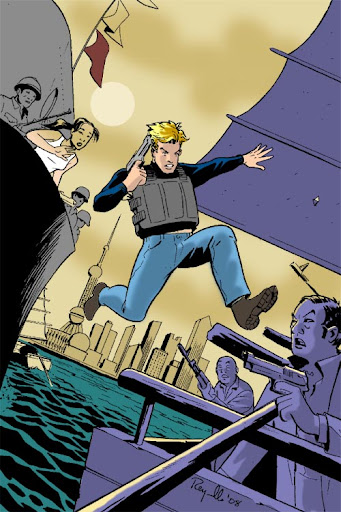
Rob Hanes Adventures #11 is now available. For an advance preview, click here

In “Rob Hanes and the Pirates," when Rob uncovers evidence of a sophisticated counterfeiting ring being run out of a rogue "axis of evil" nation, he is abducted by an old nemesis and imprisoned inside one of the world's most remote regimes.

His only hope for escape resides in an unlikely alliance with a kidnapped Asian starlet, a disgruntled military officer, and an American defector from the Cold War era!

Saturday, September 6, 2008

A LOOK BACK: American Flagg!

I was attending UCLA in 1983 when American Flagg! debuted. While I can’t recall specifically what comics I was reading at the time, aside from some early black and white titles that signaled the start of the independent comics movement like Cerebus, Elfquest, and Love and Rockets, there wasn’t much in the mainstream that I can recall particularly inspired me, though I had discovered the direct market just a few years earlier.

Then along came Howard Chaykin’s American Flagg! This year marks its 25th anniversary.

It’s probably the single series which reignited my passion for comics and which showed me that comics like my own that did not solely feature superheroes in tights were a viable alternative in the new direct comics market.

While Chaykin’s aesthetic roots are firmly planted in the pulps and mainstream comics, this certainly was a series that was truly all him, which reflected his own sensibilities and views. Flagg featured a strong author’s point of view, and featured a unique blend of science fiction, satire, and mature themes. Chaykin created a rich setting environment for his near-apocalyptic tale of consumerism and the corporate state run amuck. (It also should be noted that Chaykin also considered Flagg to be a comedy.)

Of course, like all great comics, while the concept and story were outstanding, the art brought it to a whole new level. With Flagg, Chaykin’s strong sense of design came to the forefront, punctuated by his effective use of Duoshade.

Flagg was a comic-book series that I eagerly anticipated each month, and one for a long time I continually pored over for both study and inspiration.

Though the series continued for several more years after the first 12-issue story arc, Chaykin—never one to linger and always with his eye on the next project—eventually lost interest in the series and at different times during its history turned it over to other artists and writers. For the most part, my interest gradually cooled in the series as well. Nevertheless, in its first few years, Flagg completely reinvented the form for me showing how much more could be done in monthly comic-book format. Flagg still brings back terrific memories of my college days and of an exciting and inspiring time to be part of comics.

Wednesday, September 3, 2008

Taking the Good with the Bad

Late last month, a review was posted of Rob Hanes Adventures #11 at the Newsarama website that, for the most part, can be probably best described as "negative."

I put "negative" in quotes because the reviewer does say some positive things as well—namely, that RHA is a title he enjoys and looks forward to. Being the optimist I am, I'm always heartened whenever someone mentions to being already familiar with the series. This just happened to be an issue he found fell short of what his usual expectations.

Like many artists, I tend to be my own worst critic, so such reviews usually are not too difficult to take, especially when the comments are constructive, and given in the spirit of serious and professional criticism. In such cases, I always respect the reviewer's opinions and can acknowledge well made points. Obviously, if you put your work out there, you have to take the good with the bad. For the most part, reviewers respect the series and my goal with it to recapture the feel of the classic adventure strips in the modern day. Getting serious consideration and study is always better than receiving no regard at all.

In retrospect, I'm not sure I completely agree with the review's assertion that Rob acts recklessly/stupidly in the issue—part of the series' conceit, after all, is that he is a high-spirited newbie—but by the same token Rob does tend to conduct himself in a fairly competent manner, so I can see his point. As I mention at a comment I left at the site, the best I can do is try harder and hope the next issue is more to his liking!

In any case, under the heading of "any publicity is good publicity," I'm posting this link to the review....

Friday, August 22, 2008

Spaced


One of my favorite films in recent years is Hot Fuzz, directed by Edgar Wright and starring Simon Pegg and Nick Frost, who also were involved with another cult-favorite effort, Shaun of the Dead. Though I knew Hot Fuzz was a parody of high-octane Hollywood buddy cop films, because of my preconception of it as an English movie (and mind you, foreign movies are a fairly regular staple of my movie-going diet), I was nevertheless completely taken by surprise by how slick and sophisticated a production it was, as well as funny. Discovering brilliant gems like this is what makes movie-going so worthwhile.

Just released in a deluxe DVD package is the BBC television series Spaced, an early project on which Wright, Pegg and Frost first worked together. The series played for two seasons, for a total of 14 episodes, in 1999 and 2001, and was the brainchild of Wright, Pegg and fellow actor Jessica Hynes, who also stars in the show.

Pegg and Hymes play Tim and Daisy, two slacker types who meet in the first episode after each having just ended their respective relationships. Tim is a struggling comic-book artist and Daisy is a wannabe writer/journalist. In need of fresh starts, they find an affordable flat to rent together as roommates but only can do so by posing as couple. The core cast of characters—eccentrics all, in the best English tradition—includes their heavy-drinking divorcee landlady, Marsha; Mike, Tim’s best friend from childhood, who is obsessed with guns and playing army (played by Frost in his very first acting job); Twist, Daisy’s best friend, a fashion plate; and Brian, the tortured artist who rents another flat in the house.

The show is heavy on pop culture references and incredibly self-referential, containing homages and references as varied as the Star Wars films, the Shining (and all matter of horror films), the Matrix, Grease, One Flew Over the Cuckoo’s Nest, the A-Team, and the films of John Woo. Along with its hilarious quick cuts, fantasy sequences and flashbacks, you can clearly see the beginnings of the style that would evolve into Hot Fuzz. While much of the comedy are in the characters themselves, what also distinguishes the show's work is the way it uses the conventions of genre films and direct visual homages of pop culture to heighten and punctuate the humor. Much like a DVD Easter egg, these pop culture references add another layer of subtext and hilarity to the show.

Like Hot Fuzz though, the show’s comedy and heightened reality never predominate the show or the characters: the filmmakers and the actors clearly worked to create recognizable people and situations that audiences genuinely care about. Taking advantage of the truncated British television season format, the series creates a genuinely heartfelt story and character arc within the two 7-episode seasons—much of the tension of the show is built around the complex relationship between Tim and Daisy, and the question of whether or not their relationship will go to the next level. It’s a remarkably well-done balancing act the way that the show can simultaneously feel emotionally grounded yet veer into near-surreal moments as well.

The bottom line, however, is that the show is laugh-aloud funny, and flies its geek flag proudly.


Friday, August 15, 2008

See This

UPDATE: My family and I saw this show on Saturday, August 23, and had a grand ol' time—we even spotted Actor's Gang director Tim Robbins was spotted after the show!

When I attended UCLA in the early '80s, there was a real confluence of talent in the theatre arts program. Since then many of the actors who I saw in theatre productions there have found varying level success in Hollywood. These include performers like screenwriter/director Shane Black (creator of the Lethal Weapon movie franchise), charactor actor Lee Arenberg, and actor Jack Black. Given this deep pool of talent, I developed a real appreciation for live theatre when I was at UCLA.

Also among this group was actor/director/producer Tim Robbins who, after UCLA, went on to found the Actor's Gang theatre group, many of whose productions I have seen over the years. Several years ago, the group moved to a new facility local to me in Culver City, so it's been a treat to rediscover them. (Recent productions I've seen are "Gulliver's Travels" and "Klub," the latter of which I saw when it was originally mounted back in 1992.) I've been impressed by how active they are in the local community, particularly in reaching out to youth through shows and acting campus.

One of their regular activities in this area has been free summer productions they mount for families and children. I saw last year's production, "Titus the Clownicus," a comedic adaptation of one of the bloodiest of Shakespeare's blood plays, "Titus Andronicus." It was hilarious, and like most Actor's Gang productions, edgy, with plenty of layers of comedy to entertain both children and adults.

This year's production is "King O'Leary," an adaptation of "King Lear," set during the days of California's Gold Rush. The show runs Saturdays and Sundays at 11 a.m., August 9 – 31, on the front lawn of the Actor's Gang home at the historic Ivy Substation in Culver City. (The address and directions can be found here.)

Below is a promotional video from last year's "Titus the Clownicus."

Sunday, August 10, 2008

The Prince Valiant Page

As a fan of classic comics, I’m very familiar with Hal Foster’s Prince Valiant and Foster’s enormous talent as an illustrator and his attention to detail. However, I never read the strip much—it wasn’t carried by any newspapers I read and I’ve never made an effort to pick up any of the reprints because of my focus on other strips.

A book I was interested in seeking out at the San Diego Comic-Con was Alex Raymond: His Life And Art, about the Flash Gordon and Rip Kirby artist. While seeking it out at the Bud Plant booth at San Diego, however, I came across the Prince Valiant Page by Gary Gianni, the current artist on the strip. (Gianni is only the third artist to work on the series: Foster created the strip in 1937, passed it on to his personally-chosen successor, John Cullen Murphy, in 1971, who then passed it on to Gianni in 2004. Xenozoic Tales creator Mark Schultz currently writes the script.)

While I was completely unaware that another artist had succeeded Murphy (himself a well respected comic strip artist), the samples of Gianni’s work in the book impressed me enough that I ended up picking it up instead of the Raymond book.

The Prince Valiant Page is a wonderful book. In a very simple and straightforward matter, the modest Gianni talks about the challenges and process involved in working on a syndicated strip, particularly one that requires as much work as Valiant. It’s clear he honored and appreciated the work that came before him, but he also has tried to make the strip his own. I was especially impressed by how candidly Gianni speaks candidly about his use of models, as well as reference material and “swipes.”

Perhaps because I found the book so compelling I was surprised how quickly I read it—but there are plenty of wonderful examples of Gianni’s work (roughs, original art, printed pieces, etc.) to pore over. This is a great book for any fan of Valiant or illustration in general, and certainly for aspiring artists.

Thursday, August 7, 2008

The Dark Knight: Cure or Symptom?


Until recently, beginning with the original Superman starring Christopher Reeve, and continuing through the Spider-Man franchise and this summer’s Iron Man and Hulk movies, superhero film adaptations focused on serving up to audiences—and comic-book fans— faithful live-action recreations of their favorite comic-book characters. The franchises and their concepts usually drove these films, and getting it “right” was the primary goal. After several mis-fires and re-boots (reaching a new nadir with the ‘90s series of Batman films), Hollywood has finally shown it has both the technology and respect for the material to make superhero adaptations that are entertaining and faithful to the source material.

The Dark Knight takes this natural progression to a new level. Moreso than any with previous superhero film adaptation, in the Dark Knight, director and co-writer Christopher takes his audience to a new place by taking an existing superhero character to explore complex themes and ideas that go beyond the franchise.

Though Nolan has been rather oblique about the message of the Dark Knight (he has acknowledged it can partly be seen as a commentary on the blowback the U.S. has experienced in recent years due to its foreign policy escapades), one of the issues the film addresses—which the characters in the film explicitly raise themselves—is whether the Batman (Christian Bale) is a cure or a symptom.

While the Batman’s intentions to serve as his city’s guardian are honorable, in the film his presence and methods seemingly make things worse by ratcheting up the violence, inspiring copycats who get in the line of fire, and attracting new levels of villainy, as embodied by the Joker. As a result there are plenty of casualties in the film, many of them innocent victims. And at various points, the Batman’s faithful lieutenants—his valet Alfred (Michael Caine) and his technology guru Lucious Fox (Morgan Freeman)—openly question the Batman’s tactics and whether he may be partly to blame for what has occurred.

Without giving too much away, regardless of whether he’s to blame or not, or indeed making a different (the film ultimately doesn’t answer this question), it’s telling that, at the end of the film, the Batman literally and symbolically assumes full responsibility for what has transpired. And like the archetypal Western, after having cleanses the city, he leaves town a hunted man, alone.


Like Batman Begins, this re-boot’s first installment, the Batman and his story arc are central to the Dark Knight. And although the secondary cast and, particularly, the villains are strong and colorful, unlike the previous Batman series, they never threaten to overshadow the film, and they always serve to advance the film’s main story and central themes.

Heath Ledger’s performance as the Joker has justifiably received universal acclaim (and is nicely analyzed here), so there’s no need for me to add to to the praise. But it needs to be noted that Ledger (and Nolan) have done an extraordinary job in successfully re-imagining such an iconic figure. The Joker in this film is faithful to the very chilling first appearances of the character in the 1930s and his more recent re-inventions in graphic novels like Alan Moore and Brian Bolland’s “The Killing Joke,” while also being completely new and fresh. It will be interesting to see how Ledger’s interpretation filters down to the comic book series.

Morgan Freeman, Michael Caine, Gary Oldman (Jim Gordon), and especially Maggie Gyllenhall (Rachel Dawes) and Aaron Eckhard (Harvey Dent/Two Face) all are given meaty roles even if they have limited screentime. And one should not overlook the fine performance of Christian Bale in the lead role, who inhabits the character with great respect, conviction and vulnerability.


It’s probably too early to call the Dark Knight the “best comic book movie ever”—certainly not with Watchmen on the horizon in 2009— but it’s among the most ambitious, mature and sophisticated. Plus, the increasing sophistication and varied textures of superhero films—ranging from summer popcorn flicks like the Spider-Man films and Iron Man to now darker fare like Dark Knight and Watchmen—doesn’t easily lend itself anymore to judging these movies with the same broad measure. Regardless, with the Dark Knight’s complex storyline and multiple rich character arcs, and the reviews that have acknowledged the film’s ambition, the superhero film has truly grown up.


One final comment: I had the fortune to see it in Imax format. Six scenes were filmed in the oversize, crystal-clear Imax filmstock. When the Imax sequences initiate, the film takes up the entire Imax screen, then reverts back afterwards. It is quite impressive, without being distracting or taking you out of the movie.