The issue opens in the waning days of World War II as U.S. soldiers come across retreating Nazis seeking to hide a trove of gold reserves—then flashes forward to the present day as Justice International investigator Rob Hanes picks up the trail of an extremist paramilitary group that is trying to find the still-missing gold to fund its terror operations.
Past and present fuse as Rob discovers his own personal connection to the wartime incident and races against time to uncover the final resting place of the treasure before the extremists do!
Back Issues Still Available
As always all back issues also remain available, including all single issues and trade paperbacks that collect the earliest runs of the series as well as issues 1–4 and 5–8 to date. Visit WCG Comics website for details.
* * * * *
Below: Cover art and sample interior pages (art only, sans speech balloons or other text).
Though the Tokyo Olympics has been top of the news these past two weeks, it only just hit me that a personal favorite film of mine, Walk, Don’t Run, used the 1964 Tokyo Olympics as its backdrop.Starring Cary Grant, and co-starring Timothy Hutton and Samantha Eggar, I stumbled across this film on broadcast tv back in college and found it to be a charming romantic comedy; I’ve seen it many times and am always up to watch it when the opportunity arises.
Grant pays a business executive visiting Tokyo who, unable to find any lodgings due to the Games, convinces a reluctant young worker at the British embassy (Eggar) to sublet a room in her apartment to him. After meeting an athlete from the U.S. Olympics team (Hutton) in a similar predicament, he in turn sublets half of his room to the young man, to the dismay of Eggar’s character who is engaged and worried about the propriety of rooming with two men. Of course, the two young people initially don’t get on, but Grant ends up playing a sly and sneaky matchmaker to the couple. (If the plot sounds familiar, I only just discovered it’s a re-make of the film, The More the Merrier—I’m aware of this earlier film but have never seen it in its entirety, which I plan to correct.) A running gag is Hutton’s reluctance to tell anyone his sport.
The movie is partly noteworthy for being Grant’s last, believing that audiences didn’t want to see him, at age 61, not playing a romantic lead or as a third wheel in a supporting role—which is a shame because Grant’s performance is charming and effortless.
Much of the movie was filmed on location—it highlights Japan’s progress since the war just 20 years prior and makes a brief reference to the country’s fledgling electronics industry. Over the course of its story, the film takes advantage of its setting, serving as a travelogue for the country, offering glimpses into everyday life and Tokyo’s growing reputation as a cosmopolitan city. And as you’ll see in one of the stills accompanying this post, Star Trek actor George Takei has a small role!
As I learned on Wikipedia, the ‘64 Olympics was the first time the Games were held in Asia—Tokyo was initially slated to host in 1940 (following Nazi Germany hosting in 1936!), but its invasion and occupation of China resulted in the games being moved to Helsinki, Finland that year. The ‘64 games were also moved to October to avoid the punishing summer heat and humidity and typhoon season.
In any case, given the Tokyo Olympics winding down this week, this seemed a perfect time to highlight this delightful film!
Inkpot Award Winner releases new issue for Comic-Con@Home 2021
Available at the WCG Comics virtual booth at the Comic-Con@Home edition of the 2021 San Diego Comic-Con: the newest issue of Rob Hanes Adventures, free downloadable comics and previews, trade paperbacks, all back issues, and other merchandise. For additional information, contact Randy Reynaldo at WCG Comics. See below for additional images for promotional use. Reynaldo is a 2018 San Diego Comic-Con Inkpot Award recipient.
NEWS RELEASE – For Immediate Release
Cartoonist Randy Reynaldo and his publishing imprint, WCG Comics, has been a mainstay exhibitor at the San Diego Comic-Con for more than 25 years, and continues that tradition as a virtual exhibitor at this year’s Comic-Con@Home. And no badges needed for one of the biggest and well known comic-book and pop culture conventions in the world!
Rob Hanes Adventures #22 will be available for preview and pre-order this year at WCG Comics' virtual booth at Comic-Con@Home, scheduled July 23–25. The issue opens in the waning days of World War II as U.S. soldiers come across retreating Nazis seeking to hide a trove of gold reserves—then flashes forward to the present day as Justice International investigator Rob Hanes picks up the trail of an extremist paramilitary group that is trying to find the still-missing gold to fund its terror operations. Past and present fuse as Rob discovers his own personal connection to the wartime incident, but will he be able to uncover the final resting place of the treasure before the extremists do? The issue is anticipated to be available in August.
Also available will be all back issues, including trade paperbacks, single issues, downloadable previews, merchandise, and even a FREE downloadable comic-book issue in its entirety for readers to sample the series!
Trade paperbacks collecting the early runs of the series, and two volumes collecting issues 1–4 and 5–8 at special reduced prices!
Selected packages to purchase the entire run of Rob Hanes Adventures or the run along with the trade paperback collections of additional material not appearing in the main series.
And, of course, all back issues, such as the popular and perennial “Death at Comicon” murder mystery!
All orders will receive our usual freebies like bookmarks, pins, and a free back issue!
With Comic-Con open to all this year, now is the time to experience the exhibition hall and panels for the first time and in an all new way!
About the Series
Rob Hanes Adventures is an all-ages light-hearted action-adventure series featuring the exploits of a globetrotting private eye and troubleshooter from Justice International who travels the world on assignment, facing adventure, intrigue and romance at every turn, with occasional dashes of good humor and forays into other genres. Every story is self-contained, making it easy for readers to jump in with any issue.
Launched in 1994, the title is one of the longest-running indie comics series. Readers and fans have praised Rob Hanes Adventures for recapturing the spirit of the classic adventure strip and updating it for a modern-day audience. Inspired by the classic adventure comic strips like Milton Caniff's Terry and the Pirates, Will Eisner's Spirit, and Roy Crane's Buz Sawyer, Randy's graphic black-and-white art has been favorably compared to the work of artists like Alex Toth and the modern-day cartoonists who evoke the same timeless style like Paul Dini and the late Darwyn Cooke.
In 2018, series creator-writer-artist Randy Reynaldo was an invited featured guest at the San Diego Comic-Con, where he was honored with an Inkpot Award for Achievement in Comic Arts.
For more information about the series, previews and to purchase back issues, visit wcgcomics.com. A PDF with excerpt pages from the series is also available
I like to say I’ve been a fan of Mike Nichols since I saw the Graduate, one of my favorite films of all time, but after reading this book, I have to admit I found I was not as fully aware of the breadth of his film efforts and, particularly, his stage work, for which he’s won 9 Tonys (in fact, he’s an EGOT!).
I was already familiar with most of the broad outlines of his biography as a Jewish refugee from Europe, a groundbreaking improv and skit comedian with his comedy team partner-in-crime Elaine May, and a film director. But this book, written by Mark Harris—who also wrote the terrific Pictures at a Revolution and Five Came Back—showed me the full breadth of his work, encompassing pictures he directed that I’ve seen and/or had forgotten, such as Who’s Afraid of Virginia Wolf, Silkwood, and the Birdcage. And there were several I was shocked I had never heard of (or didn’t recall) like Day of the Dolphin, Wolf, and the Fortune!
But it was the breadth of his theater work that was a revelation, ranging from “Barefoot in the Park” and “The Odd Couple” in the 1960s (pairing with Neil Simon on several occasions) to “Spamalot” in 2006.
Of special interest to me, of course, is his cartooning connection—one of the first plays he tackled as a director was by cartoonist Jules Fieffer, who discovered that Nichols and May were fans of his own work (upon seeing them on stage, Feiffer found them to be kindred spirits, doing work similar to his own “but better”). Nichols would later go on to direct the film, Carnal Knowledge, on which he had Feiffer on set for most of the shoot.
As I noted in my review a few years back of Feiffer’s memoir, Backing into Forward, Feiffer (and Nichols) grew up during a fascinating era in the 1950s and ‘60s when artists, entertainers and actors, intellectuals, playwrights, movie directors and, yes, cartoonists like Feiffer seemed to mingle and cross-pollinate. I’m not sure if this was a reflection of the era or particular to the New York City social scene, but Nichols’ friendships with Feiffer and others like Simon, Richard Avedon, Leonard Bernstein, Jackie Kennedy, Gloria Steinem and, as he transitioned to Hollywood, Richard Burton and Elizabeth Taylor (first befriending the former along with Julie Andrews when his show with Elaine May was at the Broadway theater next door to where Camelot played), Jack Nicholson, Warren Beatty, Whoopi Goldberg and more demonstrate his wide circle of connections that span decades.
While for some reason I thought Nichols to be a genial sort, like a lot of gifted artists, his personal life and demons belie that. Born to an unloving mother, prone to depression and (most surprising) addicted to coke and crack at various times in his life, he could be cruel to actors and crew on set. Like many immigrants and performers, he also was someone who reinvented himself – a Russian-Jewish immigrant by way of Germany with the birth name of Igor Mikhail Peschkowsky, he escaped Germany before the Holocaust. As he faced his demons as he got older—internalizing his guilt as a Jew who escaped Europe before the Holocaust—Nichols found a measure of peace. This was due in large part to his happy marriage to television broadcaster Diane Sawyer, who generously worked to ensure he maintained a healthy relationship with his previous wife and children. I found the book to be a compelling read about a comedian and director who had a huge impact on both the film industry and stage, and the book offers fascinating glimpses into the art that went into this work, with plenty of great anecdotes about the great figures (and their eccentricities) of the time.
Some Nichols and May, in one of their most famous sketches:
Justice League: The Snyder Cut
Director Zack Snyder is a divisive figure among movie and comics fans. While I was incredibly impressed by his film adaptation of Watchmen, like many, I’ve been put off by his incredibly dark approach to the DC Comics film universe as reflected by Man of Steel and Batman v. Superman: Dawn of Justice, a tone that has permeated many of DC’s other films. While it’s perhaps not fair to compare Marvel’s films to DC’s/Warner Brothers, Marvel has admirably built a franchise brand that exists as an interconnected and cohesive movie universe where the films share a common DNA yet still allow for a wide range of variety and expression, ranging from period pieces like Captain America: First Avenger, to political thrillers with Captain America: The Winter Soldier, to near-comedies like Thor: Ragnarok and Ant-Man. It’s a world-building approach they are now expanding into their DisneyPlus streaming shows, such as WandaVision and Falcon and Winter Soldier. Ultimately, most of the Marvel films have a sense of fun and are great popcorn movies. Their success also is the result in the complete conviction and faith in the strength of their intellectual properties.
While DC’s characters are just as rich, without the single guiding hand of someone like Kevin Feige, DC has never shown the same conviction and belief in their characters and universe as Marvel did at the very outset. A case in hand is the fate of Justice League. After Snyder and his producer-wife left the project following the tragic suicide of his daughter, Warner Brothers Studio hired Joss Whedon, who played an early role in Marvel’s success, having directed the Avengers and Avengers 2, to complete the film. As it was eventually revealed, Whedon significantly revised and simplified Snyder’s script and vision, and it may have been partly the result of Warner Brothers getting cold feet (again) over the density of the mythology.
I won’t say that I disliked Whedon’s Justice League as some fans, but neither did it make much of an impression on me nor was I among those clamoring for the “Snyder Cut.” That said, now having seen it, I must agree it’s a somewhat better movie — while I’m still not convinced that Snyder’s dark somewhat joyless approach to the characters is the way to go, at least this film reflects his singular vision and it’s better for it. Not only did he get a mulligan to improve the CGI design and character arc for the film’s original villain, Steppenwolf, but he gives him a richer back story and motivation (as opposed to simply wishing to take over the world); in fact, in this version, he is actually a low-level toady to an even bigger villain, Darkseid, that expands the DC film Universe further.
The film’s plot is also slightly re-jiggered, with Cyborg playing a more central role to the plot and having a clear character arc, which Whedon completely wrote this out of his version. We also see a little bit more of Superman and more of an origin background for Flash.
Of course to accomplish this, Snyder also made it a longer movie with a running length of 4 hours. For the most part though, the movie moves along, notwithstanding the excessive use of slow-mo.
But at least the Snyder Cut is finally out there for the world to see. While it doesn’t appear that Warner Brothers has any plans to continue the path that Snyder began with this movie – and tries to tease with epilogue scenes — at least his vision has been realized.
The Dig, which recently dropped on Netflix, is yet another quality period drama from the U.K., that the country does so well, featuring a cast of reliable and versatile British actors who move fluidly between period films like this and other film projects and genres: Ralph Fiennes, Carey Mulligan and Lily James.
Set in the back country of Great Britain on the eve of World War II, a self-taught but erudite archeologist named Basil Brown (Fiennes) is hired by a wealthy widow, Edith Pretty (Mulligan), to excavate some ancient mounds on her private property that she believes have historical significance. This leads to the discovery of a preserved ancient ship, believed to be the burial place of an Anglo-Saxon nobleman. As the significance of the discovery becomes clear, however, the British Museum moves in, initially pushing Brown aside.
This is just the backdrop, however, as the film also focuses on the people brought together by the discovery: Brown, the loner archeologist whose wife understands and supports his devotion to his work; Pretty, the lonely young widow who comes to respect and be attracted to Brown on some level, both because of their shared interest in archeology and history, but also because of the way he quickly becomes a father figure to her precocious son; and Peggy Piggott (James), with her husband (Ben Chaplin) on her first dig, who seems unavailable to her emotionally (not to mention sexually), and soon finds herself attracted to Pretty’s cousin, who is about to join the RAF as war looms.
Generally lowkey, in keeping with the famous British reserve, it is nevertheless a compelling film because it works on several levels and gently goes in directions you don’t expect, with many of the characters and their inner stories deftly told. There is an inherent loneliness to many of the characters, but they find ways to connect and find grace (and, in some cases, love), all connected by the central tale of the discovery. The "dig" is as much a metaphor for what the excavation brings out in the characters.
It wasn’t until after I watched the film that I learned the Dig is, in fact, based on a real-life story, regarding the discovery of what is known as the Sutton Hoo collection, now housed at the British Museum, which is one of the U.K.’s greatest archeological discoveries. Brown, Pretty and Piggot are all real-life figures and while of course the film no doubt took creative liberties to give the characters an inner life and to serve the purposes of the story, the basic outlines of their lives are here intact.
As I said, it’s a quiet film, but it sneaks up on you and I found it’s stuck with me since I viewed it. Highly recommended.
Newsradio
It’s a crime that this sitcom—which ran from 1994–99 on NBC—is not better known or currently available in its entirety for bingeing on a streaming channel (I came across the first season on IMDB TV and ended up purchasing later seasons for streaming).
A workplace comedy about a group of misfits who work at a news radio station, it featured an ensemble cast of both experienced and upcoming actors, each playing to a tee well-defined eccentric characters that together made for a hilarious show that combined sharp witty writing with some physical humor. Headed by Dave Foley (from Kids in the Hall) as the station’s general manager who arrives in the first episode, the cast also includes Stephen Root (as the station owner), Andy Dick, Maura Tierney, Vicki Lewis, Joe Rogan, and Khandi Alexander. Last but not least, anchoring the show was the great Phil Hartman, known as “The Glue” when he was on Saturday Night Live for his gift of holding the show together, a role he also undoubtedly played on Newsradio.
While the show ran a respectable 97 episodes and 5 seasons, and received critical attention, it nevertheless always existed on the cusp of cancellation, which was not helped by the network moving its time slot 11 times. Tragically, shortly after the show had received another reprieve and was renewed for its fifth season, Hartman was shot and murdered by his wife while he slept in his bed; addled by a mixture of antidepressants, alcohol and cocaine, after realizing what she had done, she turned the gun on herself a few hours later. Though the show continued its fifth season—with Hartman’s friend and SNL co-star Jon Lovitz taking his place—Newsradio was not the same show and it was cancelled after that season.
Nevertheless, the show remains solidly funny and timeless, occasionally veering into the slightly surreal, presaging sophisticated comedies to come like Arrested Development, but always grounded by its strong characters and the ensemble chemistry. Well worth a visit!
WandaVision
I have frequently credited Marvel for having faith in the strength of their characters and stories. Whereas rival DC Comics always focused primarily on their trinity of well known characters—Superman, Batman and Wonder Woman—believing that lesser or unknown characters would not attract an audience, Marvel built their movie universe on arguably B-list characters such as Iron Man and Captain America. Yes, Spider-Man and the Hulk eventually came into the fold, but they then continued their run with Thor, as well as characters with even lower profiles like Doctor Strange and Ant-Man, culminating with the Avenger films.
As a result, Marvel finds itself in the enviable position of having built a brand and level of trust that audiences will pretty much follow wherever the company takes them.
The Disney Plus streaming show, WandaVision, is a case in point. While audiences weren’t sure what to make of the first few episodes, which were basically homages to old TV shows like the Dick Van Dyke Show, Bewitched and the Brady Bunch (down to the opening credits and sets), Marvel patiently let the show play out before suddenly “opening up” the series and rewarding viewers by connecting it to the wider Marvel universe, bringing in minor characters previously introduced in earlier Marvel films like Thor and Ant-Man, and the more recent Captain Marvel. It’s said that WandaVision represents the start of the next phase of the Marvel universe (following Avengers: Endgame), so it’s exciting to see how the TV shows and films will begin to intertwine and further advance and enrich the world they’ve created.
When I was a kid, in the days before DVRs and even VCRs, the 1965 screwball sex comedy, How to Murder Your Wife, would occasionally pop up on local broadcast TV. (Of course, this was also before cable and streaming.) Though I saw many classic films on TV growing up, How to Murder Your Wife was one I never managed to catch in its entirety. However, when I noticed the film become available on Amazon Prime recently, I added it to my queue and finally watched it.
The primary reason for my curiosity in this film is that it's about a successful cartoonist named Stanley Ford, played by the great Jack Lemmon, whose profession and comic strip in the film (an action-adventure secret agent series called Bash Brannigan) are integral to the story. The film was directed by journeyman director Richard Quine and written by screenwriter George Axelrod.
In addition to being a cartoonist man-about-town, Ford is a confirmed bachelor who keeps a man servant in residence named Charles (the great character actor Terry Thomas) and lives in a pretty cool upscale multi-level bachelor pad studio in Manhattan. The film is racy for it’s time and it’s why I call it a “sex comedy”—Ford is pretty successful with the ladies and Charles, rather creepily, revels in his employer’s romantic escapades. (I’m glad now I never caught this film when I was young or it would have given me very skewed expectations of life as a cartoonist!)
The film opens cleverly with Ford in the middle of an exotic adventure with foreign-looking villains (one of whom is reminiscent of Odd Job from Goldfinger from the year before) that takes you through the streets and docks of Manhattan, as his man servant takes photos—it turns out these are reference photos for the comic strip. (While I’m pretty sure most cartoonists didn’t go to this extent to achieve verisimilitude, Ford notes later in the film that this is what makes his strip so popular—readers knew Bash wouldn't do anything he hasn't done himself. It's a conceit that becomes important later in the film.)
One morning, after a night of revelry at a bachelor party where a sexy, beautiful blonde pops out of a cake, Ford wakes up in bed with the girl, discovering that, in his alcoholic daze, he had married her the night before—and not only that, she’s Italian and speaks little English! For Ford, this is a tragedy of epic proportions—his man servant Charles even has a premonition about it at home when it happens. He immediately tenders his resignation, reminding Ford that when he took the job, he made it clear he only worked for bachelors.
Of course, wackiness ensues. While Ford seems to settle into the highs and lows of married life—the sex is great and she’s a great cook, keeps house, and takes care of him, she also keeps him up all night watching TV (to improve her English), has re-decorated his bachelor pad, and put a crimp in his carefree routine. As a result of his new domesticity, his comic strip turns into a gag strip about married life called The Brannigans.
Dismayed by what his life has turned into, he is driven to plot his wife's murder without getting caught—but, of course, only in the strip, so that he can return his character Bash back to his bachelor roots and secret agent life. And, in keeping with his commitment to realism, Ford carries out part of his plan in real life (short of actually dispatching his wife, of course). However, when his wife disappears around the same time the strip’s explicit portrayal of the murder appears in newspapers, Ford is suspected of foul play and arrested.
I’ll leave it at that so as not to spoil the rest of the film, but this is where I offer the caveat that the film, of course, is “of it’s time”—an era that popularized the trope that husbands and the American male are hen-pecked and women only want to marry so that they can spend their spouse's money shopping.
Adding to the films' chauvinism is the fact that the wife—played by Italian actress Virna Lisi in her U.S. film debut—doesn’t even have a name, identified only as “Mrs. Ford” in the credits. Without giving anything away, even the film’s “climax” is pretty egregious in this regard—yes, of course, it’s all played for laughs but it is undeniably politically incorrect and incredibly misogynistic given our more enlightened times (and I mean that genuinely without any intended irony or tongue in cheek—though it must be said that my wife mentioned to me that she loved this film growing up). The saving grace is the film’s final message when balance is restored—that love (and married life) does, indeed, conquer all.
That said, I've always enjoyed these 1960s' breezy PG "sex comedies" when I was a kid, such as Goodbye Charlie and Sex and the Single Girl (which Quine also directed, along with another personal favorite film of mine from the period, Paris When It Sizzles). The actors are great and the film looks terrific—Lemmon, of course, is always Lemmon and he engages in quite a bit of physical comedy that is impressive and considerable even for him.
As for the actress Virna Lisi, while she doesn’t really have much to work with, she is nevertheless charming because her character is genuinely sweet and truly in love with her husband (he comes to realize that he is deeply in love with her as well).
And while, of course, not intended to be an accurate portrayal of cartoonists and comics, I nevertheless enjoyed the representation of the profession. You get to see him at the drawing board and inking. It should be added that the strips in the movie are terrific, done by professional cartoonist Mel Keefer, an experienced newspaper comic strip artist on titles like Perry Mason and Rick O'Shay.
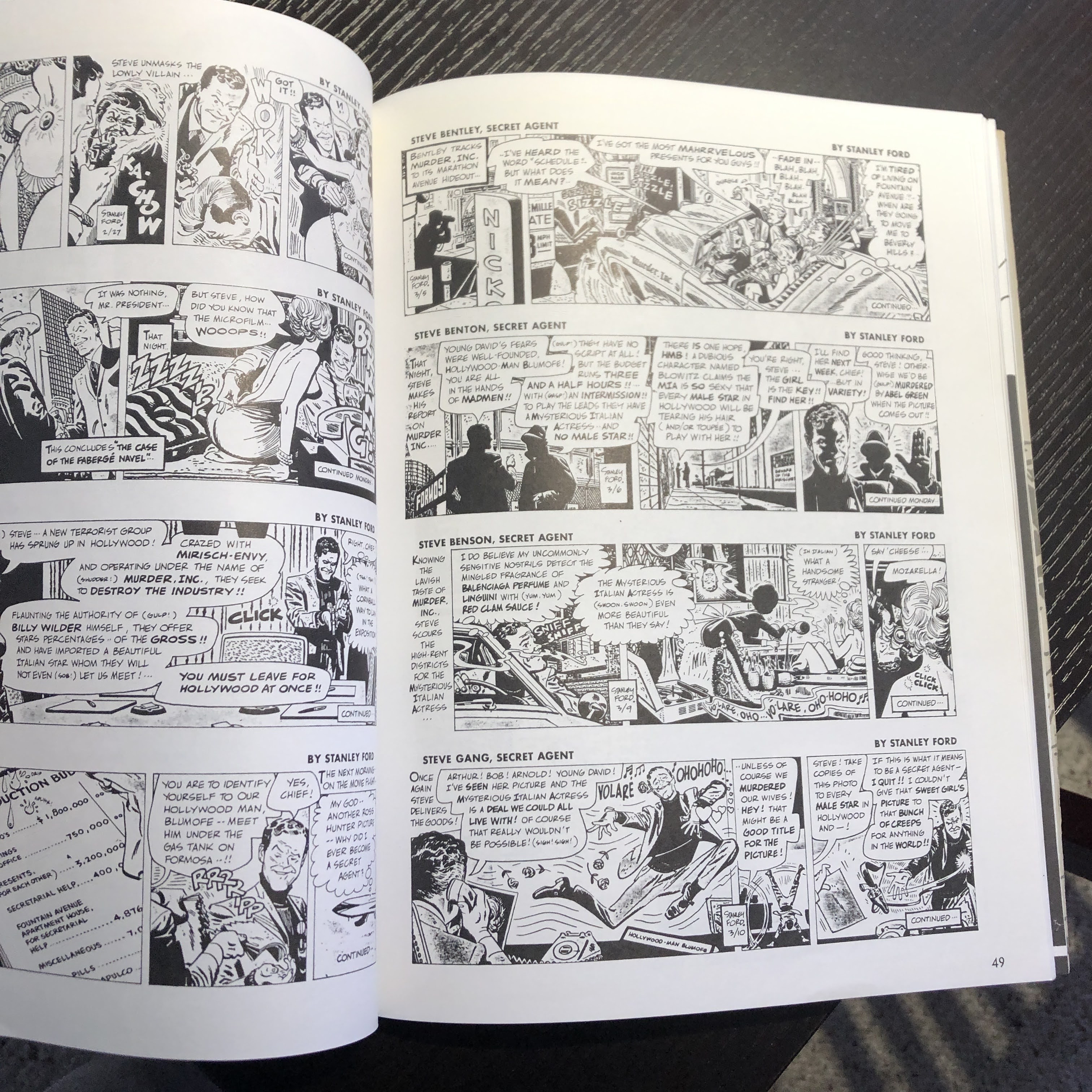
I also discovered years later that one of my favorite cartoonists of all time—the great Alex Toth— did a series of teaser strips to promote the series in the Hollywood Reporter (signed “Stanley Ford,” natch) and include samples of that work below!
After making my views known on this blog leading up to the election and immediately after —when the results had been all but settled despite Donald Trump’s baseless claims and relentless attempts to overturn the results—I thought I was done discussing politics for awhile. But I realized the inauguration of President Joe Biden and Vice President Kamala Harris required some final words to close the book on the Trumpster and an opportunity to end on a high note.
First, leave it to Donald Trump to not simply end on as ungracious note as possible as the biggest sore loser in history, but to actually make things worse every step of the way, turning the end of his presidency and the country into a dumpster fire as he left office—and impeached for incitement to riot and nearly sedition. His actions included his attempts to pre-emptively declare victory on election night; pursuing more than 60 frivolous court claims that were just about laughed out of courts (including the Supreme Court), even by judges he had appointed; the hiring of the ridiculously incompetent Sidney Powell and Rudy Guiliani (he of Four Seasons Landscaping fame); pressuring state election officials to unilaterally overturn voting results through a combination of begging and veiled (empty) threats, perhaps in violation of election laws; and demanding that his party and own vice president not certify the results despite it being Constitutionally mandated; and having it spectacularly all blow up in his face by playing a huge role in inciting a riot at the U.S. Capitol on January 6 that, while completely incompetent, nevertheless led to five deaths and a failed coup attempt.
While I’m sorry for the loss of life, the terror rained down on law enforcement and legislators, and the threat posed to what we have discovered is a fragile democracy, these acts of insurrection at the close of a disastrous, tumultuous and lawless term finally completely laid bare Donald Trump’s narcissistic malevolence for all the world to see, adding a perfectly appropriate malignant exclamation mark at the end of a presidency that will surely go down as the worst in U.S. history.
I give Biden full credit during this time for not engaging with Trump and staying high above the fray. While many people (myself included) understandably grew progressively angrier in righteous indignation at every turn, Biden quietly, competently and professionally went about his work, occasionally coming forward to reassure the country, particularly after the Capitol riots (and well before Trump did). During the transition, Biden acted with grace—while allowing Trump to slowly and self-torturously hang himself by the neck—and, dare I say it, presidentially. Finally, a grown up.
The inauguration perfectly captured Biden and Harris’s goals to restore dignity and respect to the White House and the country, as well as unity and a return to truth. I already greatly enjoy the tradition, symbolism, pomp and circumstance of events like presidential inaugurations, but even without cheering crowds, I was glad to still find the inauguration of President Joe Biden a moving and uplifting experience. It was note-perfect and restorative, from Biden’s reassuring and heartfelt inaugural address, Lady Gaga’s soaring rendition of the Star Spangled Banner and, of course, Amanda Gorman’s thrilling recitation of “The Hill We Climb.” The parade, military review, the presence of former presidents from either side of the aisle at both the inauguration and, later, Arlington National Cemetery for a laying of the wreath at the Tomb of the Unknown Soldier, were all moving celebrations of America and the peaceful transfer of power. And all of this happened only a few weeks after an attempted insurrection, albeit under the watchful eye of a a strong National Guard and law enforcement presence, but fortunately without any disruption.
I feel badly that Biden did not get to enjoy the trappings of a traditional inauguration, like the balls, but hopefully this is somewhat softened by the fact that Biden has been there before — both as a vice president and as a longtime member of Congress. The televised Celebration of America, hosted by Tom Hanks, nevertheless was a nice coda to the day.
Watching Biden in the leadup to the inauguration and his first few days of office, he actually comes off as one of the most humble and unassuming persons to be president. He has been generous in sharing the stage with Harris, a view I’m sure very much influenced by the unique partnership and friendship he formed serving as vice president under Barack Obama.
Will it be a successful presidency? Time and history will tell, and of course, the new President faces a much divided nation and a rival political party that has yet to reconcile with its own veer into radical extremism and cult of personality. But regardless, I just look forward to a presidency that is “normal,” inasmuch I do not have to be concerned and aggravated every day of the week, trusting that there is a responsible, mature and experienced individual in office who at least pays lip service and attempts to act in the interests of most honest, hard working people, and all Americans, rather than worry about what latest incompetence and self-serving misdeed has been committed in the name of pandering to a literally insane, cultish base that apparently prefers authoritarian rule over respect for our democracy and the Constitution.
As I said, being a glass half full kind of guy, I think we can take some comfort in knowing that, when it counted, our institutions held strong despite a relentless assault on our democracy. The courts and key election officials—including many from the GOP side—resisted the call to corruption and authoritarianism. And as the election both nationwide and, particularly, Georgia, showed, votes count. If people had not been energized and motivated, darkness and evil could have won. But it didn’t.