Pages

Showing posts sorted by relevance for query will eisner. Sort by date Show all posts

Thursday, October 1, 2009

A Look Back: The Post-Spirit Eisner

I've written a few times about the influence of Will Eisner and, particularly, his seminal serio-comic series, the Spirit, on my own work. Earlier this year, DC Comics completed its quarterly 26-volume hardcover compilation of the series' full run from 1940–1952. (The last volume collected the odds and ends of Eisner's intermittent work on the character from its cancellation in 1952 through 2005 shortly before Eisner's death.) In addition to the first volume, I ended up picking nearly the entire collection from about volume 13, when Eisner returned to the series after an intermittent absence from the series due to his Army service during World War II.

After the series ended in 1952, however, Eisner went on to pursue other opportunities. Although he remained a working cartoonist, he left mainstream comics to focus his energies on the American Visuals Corporation, a commercial art company he founded in the 1940s that specialized in educational comics. Operating as an independent contractor, Eisner from 1951 to 1972 produced PS Magazine, a publication for the U.S. Army that promoted preventive maintenance in the field that used a more visually-oriented approach to its subject matter, including comics and cartoons. Created as an outgrowth of the work Eisner did during the war while he was in the service, one of the running characters Eisner created for the magazine was "Joe Dope," who served as an example of what not to do. (The Army supposedly partly ended the magazine after deciding that Dope was no longer the image it wanted to project of its personnel.) During his tenure, Eisner employed the talents of some of the best cartoonists in the business to work on the magazine.

(The entire run of the series has been scanned and may be viewed online here.)

After selling American Visuals, Eisner began focusing on comics. While interest in the Spirit began to revive in the 1960s and '70s through various reprints by Harvey Comics, Kitchen Sink, and Warren Publications—which gave Eisner an opportunity to revisit the character through occasional new stories and cover art and pinups he provided—for the most part Eisner left the Spirit behind and began making good on his belief that comics were capable of serious artistic expression.

The first product of that effort is his collection of short stories, A Contract with God, and other Tenement Stories (1978), considered one of the first modern-day graphic novels. Made up of a series of independent short stories—"A Contract With God", "The Super", "The Street Singer", and "Cookalein"—the book shared the common thread of taking place in the Bronx Jewish tenements of the 1930s. Though not an autobiography, the stories obviously drew on Eisner's background as the child of Jewish immigrants. (In later years, it become clear that the title story, "A Contract with God," reflected Eisner's personal trauma in dealing with the death of his daughter that many people were not aware of until the release of his biography, Will Eisner: A Spirited Life, by Bob Andelman). The stories reflect the kind of social realism that was occasionally apparent in Eisner's 1940s work in the Spirit.

Having just discovered Eisner through the pages of Jules Feiffer's Great Comic Book Heroes, I recall being intrigued by an ad for A Contract with God (1978) and having my parents mail order it for me. It was unlike any "comic-book" I had ever seen, and made quite an impression on me—the book (a first edition by the original small publisher who released it, Baronet Publishing) became quite dog-eared from repeat readings. Adding to the book's period look was the fact that my edition was printed on sepia-toned paper and sepia inks. I recently re-read the stories and was delighted to find they still hold up and powerful today—they are still among his most effective work.

(Many years later, a friend of mine was scheduled to interview Eisner for a magazine piece, so I asked him to bring it along with him for Eisner to sign. When he handed it to Eisner, the artist reportedly said, "Wow, that's an old one!")

Eisner's next project was "Signal from Space," which began being serialized in the Spirit Magazine around 1980, completing its run in its companion magazine Will Eisner Quarterly, both published by Kitchen Sink Press. (It was later colored and collected as a graphic novel under the title, Life on Another Planet.) "Signal from Space" also made quite an impression on me because it was the first time I saw a straight thriller, with strong political overtones, done in comic-book format—in fact, I felt it was very similar to what I was trying to do with my own series. The format inspired me to create my own full-length 128-page Rob Hanes graphic novel thriller, Come Armageddon, done entirely in pencil in a sketchbook!

These projects were soon followed by an incredible amount of activity, which was made possible by the attention Eisner's ambitious work was receiving. This new work, along with the legacy of the Spirit (Eisner was also involved in the very beginnings of the comic-book industry as one of the first "sweat shop" operators), had made Eisner one of the most respected "deans" of cartoonists, partly culminating with the prestigious Reuben Award from the National Cartoonists Society in 1988, and having the Will Eisner Comic Book Industry Awards at the San Diego Comic-Con named for him—an award that, as an active cartoonist, he received several times himself with some embarrassment and modesty.

Eisner remained incredibly productive to his passing in 2005 at the age of 87. While the Spirit remains his most famous legacy, he clearly did not sit on his laurels, and remained interested in mining his personal experiences and interests in his comics. Among my favorite of his post-Spirit works are The Dreamer, a thinly-fictionalized story about his contributions to the beginnings of the comic-book industry leading up to his creation of the Spirit, and To the Heart of the Storm. Always committed to helping comics gain acceptance as an artform, Eisner also produced the groundbreaking and influential Comics and Sequential Art (1985), a treatise about the language of comics storytelling.

The Spirit remains an important touchstone and inspiration for me, but I also wanted to give credit to Eisner's other body of work that also had a great impact on me.

Note: Some of the factual information for this article was drawn from the Wikipedia entry on Will Eisner.

Monday, October 4, 2010

Two Spirited Biographies

A documentary on comics legend Will Eisner, titled Will Eisner: Portrait of a Sequential Artist, is now available. Several years ago at the San Diego Comic-Con, I attended a panel about the project that featured an extended preview of the documentary. The promotional trailer was also being used to raise funding for the project's completion. After making the rounds of the fllm festival circuit this past year—including the Tribeca Film Festival—I recently learned the film is now on DVD and ordered a copy.

Eisner’s biography is now fairly well known, but anyone wishing to gain greater personal insight and personal knowledge about the artist and his work will enjoy this high quality documentary. The film covers all aspects of his personal biography, including his immigrant roots; his founding of what is considered the first comic-book “sweatshop” in the 1930s, which underscored his business acumen even at an early age; his launch of the syndicated Spirit comic-book newspaper insert; his sojourn from the mainstream comics industry to found a company that produced comics for educational (and commercial) purposes; and his return to the industry in the 1970s with the re-discovery of the Spirit and, more importantly, a new phase of his career when he began focusing on “graphic novels,” many of which were autobiographical in nature and explored his Jewish identity. The documentary does a good job of recreating the environment that produced Eisner—it’s been well documented how comics were almost solely the brainchild of Jewish immigrant kids primarily from the ghettos of New York City.

The documentary, of course, also builds on Eisner’s legacy as one of the most innovative comic-book storytellers of his time, and touches a little on the personal tragedy that was not known until after his death that drove his first graphic novel, A Contract With God, which is considered among the first such books of its kind.

What is particularly striking about the film is the amount of home movie material that makes its way into the story, some dating back to the 1940s! The film includes interviews with many of Eisner’s colleagues in the industry, as well as a few nice surprises like Kurt Vonnegut.


The documentary also provides me with an opportunity to mention Eisner’s authorized biography, Will Eisner: A Spirited Life, by Bob Andelman. This book, which I read back in 2005, is among the first (and best) “serious” biographies of a cartoonist—”serious” in the sense that it goes beyond mere fan admiration and relies on extensive research, vetting and interviews (including with the artist and his wife).

Andelman was given unfettered access to Eisner, and spent a few years with the artist as part of his research. The book appeared in the same year as Eisner’s death in 2005. Andelman’s book was the first to contain details about Eisner’s private life—including the loss of his daughter to leukemia—that even many of his closest friends were unaware of, and which drove the titular story in the above-mentioned A Contract With God.

I highly recommend both the documentary and the book.

Monday, June 4, 2012

REVIEWS: Backing into Forward

The increased respect for comics and cartooning has resulted in a number of serious, in-depth biographies in recent years. I’ve previously reviewed several of them, focusing on Milton Caniff, Will Eisner, Noel Sickles, and Alex Toth. This is a review of Jules Feiffer’s autobiography, Backing into Forward: A Memoir (2010).

Jules Feiffer has been always proud and foremost to identify himself as a cartoonist, but he is of course much more than that: author, children’s book writer, comics historian, playwright, and screenwriter. His foray into other media—partly driven by a need for alternative artistic expression but also to make a living—has never been by design and often accidental. Hence the title of his book.

Though I’ve always been aware of Feiffer—particularly his long-running syndicated self-titled strip, Feiffer, in the Village Voice that was discontinued in 1997—his other work has also made it on my radar. These include his ground-breaking Great Comic Book Heroes which arguably helped renew interest in comics and introduced a new generation (myself included) to Will Eisner’s Spirit; and his film work, including Carnal Knowledge (which I saw in college) and Popeye. (He reportedly also wrote an unproduced script for Terry and the Pirates, which I’ve always been curious to track down and read.) As a young junior high school student who was an aspiring cartoonist, I especially enjoyed his personal anecdotes in the Great Comic Book Heroes about breaking into the comics biz as an assistant to Eisner and what was it like at the dawn of the comics age.

(I had the privilege to meet Feiffer at a talk he gave at the L.A. County Library in downtown Los Angeles many years ago. When I approached him to sign my copy of his book, The Man on the Ceiling, I mentioned to him a favorite anecdote from the above-mentioned Great Comic Book Heroes. He recounted that one of his first assignments as Will Eisner’s assistant on the Spirit was signing Eisner’s name on the stories, at which he claimed he was better than Eisner himself. So Feiffer chuckled when I asked him to sign in Eisner’s name—he inscribed my book as, “Will Eisner aka Jules Feiffer.”)

My initial interest in Backing into Forward was to read about his years in Eisner’s studio. Though this transformative experience got him into comics, it was just the beginning of what would be a productive and diverse career.

Especially fascinating are his stories of New York in the 1950s and ‘60s when he came of age professionally and the city was still the center of much of the art, entertainment and publishing world. Intellectuals, playwrights, actors, movie directors and, yes, cartoonists like Feiffer seemed to mingle and cross-pollinate easily. Feiffer’s anecdotes of working and interacting with people like actors Dustin Hoffman, Jack Nicholson and Alan Arkin (who was the first to successfully crack the code on one of his earliest plays), producer Robert Evans, and directors Mike Nichols and Robert Altman (on the ill-fated Popeye) make for fascinating and amusing reads.

A proud and unabashed old-school lefty, Feiffer also expounds at length on politics. (Nevertheless, Feiffer was not radical enough even for his sister, who was a self-declared communist.) He speaks at length of the upbringing that shaped his views and neuroses, which included a difficult mother who was slow to praise or encourage and a father who ceded all authority to his wife rather than risk challenging her.

As Feiffer mentions in his book, his success was often built on the ashes of some failure. Now in his 80s and looking back on a life and career that was sometimes more happenstance than by design, he remains as opinionated as ever, but has found happiness and comfort in his own skin as a parent, writer and artist, and now a college teacher.

Sunday, January 4, 2009

The Emperor Has No Clothes: A Review of the Spirit


It doesn't seem fair to pile on top the bad reviews that the film adaptation of The Spirit has already received, but given how much I have written about the original series and its creator, Will Eisner, I would be remiss to not discuss the movie, which I saw the day after Christmas.

The film is written and directed by cartoonist Frank Miller, who in recent years has had two of his own comics work successfully adapted to the screen: 300 and Sin City. Credited for co-directing Sin City with filmmaker Robert Rodriguez, Miller chose Will Eisner's seminal Spirit for his directorial review. (Miller has flirted with a Hollywood career in the past, most notably as the screenwriter for RoboCop 2 and 3. It’s an experience that until recently seemed to put him off pursuing a film career.) Miller is well known to be an ardent admirer of the Spirit and was deeply influenced by it. He had the fortune to become good friends with Eisner prior to the pioneering artist's death in 2005.

Interestingly, within the comics industry, reaction to the film has become a Rorschach test of sorts for what one thinks of Miller, who for some reason has become a lightning rod in the field. While Miller remains admired—if for no other reason than because he is one of the few comic-book creators who can pretty much do whatever he damn will pleases and have his audience follow him—there also has been the predictable backlash against the writer-artist. (Miller is widely credited as being one of the primary artists who reinvented the comic-book industry in the ‘80s. His work, in particular, on Batman: The Dark Knight Returns, and Batman: Year One rejuvenated the iconic character. His portrayal of the character continues to influence the character today and in recently revived successful Batman film franchise.)

By way of full disclosure, I must admit that, like many, I have been a bit put off by Miller’s recent work. The artist has seemed determined in recent years to up-end many well known comics icons in over-the-top efforts he has at times described as "satiric." These include his most recent forays back into mainstream comics, such as 2001's Batman: The Dark Knight Strikes Again (his follow up to 1986's Batman: The Dark Knight Returns) and more recently, the controversial All Star Batman and Robin the Boy Wonder. While it's possible that Miller may be trying to call attention to the absurdity and wish fulfillment inherent in the superhero genre, he hews such a fine line between grittiness and silliness, it's hard to tell how much of it you're supposed to take seriously, thus making it very easy to miss the joke. This is particularly difficult given that most comics fans take the characters and the storylines seriously—and Miller doesn’t seem very sympathetic to anyone who isn't on board to “get” it.

Having said that, I certainly don’t bear Miller any ill will—as an artist myself, I respect Miller’s right to pursue his vision and admire the very personal path he has been able to establish for himself. At the same time, of course, fans and critics have the right to review an artist’s creative work, which should be based on the merit of the work at hand, and done in a thoughtful, fair and constructive manner.

So regardless of what one may think of Miller or his work, the only question that matters is whether the movie works as a film and whether Miller has faithfully captured in some way the essence of Eisner's master work or at least some kind of vision. (And this being Hollywood after all, an important corollary to this assessment is whether the film connects with audiences and, of course, makes good box office.)

By the end of the film’s opening weekend (I saw the film the day after Christmas), it seems clear that The Spirit has fallen short by nearly all measures, having been widely panned by critics, arrived DOA at the box office, and for the most part been met with indifference (if not outright hostility) by both movie audiences and comic-book fans.


Admittedly, a Spirit film always was going to be a tough sell: though admired and respected by insiders, it has little name recognition outside the comics world. And though the Spirit has always had the advantage of always having been under the direct control of its original creator (unlike most franchised comic-book properties that are produced by committee), the series throughout its run featured widely divergent storylines and tones that each week could range from noir, high adventure, gritty urban realism, magic realism, to outright farce and comedy. Trying to decide which of these facets of the series to capture on film while remaining true to the work would have been a tall order for any filmmaker. The film no doubt got a green light on the strength of Miller's name and reputation in the wake of 300 and Sin City.

So what went wrong?

At the risk of being glib, noted movie critic Roger Ebert probably sums up the movie’s main shortcoming best:
“The Spirit” is mannered to the point of madness. There is not a trace of human emotion in it. To call the characters cardboard is to insult a useful packing material.
For a property and character that most people will have little knowledge or identification with, Miller provides nothing for audiences to connect with at any level. Comics fans familiar with Eisner's series will likely find little to like while mainstream film audiences will just feel uninvolved.

Known for his love of crime noir, Miller seemed intent on throwing into the script every line of hard boiled cliché but provides no context for them.

Giving the Spirit an air of invulnerability (which was not present in the original comic), Miller goes over the top with the comic-book violence, reminiscent of a Warner Brothers cartoon.

It’s clear that Miller was aiming for some kind of heightened comic-book reality with the film, but by refusing to give audiences anything to grab on to, and grounding most of the film’s reality in both high farce and familiar hard boiled noir, Miller is never able to really transport the movie to where he wants it to go or give it any strong voice.

It seems clear Miller was intent on making a movie for himself, but one must ask why he decided to do so with the Spirit? Anyone familiar with Miller's work will know that, temperamentally, Miller is Eisner's opposite: Eisner's work had a strong humanistic and social realist edge, with a sentimentality that was offset by its humor; in contrast, Miller's work tends to offer a very stark view of life and human existence. (Left: One of Miller's strong casting choices was Sarah Paulson as Ellen Dolan, though she has little to do in the film.)

Ultimately, the film shows little regard for the series or the elements that made it so unique and successful. Rather than try to serve the material, Miller instead seems determined to obliterate Eisner's DNA from the series and filter it through his own love of crime noir prism. That being the case, one must ask why he bothered subverting the Spirit for this purpose rather than, as many have asked, simply do so with another Sin City film or another property more suited for this approach?

The problem is, the Spirit was nearly never a particularly hardboiled series. Though Eisner, who toiled on the series from 1940 through 1952, was working contemporaneously with the golden age of the genre, even when his weekly stories went in that direction on occasion, Eisner usually injected a lot of good natured humor into the proceedings, often in send-up. It's probably what has kept the series so timeless and accessible.

Ironically, the brief flashes of heart and human emotion that appear in the film come straight from Eisner's original Spirit mythos: the romantic spine of the film is lifted from a finely done two-week Sand Saref story arc of the original series, among the strip's most memorable (and a personal favorite). These sequences in the film are the only scenes with any real life in them—I should add that while Eva Mendez is one of the few actors in the film who is able to bring some semblance of real human emotion to the film (which is a weakness of the script, not the actors) , it's the lovely young actress playing her as a teen, Seychelle Gabriel, who probably comes off best, bringing passion and an inner life to her role. (Above right: Sand Saref from the sequence in the original strip featured in the film.)

These scenes, along with a briefly implied love triangle between the Spirit, Sand, and Ellen Dolan, offer a tantalizing glimpse into what could have been. Instead, however, like everything else in this movie, it's woefully underdeveloped and half-baked.

I understand that comics need to be reinvented and changed for the big screen and to be relevant for modern audiences. Even when the initial trailers came out and the interviews with Miller about the film appeared—which early on raised red flags for many comics fans—I was willing to keep an open mind and reserve judgment until I saw the finished movie. I wanted the movie to be a success. And if the film somehow found a way to find an audience and bring the Spirit alive for a new generation of fans, I was open to whatever compromises the filmmakers decided were necessary to make the film work. Having the Spirit all in black wasn’t a deal-breaker; nor was the idea, on the face of it, of the Spirit being given superhuman healing powers because of the chemicals that, in the original comic-book, briefly put him in a state of suspended animation, leading many to believe he was dead, and which gave him the opportunity to fight crime incognito as the Spirit.

At the end of the day, however, a bad movie is a bad movie, and there are no two ways around it. And critics, comics fans, and general movie audiences all seem to be in consensus on this.

Sunday, April 15, 2012

Remembering the Legacy of Will Eisner


Last week, I had an opportunity to attend a panel discussion about the legacy of cartoonist Will Eisner. The discussion was organized by the Cartoon Arts Professional Society (CAPS), a Southern California professional cartoonist’s organization that I belong to. As pictured above from left to right, the panelists included Mark Evanier, Batton Lash, Jackie Estrada, Charles Hatfield, Patrick McGreal, and Scott Shaw!

While Eisner’s life is well documented now and I’ve written extensively about him myself, the discussion nevertheless found fresh ways to look at the cartoonist. Significant time was particularly spent on Eisner’s years outside the mainstream comics industry—from the early 1950s to the 1970s—when he headed the American Visuals Corporation to produce education comics for the U.S. military (where he produced the training manual, P.S. Magazine).

This interest came out of curiosity about why Eisner, whose work in his later years showed a passion for telling personal stories, spent so much time on education and military training manuals. (The evening included a slideshow of his P.S. Magazine work by Scott Shaw!) While no one came up with a definitive reason, various answers included the fact that Eisner found the work important and wished to demonstrate the ability of comics to serve a wide range of needs, not just tell superhero stories; the desire to break away from the restricted bonds of the mainstream comics industry; and, of course, the simple need to make a living for his family.

Though he was given many opportunities by the major comic-book companies, including DC and Marvel, to work for them, Eisner never looked back. He had little interest in either the business model or the kind of comics the companies published at the time. Eisner also craved mainstream legitimacy. Finding a “real” book publisher to release his first graphic novel—A Contract with God—was important to him. (A Contract with God and the rediscovery of the Spirit set the groundwork for Eisner’s subsequent personal comics work that lasted until his death in 2005, as well as for the graphic novel market.) The name of Eisner contemporary Harvey Kurtzman, who similarly found escape from the comics industry by working for Playboy magazine where he produced Little Annie Fannie for Hugh Hefner, was often invoked and provided comparison to Eisner’s goals.

It was a wonderful reminiscence, not just of the man but also of the artist’s continued impact and influence on the industry.

Thursday, February 1, 2024

Happy 95th Birthday, Jules Feiffer

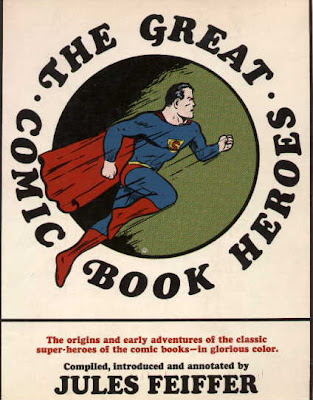
Comic Book Heroes Cover

I’m a little late, but I wanted to mark the 95th birthday (on Jan. 26th) of cartoonist, author, children’s book writer, comics historian, playwright, and screenwriter Jules Feiffer! 

I’ve always been aware of Feiffer when I was growing up, occasionally seeing his Feiffer strip that appeared in the Village Voice. And like many people my age, he introduced me to golden age comic book work through his seminal book, The Great Comic Book Heroes (1965), which I came across in the '70s. Though I was familiar with most of the classic comic book heroes featured, it was through this book that I first learned of the Spirit by Will Eisner—with whom Feiffer famously got his start in comics as an assistant (and eventually a writer) on the series, which ran as a syndicated Sunday newspaper comic book insert from 1940 to 1952.* About 10 years ago, I also read Feiffer's wonderful memoir, Backing Into Forward, which I reviewed here. It was a great read, though I initially read it out of curiosity about his years in Eisner’s shop!

The Great Comic Book Heroes also served as a bit of an early personal memoir for him—I loved how he included a cover shot of one of his own home made comics made as a child (included in the accompanying photo gallery), which was a comfort knowing I wasn’t the only one who did that!

I had the opportunity to see and meet Feiffer in 1994 when he spoke as part of an "American Comix" lecture series sponsored by the Los Angeles Central Public Library. Afterwards, when I asked him to sign my copy of his book, The Man on the Ceiling, I brought up an anecdote from The Great Comic Book Heroes—one of his first assignments as Eisner’s assistant was signing the artist’s name on the stories, claiming he was immediately better than Eisner himself. So Feiffer chuckled when I asked him to sign in Eisner’s name, inscribing my book, “Jules Feiffer aka Will Eisner.”)

Feiffer is an old-school lefty, who came of age professionally during a heady time in New York when the city was still the center of much of the art, entertainment and publishing worlds. Intellectuals, playwrights, actors, movie directors and, yes, cartoonists like Feiffer mingled and cross-pollinated at parties and salons in those days. On stage, he worked with people like Alan Arkin, and on film, Mike Nichols (Carnal Knowledge) and Robert Altman (Popeye). (I recently rewatched a documentary about Nichols and May, and was delighted to see Feiffer included among the talking heads throughout the piece.)

Feiffer is a talented hyphenated artist, but proudly a cartoonist first—in his twilight years he has returned to producing graphic novels, being one of the first to dabble in the form, with 1979’s Tantrum.

I’ve heard that Feiffer also wrote a never-produced screenplay for a film adaption of Milton Caniff’s Terry and the Pirates—that screenplay has always been a bit of a holy grail of mine.

Anyway, happy birthday to one of the greats.

Wednesday, May 27, 2009

Still Alive and Kicking

Rob Hanes Adventures Continues to Thrive in a Shifting Environment for Small Press Comics

For Immediate Release


This summer, issue 12 of Rob Hanes Adventures from WCG Comics is scheduled for release. By most measures, more than 16 issues and a trade paperback published since 1994—which encompasses an earlier series published under a different name—may not appear to be particularly prolific for a comic-book series. But with Rob Hanes Adventures, writer-artist Randy Reynaldo has garnered a small but loyal following for his longevity and steady commitment in a field where so many titles from small independent publishers seem to quietly fade away after only a few issues (if even that) and great fanfare.

With classic adventure strips like Milton Caniff’s Terry and the Pirates and Will Eisner’s Spirit enjoying a resurgence of interest among comics fans through definitive collections—and with past masters of the form like Roy Crane (Wash Tubbs and Buz Sawyer) and Alex Toth (Bravo for Adventure) being rediscovered by a new generation of fans for their work in the adventure strip genre—the time seems right for comic-book readers to take a fresh look at Reynaldo’s long-running series, which comics historian and columnist R.C. Harvey has called “one of the industry’s quietest treasures.”

Initially inspired by the pioneering adventure work of Milton Caniff’s Terry and the Pirates and Will Eisner’s Spirit, Reynaldo created Rob Hanes Adventures to bring a fresh, modern-day spin to the classic adventure serial strip. Fans and critics have described Rob Hanes Adventures as “Indiana Jones meets Jonny Quest,” and Reynaldo has been credited with helping to keep the classic adventure strip tradition alive.

Because of this, Reynaldo has gained a strong following among his fellow industry professionals. Comics veteran Kurt Busiek, a fan of the series from the very beginning, says, “Randy has done a great job of keeping alive the legacy of sophisticated high adventure that artists like Milton Caniff and Alex Toth created and perfected in comics. And he’s managed to do it by developing his own style and voice, and by keeping it fresh and modern, without making it feel or look old fashioned or out of touch.”

“When I came across reprints of classic comics like Terry and the Pirates that were set in the ‘real’ world, I wished there was something like it set in the present day,” says Reynaldo. “So I set out to do one myself. Like a lot of cartoonists, I’m doing the kind of comics I want to read myself.”

When he first began, the independent comics movement and direct market had just begun, and the black-and-white independent publishing movement was in full swing. He has weathered an industry that has experienced a bust in the black-and-white comics boom, the rise of alternative publishers like Image, the consolidation of the comics distribution network, and the emergence of the Web as an important new venue for distributing and presenting comics.

Through it all, Reynaldo has continued to publish Rob Hanes Adventures on a schedule that now averages about an issue a year. Reynaldo acknowledges that such a release schedule is not conducive to building momentum in what primarily is a periodical market where readers expect fresh material on a frequent, regular basis before moving to something else. Partly in recognition of this release schedule, every issue is self-contained so readers are never left hanging between issues. Nevertheless, Reynaldo has found an audience, as well as respect and encouragement from many quarters in the industry, including fellow professionals, for continuing the series.

Reynaldo admits that new technologies, which include print-on-demand publishing and the Web, have helped him and other small publishers remain viable. They have opened new channels of distribution and promotion; on the downside, of course, is that the competition for attention is intense.

Reynaldo’s work has evolved over time and he says he believes he’s hit a groove. Early stories in the series were much more adventure and action-oriented, and there were attempts at more serious serious drama and characterization. More recently, however, Reynaldo has begun to show a lighter touch that should serve to distinguish the series further. Issue 10, for example, was a straight action-comedy; a reviewer recently noted that “this particular issue had some nice light-hearted moments in it and the everyman side of [the character] plays well when Reynaldo uses it to comedic effect.” While Reynaldo says this is partly natural evolution, he admits it’s also by design.

“I always ultimately envisioned the series along the same lines as Will Eisner’s Spirit, where he mixed things up every week, going from straight adventure to high comedy in a heartbeat,” he says. “I've come to recognize that I'm better suited to a serio-comic approach, keeping things light and jaunty rather than to try and do straight serious ‘action-drama.’ And I’ve finally begun to tackle many of the stories that were sitting on the shelf until I felt the series was better established so that I could take it more to left field once readers were comfortable with the series.”

Issue 12, due in July, will continue in this vein, when Rob gets stranded on a desert island—but the story take a slight left turn at the end which he hopes readers will enjoy.

Due next from Reynaldo is a long-anticipated trade paperback collection that will begin to collect the series in its entirety. The project has been slightly delayed due to the decision to re-letter the early stories that were originally hand-lettered, which required made some post-production work on the art necessary. But Reynaldo is back on track to release the trade paperback later this year.

“I’m very proud of the body of work I’ve built to date,” says Reynaldo. “I have lots of fun ideas for the future direction of the series, and I’m looking forward to continuing the series for many years to come.”

For more information about the series, visit wcgcomics.com. The series is available to comic-book retailers through Haven Distributors.

ABOUT ROB HANES ADVENTURES:

Rob Hanes Adventures is an all-ages comic-book series about a modern-day globetrotting troubleshooter and soldier of fortune. Under the auspices of worldwide Justice International—a worldwide private investigations and security agency—Rob travels the world on assignment, facing adventure, intrigue and romance at every turn! Every issue is "done in one" which allows readers to jump in with any issue!

Inspired by the pioneering adventure work of Milton Caniff’s Terry and the Pirates and Will Eisner’s Spirit, Rob Hanes Adventures brings a fresh, modern-day spin to the classic adventure serial strip genre.

Series writer-artist-creator Randy Reynaldo is a Xeric Foundation grant recipient and a Russ Manning Award for Most Promising Newcomer nominee. The series debuted as Adventure Strip Digest in 1994, running for four issues until being re-booted in 2000 as Rob Hanes Adventures. A Xeric Award supported trade paperback, the Rob Hanes Archives, compiled the series' original run as a small press zine in 1996.

# # #

Click here to see sample pages from this issue

Tuesday, April 28, 2009

A LOOK BACK: Books about Comics (Part 2)

In a past blog, I reminisced about several books from my youth that fed my interest in cartooning and comics history. I mentioned this would be an ongoing feature at my blog, and I'm pleased to continue with a new installment.

Great Comics Syndicated by the Daily News-Chicago Tribune
by Herb Galewitz (1972)
I received this book as a Christmas gift in 1975, requesting it after spotting it in a bookstore.

This oversized book is light on the text and heavy on the reprint material, featuring as the title suggests the great comics syndicated by the New York Daily News-Chicago Tribune newspapers. Since I was living in New York City at the time—with the Daily News my parents' Sunday newspaper of choice—the book had resonance for me and gave me special appreciation for the strips I followed in the Daily News' Sunday comics section.

The editors who guided and built these storied newspapers in the early 20th century—cousins Robert B. McCormick and Joseph Patterson—were legendary for their ability to spot and develop strips in a very hands-on manner that had "legs" and connected with readers. Just a sampling of these strips include The Gumps, Little Orphan Annie, Blondie, Dick Tracy, Winnie Winkle, Moon Mullins, Gasoline Alley, L'il Abner, Terry and the Pirates, and Flyin' Jack—all classic "hall of fame" strips in anybody's book.

In retrospect, I've come to realize that this book was in actuality very imperfect and wouldn't pass muster with today's comic-book purists and historians. While a few complete story sequences are included, in an effort to provide a representative sample of the longer-running strips, often only a week's worth of strips are reprinted, usually in the middle of a story or adventure, which was torture for someone like me interested in reading a full adventure and seeing how a story turned out.

A particularly egregious choice was the decision to distort many of the reprinted strips to make them fit the oversize dimensions of the book. As a result, likely unbeknownst to the unsuspecting reader, some of the strips are unconscionably altered and "squashed." See the sample below, for example, compared to a reproduction of the same strip reprinted from NBM's definitive '80s compilation of the series' entire run—most of the Terry dailies in the volume (like many other strips) are reprinted in this fashion and, being the Milton Caniff acolyte I was, I conscientiously aped the squat style of the figures, realizing later that this was not the quirky, conscious style of the artist but rather a bad reproduction choice by the book's author!
Nevertheless, being in my early adolescence at the time—and given that such classic reprints were hard to come by in those days—I was none the wiser and this book was a treasured possession that I pored over constantly studying and reading. So it remains a book for which I have fond memories, warts and all.

The Great Comic Book Heroes by Jules Feiffer (1965)
Feiffer's Great Comic Book Heroes is considered a classic, credited with helping to renew in the 1960s interest in the classic comics of the Depression era from Feiffer's youth, that were the foundation of the modern comic-book industry. It remains an important book to many people of my generation as well, introducing me and my peers to the classic origin tales of familiar heroes like Superman, Batman, the Human Torch, etc., at a time when these classic strips were not easily available.

The first part of the book is a multi-chapter personal essay by Feiffer (reportedly expanding a piece he wrote for Playboy)—it's not so much a history of the early days of the medium as much as a personal remembrance of the raw power of these comics and the effect they had on him as a boy. He writes a bit about the artists and the characters; talks about how they inspired him to create his own home-made comics as a child (he even reproduces the cover of one of his childhood self-made comics, which fascinated me since I myself was doing the same thing as well, as shown in this post); and vividly portrays life in the trenches working as a journeyman artist in one of the comic-book "sweatshops" that sprouted up all over New York City in the early days of the industry.

The majority of the book, however—approximately two thirds of it—is devoted to reprinted full-color comics from the era, including the origin tales of many of the characters. (While Fantagraphics issued a new edition of the book in 2003, the reissue does NOT include the reprint art, presumably for copyright and licensing reasons.)

This book is also noteworthy because it re-introduced Will Eisner's Spirit to a new generation of readers, myself included. Feiffer devotes a whole chapter to the Spirit, and includes a Spirit story in the book. This is understandable since Feiffer entered the field as an assistant to Eisner. Nevertheless, given the prominence Feiffer gives to a relatively unknown and obscure character that had not been in published for nearly a generation, the series was a tantalizing revelation to younger readers. In addition, because Feiffer preferred the early pre-war version of the Spirit (tellingly, the version from his childhood before he worked on the strip), an early story from the series is presented in the book, though most historians agree that the series' post-war period was the apex of the series. As a result, it wasn't until the mid-'70s when the Spirit began being reprinted by Warren Publications that I realized the Spirit that I had faithfully co-opted for my own adolescent self-made comics was actually "off design" and not the commonly-accepted version of the character.

(Years later, I attended a slideshow presentation given by Feiffer as part of a series on the comics presented by the Los Angeles Public Library. This was around the time the cartoonist also was promoting the release of a new book, the Man in the Ceiling (1995). I had brought along a copy of the book for him to autograph, and when it was my turn to get his signature, I reminded him of an anecdote in his book that when he first began working for Eisner, one of his first jobs was to sign Eisner's name to the finished Spirit strips because he said he was better at it than Eisner was. So I asked him if he could inscribe an Eisner signature to the book. He laughed and signed the book, "Jules Feiffer AKA Will Eisner.")

A History of the Comic Strip by Pierre Couperie and Maurice C. Horn (1967)
This book was in the collection of my high school library in New York (as well as my college campus library in Los Angeles), and another one I was quite taken with for a time. (I don't own this volume personally.)

Originally published in France where popular art and "genre" literature are not quite as much frowned upon upon as they are in the U.S., and where classic comic strips can be admired as high art, this book offers a subtle but different approach to looking at comics.

Until relatively recently, in the U.S., most books about comics usually study the medium in a cultural or pop culture context.

In contrast, A History of the Comic Strip generally starts from the supposition of comics as "art." Reminiscent of Lichtenstein's comics-inspired fine art work from the period, panels from strips are often "blown up" in the book pop-art style, often giving readers a whole new way to look at the works.

My memory of the book has dimmed a bit over the years, but I have great memories of this book presenting the work of people like Milton Caniff and Burne Hogarth in an exciting, fresh new way that was fun while also taking the value of the work seriously.

Monday, July 9, 2018

A Look at Comic-Cons Past, Part I: Before the Frenzy (1986–90)

First in a series…I already planned to share some of my reminiscences and thoughts from past San Diego Comic-Cons, but my status as a Special Guest at the 2018 show seemed to make this an especially perfect time to finally post this...

I don't have the greatest memory and have only a few photos from these early years in the days before the convenience of digital and smartphone cameras, but fortunately personal letters from the time helped in these recollections, as well as the outstanding souvenir coffee table book published by Comic-Con in 2009, Comic Con: 40 Years of Artists, Writers, Fans, And Friends, to help with some of the chronology...


San Diego Comic-Con helped me meet many distinguished fellow pros like Sergio Aragones (2014)

I went to my first San Diego Comic-Con in 1986 and haven’t looked back since. Since then, with the exception of the year I married and went on my honeymoon (2000), I haven’t missed a show! (It helps to have an understanding wife who enjoys Comic-Con herself.) In 2001, my wife even came down while expecting our first child and in 2005 with our 3-month-old son and 4-year-old daughter in tow. (We have to travel separately since I'm an exhibitor and have to transport items for my booth.)

For those of you too young to know, there once was a time when you could decide on a whim to attend Comic-Con, drive down at the last minute, walk up to a registration booth, and purchase an attendee badge for the day or the entire show! I did this several times those first few years. This included booking hotels at the last minute as well—boy, those were the days! And no doubt like many attendees today, to save some bucks on the then-$79 per night hotel fee, my friends and I would double up (or more) in a room.

Cover to 1986 San Diego Comic-Con
(from Marvel Comics of the 1980s)
The first time I attended, in 1986, was with a college buddy who I introduced to comics and would later work in the industry himself. We stayed with his older brother who happened to be living in San Diego at the time. (His brother was also taking flying lessons and during our visit, he took us up in a small Piper Cherokee, an experience which is very different than flying a commercial airliner!) In the years that followed, I attended Comic-Con with a rotating entourage of friends—nearly all college buddies—who mostly shared the same interest in comics. Also usually joining us was my brother, who's been incredibly supportive of my comics work over the years.

Though I had been reading and producing my own “home-made” comics since my tweens in the early 1970s in New York where I was born and raised, I wasn’t aware of “comics fandom” until I moved to Northern California and discovered my first comic-book shop. These pioneering comic-book stores had a grungy/garage sale feel, often run by aging hippies in dilapidated, stripped down store fronts—and I don’t mean this in a bad way! You usually could hang out all day reading comics (then leaving with some purchases). By the time I hit college in the early ‘80s, comics—always a boom-and-bust industry—were on an upswing with independent comics like American Flagg (1983) and Love and Rockets (1982), which themselves had been preceded by early breakout hits like Cerebus the Aardvark (1977) and Elfquest (1978), to be soon followed by landmark mainstream series like Crisis on Infinite Earths (1985-86), Frank Miller’s Dark Knight Returns (1986), and The Watchmen (1986-87), all energizing the era’s comics scene.

I know people whose attendance date back to the very first year of the show in 1970. Before I attended, Comic-Con had been held at a variety of locations in San Diego, notably the El Cortez Hotel. By the time I began attending, the show had moved to the San Diego Concourse and Performing Arts Center, a rather drab facility that felt dated even then. But I wasn’t there for the ambiance!

Catching a glimpse of comics legend Will Eisner
In those early years, my innate shyness and apprehension about attending after-hours fan events like the masquerade ball, award shows, or the after hours bar scene tended to limit my Comic-Con participation to the exhibitor’s floor and panels. (The Will Eisner Awards, often referred to as the comics industry’s Oscars, was first held in 1988.)

As an aspiring cartoonist, Comic-Con was an eye-opening experience. It gave me the opportunity to see and meet my first comics pros in person. In these first few years, this included Frank Miller, Howard Chaykin, Jerry Bingham, Gary Groth, the Hernandez Brothers, and Steve Rude.
I often like to say that I started attending Comic-Con at a time when the biggest celebrities were the actors who portrayed Lois Lane on the Superman television show (Noel Neill) and Lone Ranger (Clayton Moore). With that said, Hollywood did occasionally show up at Comic-Con to connect with fans. At my first Comic-Con, I attended a panel for the television pilot based on Will Eisner’s Spirit that starred Flash Gordon’s Sam Jones. It never got picked up, but I saw the pilot when it aired and, years later, purchased a bootleg DVD of the show at Comic-Con. Most famously, but before my time, one of the first movie promotion success stories at the event was Star Wars, which created a buzz in the fan community long before it was discovered by the mainstream. Of course, today, many film studios consider Comic-Con an important part of their promotional effort, sometimes even pausing productions so that their directors and casts can make an appearance. Years later, the Flash television show and the first Tim Burton Batman film would be heavily promoted at Comic-Con. For many, Batman was a major turning point since, along with 1978’s Superman starring Christopher Reeve, the film arguably heralded the start of comic-book-based films that fans felt were faithful to the source material and not disdainful of it.

San Diego Concourse, 1982 – Photo by Alan Light (posted at Marvel Comics of the 1980s)
On one occasion, after driving down to Comic-Con from L.A. just for the day, still flush with the excitement of the show, I drove back the very next day with a few additional friends in tow! Another time, in 1989, the night before driving down, I went to a Hollywood Bowl concert with my new girlfriend (now my wife), got home at 3 a.m., and somehow found the energy to drive down to Comic-Con that very morning. I then drove back to L.A. that same night since I had made plans with my girlfriend to visit the Getty Center in L.A. the following day! (Ah, love and youth!) And in yet another year, I threw a surprise birthday party for my girlfriend and then drove down to Comic-Con the very next morning!

Steve Rude drawing Space Ghost for a
Comic-Con art auction/fundraiser
And what comics convention experience is complete without a story of tracking down a long-sought after comic-book issue? In my case, it was finding issue 4 of The Rook, containing the second and final chapter of a backup story by famed comic-book legend Alex Toth, featuring his original series, Bravo for Adventure! This is the reason comic-book conventions were invented! Of course, the advent of online shopping and the fact that so many comics have been collected and reissued has somewhat reduced this pastime, for me at least.

Those early days also gave one the luxury to methodically walk each aisle of the show aisle to check out the different booths, deciding where I might come back to make a purchase. As the show got larger, however, this became impossible as the surging crowds tended to determine which aisles to navigate and which to avoid.

But in subsequent years, Comic-Con began to change and grow, starting in 1991—the year the San Diego Comic-Con moved to its present home at the San Diego Convention Center.

Next: Comic-Con Explodes


Jonny Quest, also by Steve Rude

References:

A photographic timeline of the San Diego Comic-Con from the Los Angeles Times 

San Diego Comic-Con: The Untold History, Rolling Stone Magazine, July 19, 2017

Comic Con: 40 Years of Artists, Writers, Fans, And Friends (2009)


Monday, July 27, 2020

Report on Comic-Con@Home (SDCC 2020)


When the 2020 San Diego Comic-Con (SDCC) was cancelled in mid-April, it was a disappointment for many but a surprise to few—health and safety, of course, comes first, and the state and local officials likely would not have it allowed it to be held anyway; many other large events, including WonderCon, usually held in the Spring and also organized by Comic-Con, similarly were cancelled. Like many, I had purchased a table, paid a deposit at my hotel, and had badges.

Shortly after the cancellation, Comic-Con announced SDCC 2020 would be a virtual event, open to all—Comic-Con@Home to be held on the same dates, July 23–26. There would be online panels and even a virtual exhibit hall online where confirmed exhibitors like myself would have a space!

Comic-Con@Home has now come and gone. Though I didn’t expect to have much to report regarding a cancelled event, I have to say that like the “real” Comic-Con, it was whatever you made of it, with online programming and mainstream coverage of the event. They even provided badges and signs that could be downloaded to make it as fun and “real” a Comic-Con experience as you wanted to make it. The traditional program was available for download as a PDF and they rolled out their programming for the event in advance like any other year, including the Eisner Awards and the Masquerade Ball. (All the panels—including the Eisner announcements—were pre-taped.)

As an exhibitor, I had a “table” in the virtual exhibition hall, which allowed exhibitors to promote products and exclusives, and link back to your website. As usual, I had a new issue available for sale at Comic-Con: Rob Hanes Adventures #21. You would have had to drill pretty far down to find me, and that's if you were looking—however, being active and promoting on social media made a big difference, and sales were way better than expected and a pleasant surprise. (You can see I re-posted some of my Tweets on my blog below.)

So though I did not have to be “on” 24/7, I was relatively active during the show posting on social media and watched panels throughout the weekend at my leisure—I also mixed things up by using Comic-Con as an opportunity to post photos from past shows of cosplay, the year I received the Inkpot, etc. (Though the panels dropped as scheduled on Comic-Con’s YouTube channel, they remain available for viewing.) To be honest, although it's only an annual event, it was nice to have the break and not have to be "on" 24/7. So, again, though Comic-Con did a great job of making it an inclusive celebration, of course it’s not the same as capturing the excitement and enthusiasm (and exhaustion) of the show IRL.

Some of the panels I “attended” include:
  • Public Domain Comics: From Sherlock Holmes to Mickey Mouse & Beyond 
  • Full Time Creative Work On A Part Time Schedule 
  • Cartoon Voices 
  • Celebrating 80 Years of Will Eisner's The Spirit 
  • Fantagraphics and IDW: Classic Comics Reprints 
  • 32nd Annual Will Eisner Comic Industry Awards 
  • Bill and Ted Face the Music 
  • The Brave New World of TwoMorrows 
  • Oddball Comics Not So Live! 
As a confirmed exhibitor for 2020, I’m already confirmed as an exhibitor in 2021—let’s hope it happens and see you there!

My brother, who helps me year every year at my booth, created the exhibitor badges featured below for this year’s San Diego Comic-Con, courtesy of a template provided at the Comic-Con website so that people could still have the Comic-Con experience at home!


Wednesday, June 6, 2007

Rob Hanes Adventures Hits Landmark 10th Issue

Longrunning indie series celebrates milestone with sports story

June 6, 2007

For immediate release

The long-running independent comic-book series Rob Hanes Adventures hits its landmark 10th issue in July. To celebrate, the action-adventure series will cross genres in the issue with a full-fledged sports story. The issue is now available to retailers and also will be available from WCG Comics at the Comic-Con International in San Diego, July 26-29, 2007.

Though primarily a modern-day soldier-of-fortune series, Rob Hanes Adventures creator Randy Reynaldo frequently explores other genres. In issue 10, the series enters the world of minor league baseball in a humorous sports adventure entitled “The Pride of the Chickenhawks.” Past stories have featured a drawing room mystery and outright comedies.

“Although Rob Hanes Adventures is primarily a globetrotting action-adventure series, I've always intended to keep myself challenged by mixing things up and throwing the character into different, offbeat situations,” says Reynaldo. “I had a lot of fun doing a baseball story and may tackle other sports in the future (no pun intended!).”

In the issue—just in time for baseball season—globetrotting adventurer and Justice International private eye Rob Hanes is hired by a minor league baseball team called the Brisbane Chickenhawks to investigate allegations of steroid use. In the course of the story, however, Rob becomes more interested in getting a hit than with cracking the case—leaving it up to his partner, Abner McKenna, to solve the mystery! Rob's obsession with getting on base and the resolution of the case come to a thrilling climax in a baseball game with playoff consequences. All the elements of a classic sports story are blended with a classic mystery-adventure.

In addition to classic adventure strips like Terry and the Pirates, Scorchy Smith, and Buz Sawyer, Reynaldo also is a longtime fan of Will Eisner's Spirit, and has always appreciated the wide variety of stories presented in the groundbreaking series. Stories often ranged from straight adventure to lowbrow comedy, and everything in between—including numerous sports sequences.

And while even Reynaldo is too young to have enjoyed first hand classic sports comics like Joe Palooka and Cotton Woods, he knows they once enjoyed an enormous following in comics. Sports comics also are a popular genre in Japanese manga.

Upcoming stories in the series will feature the character battling modern-day pirates in Asia and being stranded on a desert island with a convict Rob has been hired to extradite from overseas.

Rob Hanes Adventures is a comic-book series about an international troubleshooter and modern-day soldier of fortune who works for Justice International, a worldwide private investigations and security agency. Reynaldo is a Xeric Foundation grant recipient and a past nominee for the Russ Manning Award for Most Promising Newcomer, which is awarded annually with the Will Eisner Awards. In 2006, WCG Comics celebrated 15 years of publishing.

More information about the series may be found at the WCG Comics website at wcgcomics.com.


Thursday, September 10, 2009

"I always wondered when Warner Brothers would figure out that they owned DC Comics?"

Shortly after I had scheduled to publish my comments below about the Disney/Marvel announcement, another huge entertainment-related news story broke which threatened to overshadow the Disney/Marvel story....

I'm speaking, of course, about the announcement that Ellen Degeneres is joining "American Idol."

I'm kidding, of course—I'm actually referring to the shakeup over at DC Comics, in which in a move similar to Disney/Marvel, the venerable comic-book publisher of Superman, Batman and Wonder Woman now becomes DC Entertainment and more fully integrated within its parent company at Warner Brothers.

To be fair, a move like this takes a lot of planning so it's likely been on the boards for awhile. The timing of the announcement, however, was no doubt precipitated by Disney's action, perhaps in an attempt to suck some of the air out of the excitement over Disney's move. While I personally found the timing poor, conveying a sense of desperation, I guess WB felt that if it waited longer (or until the new year), they might otherwise look like total also-rans that were copycatting Disney. By making the announcement sooner than later, they can say they meant to do it all along.

Indeed, such a move was expected at some point. It was generally agreed that WB had never done a good job of managing or fully exploiting its superhero properties—an example being the fitful way the company dealt with the re-launch of the Superman franchise earlier in this decade (at one point, a Batman/Superman film was on the boards), and the off-and-on again Wonder Woman movie.

WB has owned DC since the '70s, but the huge conglomerate generally kept the comic-book company at arm's distance, meddling little in its affairs, and licensing out its characters piecemeal, no doubt seeing the company as a minor licenseable property within its multimedia empire. (As one columnist noted, "I always wondered when Warner Brothers would figure out that they owned DC Comics?")

Marvel, too, had similar problems maximizing the potential of its properties—witness two on-the-cheap film adaptations of Captain America and the Fantastic Four from the '90s that the studio paid to bury so embarrassing were the results. But when the Spider-Man films proved the worth of their properties, Marvel—being a bit smaller and, hence, nimbler than the WB-owned DC—moved to clamp down on its properties and assert greater creative say and control by establishing its own movie studio. With comic-book properties now becoming the source of highly successful tent-pole franchises, WB has clearly seen the light, and is now hoping to emulate this integrated approach that creates some continuity and synergy in the way DC's characters are handled.

To echo what I wrote below about the Disney/Marvel partnership (and written before WB's announcement), it’s likely that new DC Entertainment President Diane Nelson—who self-admittedly is not "by nature a comic fan"—does not plan to manage DC Comics or its comic-book publishing operations on a day-to-day basis. Like Disney with Marvel, as long as DC makes money and supports its own operations, DC likely will be allowed to continue publishing its comics as it sees fit, if for no other reason than to continue producing the content that will be the source for other more lucrative new media platforms. Nelson’s job is not to run a comic-book company, but to migrate those characters and their decades of content to films and new media.

While I would prefer to avoid the term "winners" and "losers," in such shakeups there invariably always will be collatoral damage. Chief among them is now-former DC Comics President and Publisher Paul Levitz. Levitz is a true-blue fanboy, starting at DC in his teens (particularly known for his writing on the Legion of Super-Heroes), who got an MBA while he remained working with the company, and rose to the position of president and publisher. Generally recognized as one of the "good guys," Levitz will return to writing (including Legion) and work as a "special consultant" due to his extensive knowledge of the DC universe. While it's not clear whether Levitz was given an opportunity to remain in a management position at DC, the change likely would have made him a mid-level person in the new new DC Entertainment chain of command, so he likely opted to exit as gracefully as possible.


With much of the dust now settled, I thought I might as well weigh in on my own thoughts about what likely will be one of the biggest comics/movie/entertainment news stories of the year: Disney's acquisition of Marvel Comics for $4 billion.

Though there have been a few reported predictable fanboy rants like the one below (quoted at The Beat)—
This is like disgusting in many levels......

Disney has always been in their entire existence to buy out the competition or aquire it and then ruin the foundations it was based on. Although it may be a “sweet deal” to everyone who has stock Marvel will forever be a Disney product and I will not buy anything from Marvel again. 4 billion is “chump change” to Disney, Marvel will “lose” out again in making more money on their own!!!!!!

I think this is a “bad” idea for Marvel to “sell out” to Disney I mean the reason Marvel is doing well is because of us “kids” who are now in to their 40’s and 50’s who still appreciate the characters we grew up with and totally support all of the merchandise involved with Marvel heroes.
—for the most part, I doubt the average person (or, indeed, even most comic-book fans) will see much of a difference. (The above rant typifies the distorted view of some fans who equate emotional investment of a product with actual ownership.)

Marvel Comics will undoubtedly continue to produce their comics—and probably even their films—under the Marvel Comics imprint, with little if any meddling by Disney. Disney acquired Marvel for the strength of its brand, and I doubt Disney would do anything to risk damaging that brand, under the "why fix what ain't broke" axiom. Disney will likely grant Marvel the same degree of independence it has given Pixar, leaving well enough alone (keeping in mind this never would have been possible under former Disney CEO Michael Eisner's stewardship).

So if Disney isn't interested in directly running a comic-book publishing company, what do both sides get out of the bargain?

The $4 billion Disney paid for Marvel wasn't for the joy of publishing comic books, but rather for Marvel's rich goldmine of 7,000 characters and 70 years of story continuity. So while Marvel will continue to publish its comics as it always has done, no doubt Disney will work with Marvel to bring its characters to new, more lucrative platforms.

With this acquisition, Disney also finally has an instant, credible foothold in a market that so far has eluded the house of mouse: young male adolescents. While Disney Channel has evolved into the de facto channel for tween girls, Disney has met with less success finding ways to appeal to boys (witness Disney's launch earlier this year of the XD Channel). Marvel solves that problem.

And on top of all this, of course, any profits generated by Marvel will trickle upwards towards Disney's coffers.

For its part, Marvel gets the muscle and access to the deep pockets of one of the most recognized and largest multimedia companies in the world. Despite its success, Marvel has struggled finding adequate resources to achieve its goal to self-finance its films—witness the embarrassing attempts to save money that nearly resulted in the exit of director Jon Favreau from the Iron Man sequel and of Samuel L. Jackson as recurring character Nick Fury.

Yes, this is a sea change—but remember that Marvel's main competitor, DC Comics (publisher of Superman, Batman and Wonder Woman), is itself owned by Warner Brothers. Most changes will be transparent to consumers, and will occur more on the business/platform side of things rather than content, particularly as Hollywood continues exploring new media platforms as traditional print, television and film struggle to re-invent themselves. Marvel's established characters and fan base will give Disney recognizable content to more aggressively explore new arenas.

To me, aside from the actual acquisition, the real story behind the announcement was that it was such a well kept secret. The news took everyone by surprise, turning it into an even bigger story as news outlets scrambled to get up to speed. Most observers quickly saw the great genius of the partnership, and even rival companies found themselves kicking themselves for not thinking of it first.

For a detailed report on how the deal happened and an assessment of the Marvel acquisition, I recommend entertainment blogger Nikki Finke's recent coverage of the news.