Pages

Thursday, December 10, 2020

Consider the Gift of Comics for the Holidays!

I know it’s been a tough year and hope everyone has been safe and healthy!

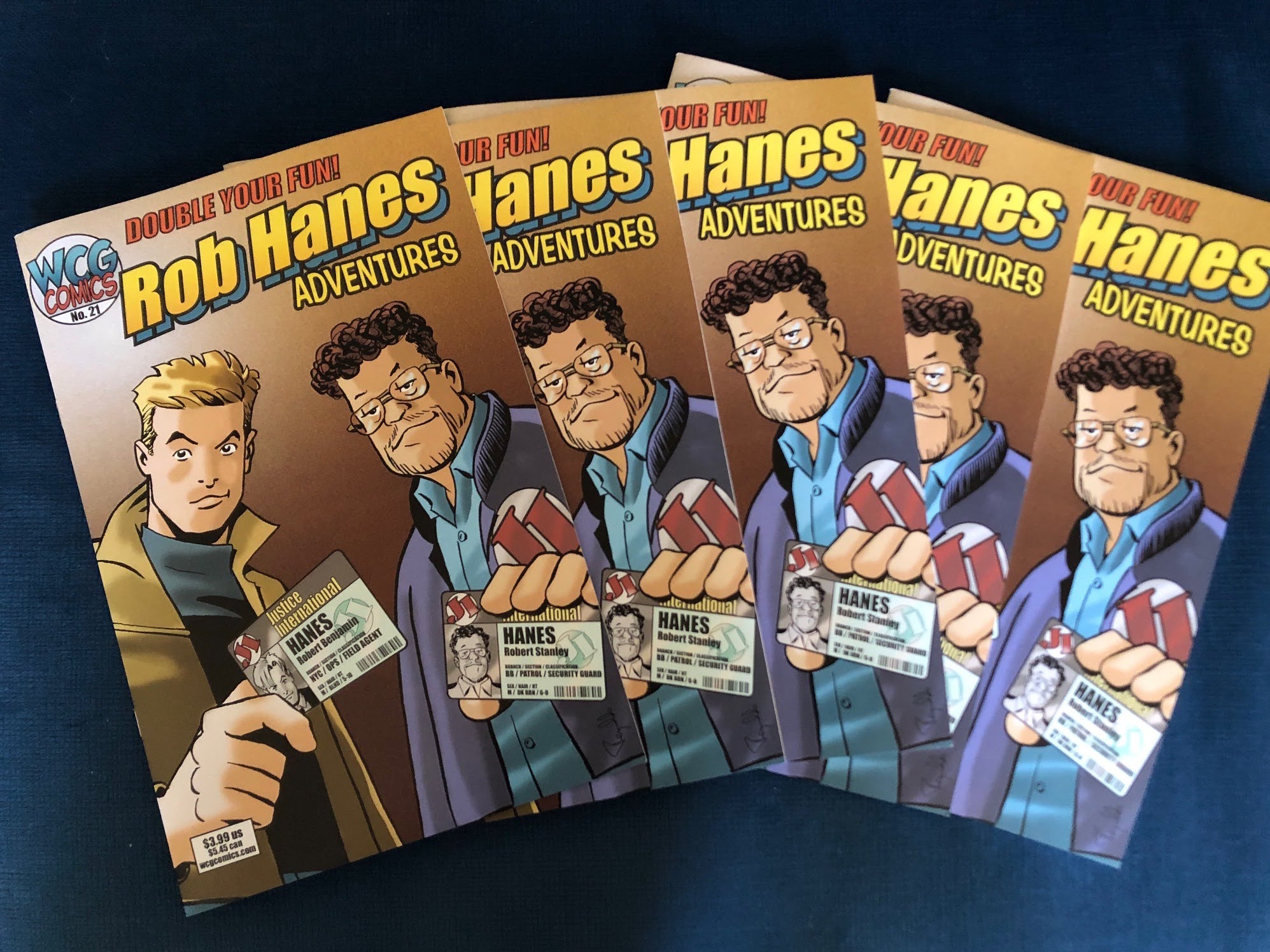
On the comics front, in July, issue 21 of Rob Hanes Adventures was released! Though the in-person San Diego Comic-Con was cancelled, I was fortunate to have a virtual table at this year’s re-imagined online Comic-Con@Home and was pleasantly surprised by the strong sales. Thanks, as always, for everyone’s continued support this past year.

Now is a great time to catch up with the series or consider ordering for a friend as a holiday gift! Visit our webstore to place an order! Issue 21 remains available, as do all back issues—or order one of our trade paperback collections!

And, yes, issue 22 is in the works and promises to be a special treat—Rob goes to France in search of hidden Nazi gold and discovers that one of his forbearers, Sgt. Jim Hanes, played a crucial role in a World War II firefight over the treasure. Read all about it in “Operation Werwolf!”

In the meantime, enjoy the preview art below and best wishes for a happy holiday season and new year!


Tuesday, December 8, 2020

Election Post Mortem

When Hillary Clinton lost the 2016 election—winning the popular vote but losing the electoral college—like most in the country, I was stunned by the results. This was partly because it was a shocking upset that defied the polls. But ultimately I never questioned the votes or legitimacy of the outcome. Unhappy as I might be by the election and the process, these were the system and rules by which our country elected its leaders and that we, as a nation, abided by.

So it is shocking the extent to which the current incumbent president has fought to delegitimize and overturn the 2020 results. This is despite the fact he lost the election by a resounding margin (more than 7 million votes), and ironically by the identical Electoral College count he won by in 2016 — 306 to 232 — a margin he described as a “landslide” at the time despite losing the popular vote.

But, perhaps, I shouldn’t be shocked. As the past four years (and even prior earlier) have proven, the sitting president has shown no shame, let alone any respect for democracy, or for American values or basic human decency. Nor does he understand the importance of public service and the peaceful transfer of power, let alone good sportsmanship and fair play. (After all, this is the same person who’s called people who have served in the military “suckers and losers,” genuinely not understanding why people may choose to serve their country — this, from a man who wished to serve as President!) Easily the most unfit and sociopathological person to have ever been elected to the White House in modern times, Donald J. Trump has shown throughout his career and life—starting with childhood—that he is a narcissist to the nth degree, who sees everything in purely transactional terms, interested only in how any decision will ultimately benefit and bring glory to himself, the rest of the country be damned.

If the stakes weren’t so high, he would be a laughable buffoon.

But what makes him dangerous and most troubling, is that, for some inexplicable reason, he has a base of rabid followers—perhaps as much as 40 to 45 percent of this country—who do not question even the most ridiculous and specious of his claims.

Trump, of course, is the basest of populists, explicitly pandering to only his base and never throughout his presidency did he ever try to broaden his appeal, let alone try to represent “all” Americans. I’m firmly convinced that the people who idolize him do so purely because if they were in his position and could similarly screw others and the system over and get away with it as he does, they would—and they admire him for it. It is the most selfish and greediest of motives, having nothing to do with values—American, Christian or otherwise.

I’m also firmly convinced that this election—where Trump still did better than expected—exposed the complete lack of knowledge or education in basic American civics or democracy. Authoritarianism thrives in exploiting the uninformed and ignorant with lies and fear, and they have found willing rubes in American society.

 
Art by Garry Trudeau
There is some comfort to be drawn from the fact that the 2020 election served as a stress test on America’s democratic institutions and they held — but barely. On the one hand, we can actually take some comfort in knowing that this was a bit of a stress test and our institutions and courts held against this assault on the democratic process (though many in the GOP were enablers). On the other, as many have note, if the election had been closer and Biden hadn’t won relatively overwhelmingly (more than 7 million now), it could have resulted in a battle that could have been truly destructive to the country and its democracy.

Nevertheless, it should be deeply concerning that Trump found success in casting doubt on the credibility of the election and made serious attempts to overturn the will of the people and negate votes, essentially an attempt at an authoritarian coup. I have no doubt that this presidency will go down as one of the worst—and perhaps one of the most chaotic—in the nation’s history. In the waning days of his presidency, Trump has only affirmed how unfitting he was for office. Uncaring and tired of the COVID-19 pandemic that probably cost him the presidency because of his incompetence, rather than take a “victory lap” he could have hogged credit for (and briefly tried to), he’s instead descended into self-pity and sulking over an election that he tried to steal and overturn, despite it being declared one of the most secure in history.


This is not to overlook the damage done to democracy on Trump's watch. Among other things, Trump and his Republican enablers have normalized corruption and nepotism, degraded public discourse, invited foreign involvement in US elections, abused presidential pardons, deepened racial divides and politicized the bureaucracy in ways rarely seen in American history. Trump's refusal to concede after a clear loss is sweet music for autocrats across the globe and a stain on American's reputation.

Sunday, November 8, 2020

Our Long National Nightmare is (almost) Over


The title of this blog, of course, quotes President Gerald Ford’s famous words on national television upon the resignation of Richard Nixon in 1974—I had long planned (and hoped) that these would be the words I’d post on Facebook if Donald Trump was denied a second term.

While pundits and pollsters had long warned the public that the vote count might take time, the early returns on Election Day were worrisome for those of us anxious for change. Seemingly defying the polls as he had in 2016, Trump jumped out to early leads on Election Day, winning Florida and Texas fairly early, though the Biden campaign had worked hard to flip them. I have to admit, I went to bed on Election Night with a sense of foreboding, remembering Trump’s shocking victory in 2016, when he won the electoral college while losing the popular vote. I slept fitfully, dreading and turning over in my mind the possibility of living through four more disastrous years of Trump.

When I woke up the next day, there seemed to be some hope—reports seemed to indicate that the states still in play were trending Biden’s way. As the pollsters had predicted, the early voting ballots in many states, which the Democrats had pushed and Trump had discouraged among his own followers, were now being counted and trending Biden’s way; and many of the remaining areas yet to be counted were Democratic strongholds. Minnesota and Wisconsin soon fell into Biden’s column. Then it seemed all eyes were on Arizona, Nevada, Georgia and Pennsylvania. As I mentioned in an earlier post, I tend to be a pessimist about such things, but simple math made me feel cautiously optimistic. I could now see how the electoral map was trending—nearly all of the remaining states were leaning towards Biden and he only had to win one or two of them to put him over the top, while Trump had to sweep them all to win. While Biden had many paths to victory, Trump had only one. Not impossible, but highly improbable.

To no one’s surprise, that morning, Trump went on national decision to preemptively declare victory, despite the fact that he (nor Biden) had not yet officially reached the 270 electoral college threshold. In retrospect, it’s clear this would be Trump’s culminating move to autocratic/authoritarian rule—to subvert the election and steal victory through his usual bluster, bullying and lying, claiming “fraud” without any shred of evidence. For once, however, given the stakes and the importance of maintaining the integrity of a democratic election, the media pushed back, with some cutting away from him as he spoke, reporting that Trump’s claims were untrue and, in fact, dangerous. With simple math and the vote count now dominating the news, history and facts had, for once, overtaken Trump—he no longer controlled the narrative.

Nevertheless, the count continued through the week with the remaining states too close to call, dragging out the suspense. I felt it was important for the race to be called—if, as was anticipated, Biden was definitively named President-Elect, it would grant him a legitimacy that would make it difficult for Trump to assail, even in the courts.

Saturday morning, November 7, I woke up and was checking the news feeds on my mobile device when I received a text from my sister with a screenshot that CNN had called the race for Biden, with the other networks soon following with the same call.

Cartoon by David Parkins
My belief in the importance of Biden winning the electoral college was prescient—Trump, of course, immediately assailed the decision (earlier in the morning, he tweeted that he had “WON, BY A LOT!”). But Biden being named President-Elect suddenly made Trump’s bluster seem empty and toothless.

Between now and January 20, of course, Trump can still cause a lot of chaos. His allegations have been made with no shred of truth to back them. But the writing on the wall is there, Biden’s victory is definitive and nearly unassailable.

The victory speeches of the President-Elect and the Vice President-Elect were a salve, reminding me and others of the dignity and sense of national unity that have been missing in the presidency and our national discourse the past four years. Both addresses were moving and Biden--often derided as “Sleepy Joe” by Trump--gave what I thought was an electrifying, inspirational speech, the address of a lifetime.

The spontaneous jubilations and celebrations that broke out around the country--indeed, worldwide--felt like a great release, many saying it felt like a dictatorship had ended (some even compared it to the end of Star Wars: The Return of the Jedi, when the Death Star was destroyed.)

It can’t be denied that Trump did better than expected—the turnout underscored the strong support Trump garners among his base. While his approval ratings throughout his presidency never exceeded 50 percent—indeed his average 40 percent is a record low -- that base has stayed incredible loyal. Fortunately, those who supported Biden and repudiated Trump were similarly energized.

As many people noted, the U.S. narrowly dodged a bullet by unseating a dangerous, authoritarian figure through peaceful democratic means. However, looking ahead, whether or not Trump will respect the tradition of a peaceful transfer of power is another story. By not doing so, he risks further destabilizing the country and de-legitimizing Biden’s presidency.

Having said all that, as surprised as I am to say this, Biden does need to find some way to acknowledge to some degree what the "other" side is feeling, especially as they still represent a (shockingly) 35–45 percent of the country. Of course, racism, hate and threats of terror and violence shouldn’t be abided, and there is plenty of resentment and grievance (often imaginary), but hopefully there can be some way to address what they're looking for. In his victory speech, Biden spoke about wanting to represent all American, which Trump never even tried to do, nor did he ever understand or care to, so hopefully there can be some healing. I’m probably getting a little ahead of myself, and maybe I'm being overly optimistic, but there you go.

Wednesday, October 28, 2020

The Case Against Donald Trump

For the most part, I try to avoid politics on this blog, but with Election Day coming up, thought that for the record I'd throw in my opinion and two cents.


Let’s face it, Donald Trump winning the 2016 was a fluke—as one pundit put it, the equivalent of drawing an inside straight in poker. While he lost the popular vote, he threaded the needle and ran the table to win the electoral college.

As we approach Election Day 2020 on November 3, Trump faces a very different environment.

First, while Trump seems to have retained a measure of core support—over the years, anywhere from 35–45 percent of people from around the country have remained in his corner (which, frankly, is a frightening statistic considering his white supremacist views). And unlike 2016, he faces a candidate with much higher trust and likability ratings. People have realized that the more you get to know Donald Trump the more you dislike him.

Second, most Presidents, upon assuming office, usually move towards the political center and try to expand their base. In contrast, Trump, has doubled-down on divisiveness, choosing to pander only to his limited base and “red states,” which he has made explicitly clear many times. He particularly has targeted evangelicals, giving lip service to their priorities like abortion and prayer rights (based on their specious claim that Christians in this country are oppressed and under attack), making for strange bedfellows as Trump is the least religious of people and, in fact, among the most amoral if not outright immoral individuals to ever sit in the White House. As a result, as polls show, he not only has failed to expand his base, he has lost and alienated many of the swing voters that made his win in 2016 victory possible, such as suburban women/moms, the elderly, and even some blue collars.

Of course, these challenges are mostly of his own making, with his stiffest head winds coming from COVID-19. While the pandemic was obviously not his fault, once the virus hit the country's shore, the responsibility to protect the American people using all the resources and knowledge available to him fell on him. As a result, his inability and outright willful refusal to rise up to meet one of the greatest challenges in modern history was matched by one of the greatest collapses in presidential leadership. Many presidents have been measured or taken down by the crises they faced — think FDR and the Great Depression and World War II; JFK and the Bay of Pigs; Nixon and Watergate; George H.W. Bush and Iraq; and George W. Bush and the Great Recession. Trump will forever be tied in history to his COVID-19 fail.

Early on in the crisis, in a rare moment of clarity when he seemed to recognize his moment in history (but also borne out of his usual false bravado), Trump declared himself a “war president”—then decided to not take any action. Whether out of an obvious predisposition for laziness or his inability to ever see anything through over the long term, he chose—apparently primarily for political gain, believing “blue states” would suffer the worst—to let the American people and states fend for themselves. He asserted early on that he took no responsibility for what was happening and, as he’s done through most of his life, tried to bully and bluster through the crisis. But for once, with real lives at stake, hard evidence and science would have none of it. He tried magical thinking (saying it would magically disappear), fake and quack cures like bleach and hydroxychloroquine, and continues to delusionally insist we’re “rounding the turn” even as cases continue to spike (currently in record numbers) in many areas of the country—particularly in his precious “red states”—as a third peak wave of cases and deaths ravages the country. He can talk as much as he likes about how well we’re doing—or declare victory over the virus—but the fact remains, the U.S. has the highest number of cases and deaths of any country in the world to date, with no end in sight, even as the infection spreads like wildfire through his White House staff. It should be added that all of Trump's claims are usually at polar opposite from the guidance of his own public health experts, including those he appointed.

As the news has gone from bad to worse, of course, he’s fallen back to his favorite default defense by playing the victim card. He’s incessantly whined about his lot both in private and in public, constantly trying to deflect blame to others, whether it be China, the governors of blue states (regardless of the fact that it’s now the red states that are experiencing the worst surges) or even the health profession. To blame is anyone but he, who's first priority as president is to ensure the safety of the American people.

Of course, when he can, Trump also tries to play up his financial and business bonafides—which don’t exist. He often asserts that his "business experience" qualifies him to be chief executive, though he has never been beholden or accountable to a board of directors or anyone else since his companies are all privately held. In addition, his favorite measure of the strength of the economy has always been the stock market—but as an article in the Washington Post showed, Wall Street has actually fared worse under him in his 45 months in office relative to past administrations (including Obama). And, of course, both the economy and the unemployment rate under his watch have fallen off the rails. 


Of course, the pandemic is much to blame—but his inaction and lack of leadership made the crisis much worse. If he’s so quick to take credit for a roaring economy even when he has little to do with it (as Presidents are wont to do), he also needs to be ready accept blame and responsibility when things go south. (By the way, despite what the GOP may have people to believe, the economy historically actually performs better under Democratic presidents than Republican.*)

By the way, it seems silly to have to address this, but anybody who buys into the claim that we’ll be pursuing a socialist agenda under Biden and Harris is a fool and an idiot. To do so is to ignore Biden's record of 50 years as a middle-of-the-road slightly to the right Democrat—and the fact that we have checks and balances built into the system to prevent such overreach. 

(Regardless, as I’ve always said, socialism is just a word, often used as a scare tactic. No pure or dogmatic form of government or ideology have ever proved to be successful and many Western democracies feature “socialist” programs, ranging from healthcare to public schools and public libraries; after all, people don’t seem to mind the "corporate welfare" handed out to farmers in the form of subsidies and bailouts for banks. If we truly believed in a pure free market or capitalist system, we’d let those banks and farmers go out of business.)

It's dumbfounding that it needs to be said that Trump is likely the most unfit person to ever hold the presidency. His lack of respect for the norms and values of American democracy; his inability to learn or hear views or news that contradict his narrow view of the world or the high self-regard in which he holds himself; his obvious embrace and admiration of other authoritarian figures while destroying relationships with longtime friends and allies; his undermining of our democracy and many of the nation's institutions; his obviously racist views and alignment with white supremacists; and his belief in unfettered power and that all levers of government owe fealty to him rather than the Constitution—all aided and abetted what can be generously described as a criminal enterprise that include members of his own family—are each individually sufficient to disqualify him from any public office, let alone the U.S. presidency.

Like many people, I'm simply tired and exhausted of this odious man's non-stop need to be the constant center of attention and in the 24-hour news cycle. I just want a day when there's nothing important to report on the news about his latest meltdown, ridiculous exaggeration or narcissistic self-regard.

Need it be said that I will vote for the Biden/Harris ticket? With that said, if you haven’t already, go out and vote.

Tuesday, September 15, 2020

More Capsule Reviews in the Time of Coronavirus (4)

Batman and Bill

When I went to see the film Batman v. Superman: Dawn of Justice, I remember gasping in surprise (and excitement) when I saw Bill Finger—a comics writer widely acknowledged but never officially credited as instrumental in developing the character of Batman—receive screen credit in the film’s opening title sequence. I was aware that Bob Kane, who came up with the initial idea of Batman, had contractually been given sole official credit as the character’s creator from the very beginning and that Finger, a prolific writer who primarily worked as a ghostwriter in comics for most of his career, had died penniless and in obscurity.

The Hulu documentary Batman and Bill tells the full story that led to the credit Finger received on the film and now on all subsequent Batman productions. Much of the film focuses on the relentless detective work of Marc Tyler Nobleman, a writer who became obsessed with uncovering the story of Finger, his involvement with the creation of Batman, and his crusade to get Finger credit.

Finger’s involvement with Batman has always been an open secret in the industry—though Kane came up with the initial idea of the character, Finger wrote most if not all of the earliest stories and reportedly suggested many of the elements that became a signature of the character, such as the cowl, dark colors, scalloped cape, the batcave, batmobile, and many of the villains. Finger was essentially considered an early member of Kane’s shop—a ghost who also did other work for DC—and died in obscurity in 1974.

Unlike the more naive Jerry Siegel and Joe Shuster, who created Superman and notoriously gave away the rights to the character for $130, Kane shrewdly leveraged a sweetheart deal with DC Comics that gave him sole creator credit and a share of the licensing and profits. As far as I know, the contract has never been made public, which the documentary seems to confirm.

Adding to the mystery was the fact that Finger had no known direct heirs or descendants, who would be the only people with any standing to make a claim. His line seemed to end with Finger’s son, who died in the 1990s of AIDS. However, in a quirk of fate, Nobleman discovered that Finger’s son actually had been briefly married and produced a daughter. After Nobleman connected with the family, he learned that Finger’s involvement in the creation of Batman was part of family lore and had hung over the family like a dark cloud. Both Finger and Finger’s son made occasional attempts to get DC Comics to make amends with little luck. While DC never denied Finger’s claim outright, they never, of course, made any concessions. (Throughout, the family made clear their main goal was simply getting Finger credit).

(Kane himself does not come off well—while in moments of guilt he acknowledged Finger’s work, including in his memoir, at the end he seemed to double-down on the myth that he was Batman’s sole creator.)

Though the family by then felt they no longer had the energy or resources to pursue the claim further, with the encouragement and support of Nobleman and others, including family and friends who were attorneys, they again approached DC. To their credit, again due to Finger’s well known involvement in the creation of the character, DC treated the family amicably and with a degree of understanding, inviting them to premieres and other events celebrating the character; his granddaughter also was invited to comics conventions where she got the opportunity to speak about her grandfather and their cause. After some legal back and forth, an agreement was soon reached—the family prudently came to an agreement rather than pursue a protracted legal fight, though they used the threat of potential litigation as leverage. The outcome was the credit given to Finger on the film and in other media where creative credit is given: “Created by Bob Kane with Bill Finger.”

I found the documentary moving—after Siegel and Shuster (and, over at Marvel Comics, Jack Kirby), Finger’s story ranks among the great injustices in the comics industry. Fittingly, an award presented annually at the San Diego Comic-Con that recognizes comics writers—one deceased and one still living each year—who have not been adequate recognition during their lifetimes for their work was named the Bill Finger Award.

Professor Marston and the Wonder Women
Professor Marston and the Wonder Women tells the fascinating and salacious story of William Moulton Marston, creator of Wonder Woman, and the women with whom he appeared to have lived with in a polyamorous relationship, Sarah Elizabeth Holloway and Olive Byrne. (Marston was legally married to Holloway, had children with Byrne, and the two women continued to live with each other after Marston’s early death at age 53).

Though the family has dismissed the details of the story—which the filmmakers acknowledge is based on conjecture—it is nevertheless, at times, a moving account of their complex relationship and arrangement. The story is less successful when portraying their sexual life—though rated R due to subject matter, the film nevertheless keeps the portrayals relatively tame and in good taste; however, given that their relationship may have involved BDSM (which is partly relevant because the early Wonder Woman comics notoriously featured such acts explicitly in the comic book), these scenes sometimes unintentionally come off as humorous. While all the actors are fine, including Luke Evans as Marston and Bella Heathcote as Olive, Rebecca Hall particularly shines as Elizabeth.

Nevertheless, by the end of the film, I felt sufficiently moved by the story and their love for each other that I could get past these scenes. 


Rebel in the Rye
Actor Nicholas Hoult, who has been on a roll lately (and who I’ve followed since his film debut in About a Boy when he was about 13), has become the recent go-to actor of portraying writers: he recently played J.R.R. Tolkien in Tolkien (2019) and also appeared as J.D. Salinger in 2017’s Rebel in the Rye. I actually saw Tolkien in the theaters on its release earlier this year and was not aware of Rebel in the Rye until I came across it recently on Hulu.

What’s striking about the film is that they are similarly about two writers who were deeply scarred psychology by war, which manifested itself in their writing: Tolkien was gassed in World War I whereas Salinger saw combat on D-Day, the Battle of the Bulge and other skirmishes in World War II (which included liberating the Dachau Nazi concentration camp).

Of the two, I found Rebel in the Rye to be the slightly better film, though it only lightly touches on Salinger’s questionable behavior related to pursuing (and perhaps grooming) much younger women. (The film came out about the time the #metoo movement was born.) In contrast, Tolkien focuses more on his relationship with the woman who would become his wife. Nevertheless, both are fine movies that provide some insight into the writers and the experiences that informed their writing.

Margin Call
I want to give a shout out to the outstanding film Margin Call, a perennial favorite of mine which I have watched several times over the years (meaning it’s shown up more than once in my end of year Entertainment Roundups!)

Set at a fictional Wall Street investment bank over a 24-hour period during the start of the 2007–08 financial crisis, the film’s events are set in motion by the discovery of an investment bubble that threatens to bring down the firm by a low-level risk management officer (Zachary Quinto), who is given a head’s up by his boss who has just been laid off (Stanley Tucci). The discovery prompts a late-night/early-morning emergency meeting that leads to the fateful decision to save the firm by essentially selling back and unloading all their investments and positions back onto their unwitting customers and clients before the meltdown occurs and they’re found out. (Investment bank Goldman Sachs similarly moved early to reduce its position in mortgage-backed securities, which triggered the great recession of 2008.)

The film itself feels like a taut suspenseful thriller. At first, this might sound like hyperbole since the movie itself consists of talking heads (in fact, the film feels like it could be produced as a stage play), until one remembers that ordinary people’s very livelihoods and futures throughout the country and around the world were very much impacted by the over-exposure to risky investments and their collapse.

Nevertheless, while the film gives enough information to viewers to understand what is happening, it focuses on the people and their varying degree of culpability and sense of responsibility/conscience of what is occurring. It does seem to suggest that the higher up you are in the chain, the more entitled and less responsible you feel—but make no mistake, these are indeed the so-called “Masters of the Universe,” as portrayed in Tom Wolfe’s book about Wall Street, The Bonfire of the Vanities. It helps to have a topnotch cast; in addition to Quinto and Tucci, the film also features Kevin Spacey, Paul Bettany, Jeremy Irons, Simon Baker, and Demi Moore.

The cast is equally excellent all around, but Irons as the somewhat amoral head of the company is particularly delicious in a relatively small role—underscoring how complex and inscrutable high finance can be even to the people running the companies, at one point asking that the problem be explained to him as simply as possible: “Speak to me as you would a two-year old or a golden retriever.”

I always enjoy such these financial drama, though they vary widely in quality. I count Margin Call and 2015’s the Big Short among the very best of these (one could also include the influential Glengarry Glen Ross here, though the financial shenanigans there are more incidental to the plot rather than the centerpiece). Wall Street, the Boiler Room, and Too Big to Fail are additional films in this category that are less successful. Wall Street certainly hit the zeitgeist of the time, and while it's a great time capsule of the ‘80s financial world, I don’t feel it’s aged well.

Sunday, August 23, 2020

More Capsule Reviews in the Time of Coronavirus (3)


Following the cancellation of the San Diego Comic-Con earlier this year due to the COVID-19 pandemic, Warner Brothers (WB), the owner of DC Comics, announced DC FanDome, an entertainment and comic-book convention that would be held virtually on Saturday, August 22, and not participate at Comic-Con@Home, the virtual version of this year’s Comic-Con. 

Though the event was vaguely on my radar, I didn’t make a point of noting the date on my calendar. The morning of the convention, however, I got a text from my brother reminding me of the event. My family and I ended up turning it on and streamed it through YouTube all day, watching more of it than we expected (it helped, of course, that like many across the country, we were sheltering at home).

What was a bit awkward about the timing of Fandome was the announcement the week before of massive layoffs and restructuring at Warner Brothers that reached down deep into DC Comics as well. Several senior and longtime staff at DC were let go, though DC chief executive Jim Lee remained among the last people standing as DC Chief Creative Officer/Publisher. (Indeed, on a panel about the Multiverse of DC’s head honchos that included Lee, President of DC Films Walter Hamada and showrunner Greg Berlanti, who oversees DC Comics’ TV shows on the CW, it was clear that all decisions related to the direction of any DC characters were run through Lee.)

That aside, for the most part, the event was engaging and entertaining. Like regular Comic-Con, there was something for everyone, including gamers, fans of the DC Comics superhero films and, hey, even comics! And, as noted on the above panel, there was a very evident focus on developing an international audience—indeed, many of the hosts and fan questions were from overseas.

The main anchors of the virtual event were clearly the upcoming Wonder Woman, Snyder Cut Justice League, Suicide Squad and Batman films, along with coverage of TV shows like the Flash, and upcoming video games. There were brief bits on the Flash television show, highlights of fan art, an announcement about the return of DC imprint Milestone, one of the first comics companies founded by African-American cartoonists, and like a normal comics convention, even a “portfolio review”!

FanDome was held as a continuous, single stream, with “panels” following each other successively on a schedule during a 24-hour period, with the content taken down soon after.

In contrast, Comic-Con@Home, San Diego Comic-Con’s 2020 edition, like the regular Comic-Con, ran a gamut of panels concurrently and have kept the content online. While Comic-Con@Home received good-to-mixed reviews, it’s not really a fair comparison: while Comic-Con@@Home depended on a wide variety of people and companies to provide content, WB of course had more control over the content, execution and production, and presented it as a single stream, all in support of a single message and brand. (I presume it was also cheaper to mount.)

While it’s possible WB has developed a model that other conventions may want to emulate going forward, that doesn’t necessarily mean the traditional in-person convention is suddenly obsolete. Perhaps the main advantage of the virtual convention is the egalitarian nature of it--open to all, to anyone around the world. But, of course, it doesn’t beat the advantages of being able to interact directly with fans in person. It’s clear WB is partly following the model Disney has created with its D23 conventions, which has resulted in Disney partly pulling back on its presence at Comic-Con, I’m not sure WB and its DC FanDome would have the same reach and impact. No doubt they’re assessing though.


Saturday, August 8, 2020

Rob Hanes Adventures #21 Now Available!

Fresh from its debut at Comic-Con@Home —the safe-at-home edition of the 2020 San Diego Comic-ConRob Hanes Adventures #21 is now available! To purchase, visit our webstore for this and all back issues and trade paperback collections! (Or get the entire series for a great price!) 

In his newest adventure, Rob is dropped inside a foreign enemy state to spirit out of the country a defector and a rogue nuclear scientist. Along the way, he discovers, in a comic case of mistaken identity, that another employee from his espionage and security agency, Justice International, who shares the same name and works as a mall security guard in middle America, has been kidnapped and taken prisoner inside the country, turning Rob's mission into a rescue operation as well! Fans of international intrigue and non-stop action won’t be disappointed! 

I’m also pleased to report that start has begun on issue #22—it’s bound to be a memorable one, reaching back to World War II and featuring characters I created many years ago but am introducing into the “Rob Hanes Universe” for the first time!